
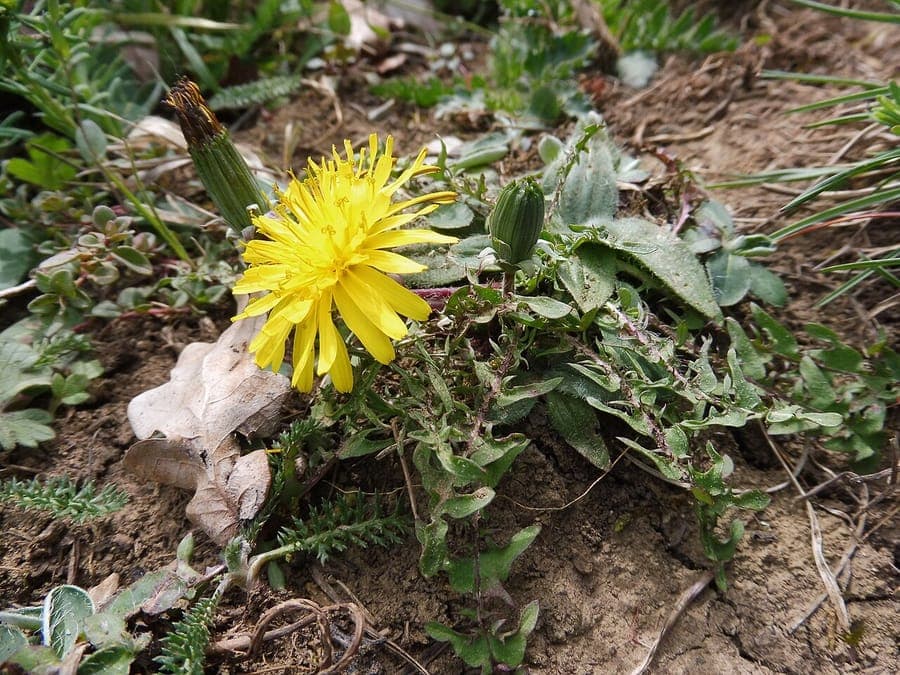
Steffen Hammel / CC BY-SA 4.0, via Wikimedia Commons
Taraxacum tortilobum: complete guide
Taraxacum tortilobum
Want to see Taraxacum tortilobum: complete guide in your garden?
1 minute, no credit card
Taraxacum tortilobum, known as the twisted-lobed dandelion, is a fascinating plant species from the Asteraceae family. This European native distinguishes itself through its unique leaf morphology featuring characteristically twisted and crinkled lobes.
Overview and Appearance The twisted-lobed dandelion is a low-growing plant typically reaching 10 to 40 centimeters in height. Its most distinctive feature is its bizarrely twisted and crimped foliage, which lends it its common name. The plant produces yellow flowers typical of dandelions, borne on long, leafless flower stems. These blooms appear from April through May.
Geographic Distribution Taraxacum tortilobum is native to Europe, particularly in the damper areas of Central and Northern Europe. It grows from Finland and Russia in the north to Italy in the south. The plant traditionally flourished in damp hayfields, wetlands and along woodland edges. In the Netherlands it occurs in damper grasslands and peat areas.
Flowers and Seed Formation The small yet striking yellow flowers appear individually on long, succulent stems. Each flower results in a spherical seed head that opens upon ripening, enabling the characteristic dandelion seed dispersal. This seed dispersal mechanism ranks among the most efficient in the plant world.
Growing Conditions and Location Taraxacum tortilobum thrives on damper soil and wet locations. Although the plant tolerates sunlight, it also grows well in partial shade. It prefers damper environments without complete waterlogging.
Soil Requirements The twisted-lobed dandelion grows best in nutrient-rich, moist soil. It tolerates both acidic and alkaline soils and is extremely flexible regarding soil quality. The plant demands minimal nutrients and grows almost anywhere sufficiently damp.
Watering Needs The wetter, the better this plant thrives. During dry periods, additional watering is needed, especially during the growing season. The plant flourished in its natural habitat in damper conditions.
Pruning and Maintenance Maintenance is minimal. The plant can simply have seed heads removed to prevent spreading, although many gardeners prefer leaving these for bird food. Dead leaf matter can be removed after blooming.
Maintenance Calendar March-April: Growth starts and flowers appear. May-June: Seed heads ripen. July-August: Rest period in dry summers; extra water helps. September-October: Possible autumn growth. November-February: Winter rest with minimal activity.
Winter Hardiness Taraxacum tortilobum is extremely hardy and survives temperatures to minus 20 degrees Celsius. In the UK it overwinters completely outdoors without protection.
Health and Pests The plant is extremely robust and resistant to disease and pests. Fungal problems are rare thanks to good air circulation.
Garden Applications Although considered a "weed" in many gardens, Taraxacum tortilobum holds botanical value as a wetland plant and bird food source. It can be used in moist planting schemes, water edge plantings and ecological gardens.
Bird Food and Ecology Ripe seed heads provide food for birds, especially finches and other seed-eaters. Flowers form a nectar source for insects.
Conclusion Taraxacum tortilobum is an intriguing European native plant with unique characteristics. Although not always valued in formal gardens, it offers ecological value and botanical interest. For those seeking damper soils and wetland vegetation, it provides a natural, low-maintenance choice.
Want to see Taraxacum tortilobum: complete guide in your garden? Make a free design now.
Upload a photo, pick a style, and get a photorealistic design with plant list in under a minute.
10,000+ gardens designed already
No credit card required


Similar plants
Calendula stellata: complete guide
Calendula stellata
Complete guide to Calendula stellata, the star-flowered marigold from Sicily: location, soil, watering and companion planting tips.
Korean chrysanthemum: complete guide
Chrysanthemum x rubellum
Chrysanthemum x rubellum is a hardy autumn perennial with single pink to copper flowers from August to November. Care and combinations.
Helianthus divaricatus: complete guide
Helianthus divaricatus
Helianthus divaricatus is a North American woodland sunflower with yellow summer blooms, ideal for naturalistic borders and shady edges.