
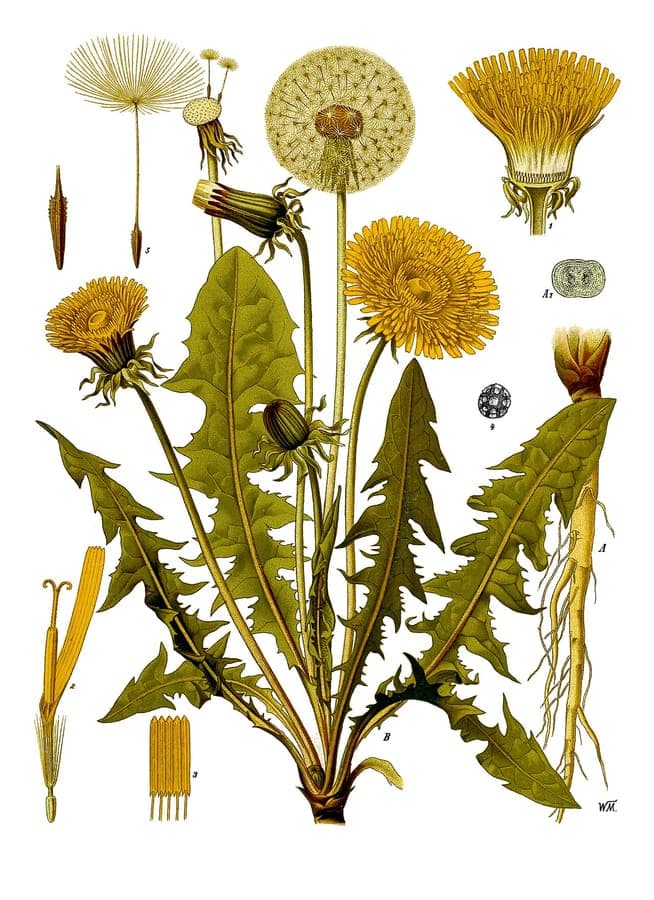
Walther Otto Müller / Public domain, via Wikimedia Commons
Common dandelion: complete guide
Taraxacum officinale
Want to see Common dandelion: complete guide in your garden?
1 minute, no credit card
Overview
Common dandelions (Taraxacum officinale) are robust, versatile plants used for food, medicine and wildlife food across many cultures. Belonging to the Asteraceae family, dandelions grow almost everywhere globally. In Europe they are native and renowned for resilience and utility.
Though often regarded as weeds, dandelions deserve recognition for nutritional value and multiple uses. Leaves, flowers and roots are all edible and packed with vitamins and minerals. Traditional medicine has used dandelions for centuries.
Appearance and bloom
Dandelions form rosette growth close to ground, typically 15 to 40 centimetres tall. Leaves are deeply lobed and toothed, green and succulent. In spring bright yellow flowerheads appear on tall, hollow stems.
After blooming, flowers transform into characteristic white seed balls dispersed by wind. These fluffy seedheads are eaten by many bird species. Plants grow rapidly and rebloom repeatedly throughout the season.
Ideal location
Dandelions grow in virtually all light situations. They thrive in full sun to light shade. The plant is highly adaptable and grows in lawns, borders, containers and disturbed ground.
They tolerate compaction and disturbance well. Slightly shaded locations may be beneficial in very hot climates.
Soil
Dandelions grow in almost all soil types. They prefer moderately fertile soil with good drainage. Very poor soils result in smaller plants. Research indicates pH tolerance of 4.8 to 7.5.
Amending soil with compost helps growth, but is not essential. Dandelions break up hard soil through deep taproots.
Free design
Want to see Common dandelion: complete guide in your garden? Make a free design now.
Watering
Established dandelions are very drought tolerant owing to deep taproots. Young plants benefit from regular water until established. Once established, watering is minimal except in severe drought.
Excessive water is unnecessary and encourages soft growth. Mulch helps retain soil moisture.
Pruning
Cutting flowers promotes more blooms and prevents uncontrolled seed spread. Harvest leaves regularly when young and tender for eating. This stimulates further leaf production.
Roots can be dug in autumn for drying and roasting as coffee substitute.
Maintenance calendar
Spring: Plant seeds or transplant vegetative fragments. Begin leaf harvest. Summer: Enjoy bright yellow blooms. Cut flowers to prevent seed spread. Water during drought. Autumn: Birds eat seed heads. Dig roots and prepare for winter. Reduce harvest. Winter: Plants die back. Keep ground covered with mulch.
Winter hardiness
Dandelions are fully hardy to -30 degrees Celsius. They grow in all temperate zones. Plants are perennial and persist for many years. They can even resprout after freezing.
Companion plants
Dandelions work well with:
- Other edible wild plants like brambles and soapwort
- Insect-attracting flowers
- Cover crop plants
- Medicinal herb plants
- Bird-feeding plants
Closing
Dandelions deserve a place in modern gardens. With nutritional value, medicinal properties and ease of cultivation, they bring far more to gardens than aesthetics alone. These versatile wild plants are treasured for sustainable, food-producing gardens.
Find dandelion seeds at local garden centres. For more inspiration with edible plants, visit gardenworld.app for professional garden designs. Gardenworld.app can also help with edible garden concepts.
Want to see Common dandelion: complete guide in your garden? Make a free design now.
Upload a photo, pick a style, and get a photorealistic design with plant list in under a minute.
No credit card required


Similar plants
Calendula stellata: complete guide
Calendula stellata
Complete guide to Calendula stellata, the star-flowered marigold from Sicily: location, soil, watering and companion planting tips.
Korean chrysanthemum: complete guide
Chrysanthemum x rubellum
Chrysanthemum x rubellum is a hardy autumn perennial with single pink to copper flowers from August to November. Care and combinations.
Helianthus divaricatus: complete guide
Helianthus divaricatus
Helianthus divaricatus is a North American woodland sunflower with yellow summer blooms, ideal for naturalistic borders and shady edges.