
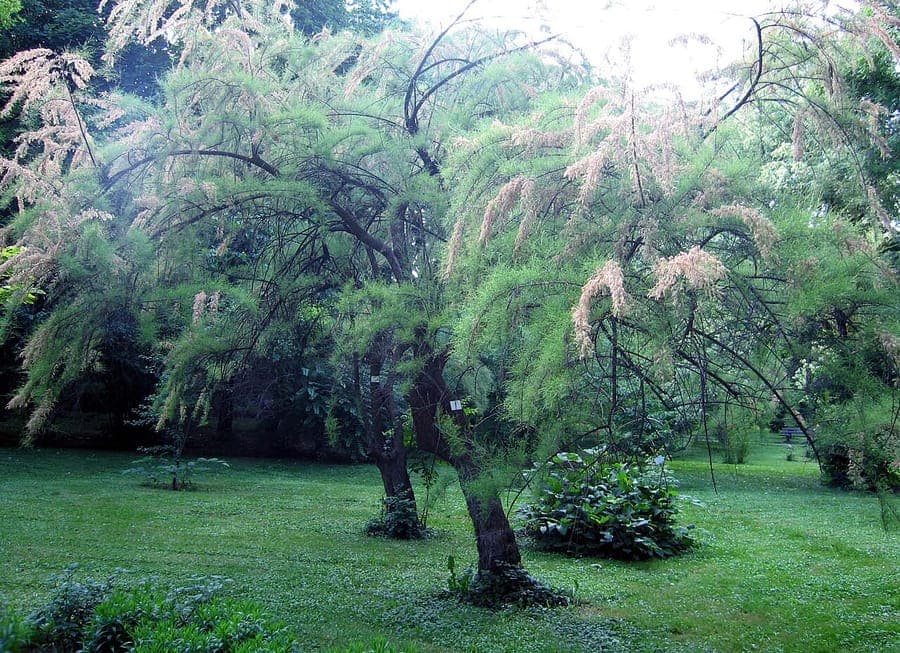
Snezana Trifunovic, user:Tsnena / Public domain, via Wikimedia Commons
Four-Stamen Tamarisk: complete guide
Tamarix tetrandra
Want to see Four-Stamen Tamarisk: complete guide in your garden?
1 minute, no credit card
Overview
The four-stamen tamarisk (Tamarix tetrandra) is a beautiful shrub native to Southeast Europe, the Mediterranean, and Asia. Belonging to the Tamaricaceae family, this species is renowned for its elegant, airy appearance and its ability to thrive in the most challenging conditions. With its fine, hair-like foliage and silky flowers, the tamarisk adds a unique texture to any garden design.
The plant is particularly suited to gardeners seeking a hardy element that requires minimal maintenance. Tamarisk grows well in coastal and Mediterranean gardens and thrives in dry, chalky, and even saline soils where many other plants would struggle.
Appearance and Bloom
Tamarix tetrandra distinguishes itself with extremely fine, needle-like foliage that gives an almost fern-like appearance. In spring and early summer (April to May), numerous small flowers appear, clustered in slender, stylish flower spikes. The flowers range from white to light purple, further emphasizing the plant's elegance.
The plant typically reaches heights of 2 to 4 meters and can spread equally wide. The grey-green foliage provides a beautiful contrast to the light flowers and gives the plant structure and interest throughout the entire season. Even in winter, the tamarisk maintains its architectural form.
Ideal Location
The tamarisk performs best in sunny locations receiving at least 6 to 8 hours of direct sunlight daily. This ensures optimal flowering and healthy growth. The plant is highly wind-resistant and actually thrives in windy coastal areas where many other shrubs struggle.
With its high salt tolerance, the tamarisk is ideal for gardens near the sea or where salt-laden air is present. The plant also tolerates light shade, though flowering will be less abundant.
Soil
Tamarix tetrandra is exceptionally tolerant of soil conditions. It grows well in dry, poor soils and thrives in both acidic and alkaline earth. The plant needs no rich, nutrient-dense soil and actually performs better in leaner material.
Good drainage is essential. Tamarisk cannot tolerate waterlogging and will be more prone to disease in wet soils. Plant the shrub in well-draining soil and add sand or gravel if necessary to improve drainage.
Watering
Once established, the tamarisk is an extremely drought-tolerant plant. After the initial establishment period of a few months, the plant needs little additional water, especially during months with normal rainfall.
During planting and the first summer, the plant should be watered regularly until it becomes well-rooted. Subsequently, watering can be significantly reduced. In very dry periods, some extra water can be provided, but generally rainwater will suffice.
Free design
Want to see Four-Stamen Tamarisk: complete guide in your garden? Make a free design now.
Pruning
The tamarisk responds well to pruning and can even be cut back severely to form a fuller, more compact plant. The best time to prune is immediately after flowering, usually in June. This gives the plant the opportunity to set new flowers for the following spring.
Regular pruning of about one-third of the growth ensures a well-shaped specimen. The plant can also be subjected to heavier pruning annually to combat aging and bare spots.
Maintenance Calendar
Spring (March-May): Check watering and feed if the plant looks very poor. Perform light pruning if needed. This is also the time for planting new specimens.
Summer (June-August): Enjoy the flowering display. Water during very dry conditions. Perform timed pruning after flowering to stimulate compact growth.
Autumn (September-October): Fall colors emerge; ensure good drainage in preparation for winter rains.
Winter (November-February): The plant is usually dormant. No maintenance needed except removing severely damaged branches.
Winter Hardiness
Tamarix tetrandra is fairly hardy in temperate climates. The plant can tolerate temperatures down to about minus 10-15 degrees Celsius, though damage may occur in extremely cold winters. In colder regions, protecting branches with burlap can be beneficial.
In milder climate zones, the plant grows without problems as a permanent evergreen specimen. Damaged branches can be removed in spring.
Companion Plants
The tamarisk's fine structure pairs beautifully with structural plants like ornamental grasses for greater contrast. Robust low-growing plants such as lavender and sage work well in the same setting.
Silver- and grey-foliaged plants like artemisia and santolina form beautiful contrast partners. Together they create a light, Mediterranean garden scheme.
Closing Words
Tamarix tetrandra is an excellent choice for gardeners seeking an elegant, low-maintenance plant that thrives where others fail. With its fine foliage, silky flowers, and exceptional drought tolerance, the four-stamen tamarisk adds depth, structure, and movement to any garden design. Plant this special shrub in well-draining soil in a sunny spot and enjoy years of effortless pleasure.
For purchasing Tamarix tetrandra, consult specialized nurseries for expert advice on the best location in your garden. Visit gardenworld.app for more plant recommendations and design inspiration for your outdoor space.
Want to see Four-Stamen Tamarisk: complete guide in your garden? Make a free design now.
Upload a photo, pick a style, and get a photorealistic design with plant list in under a minute.
No credit card required


Similar plants
Athel tamarisk: complete guide
Tamarix aphylla
Discover the Athel tamarisk, a remarkable desert tree with delicate feathery foliage and pink flowers. Highly drought and salt-tolerant, ideal for challenging landscapes and coastal gardens.
Tamarix chinensis: complete guide
Tamarix chinensis
Master the care of Tamarix chinensis (Chinese tamarisk) - an elegant shrub perfect for dry gardens with stunning pink flowers and minimal maintenance.
Canary Island tamarisk: complete guide
Tamarix canariensis
The Canary Island tamarisk is a drought-tolerant shrub with delicate pink flowers. Perfect for sun-drenched, dry gardens in warm climates. Discover cultivation and care tips.