
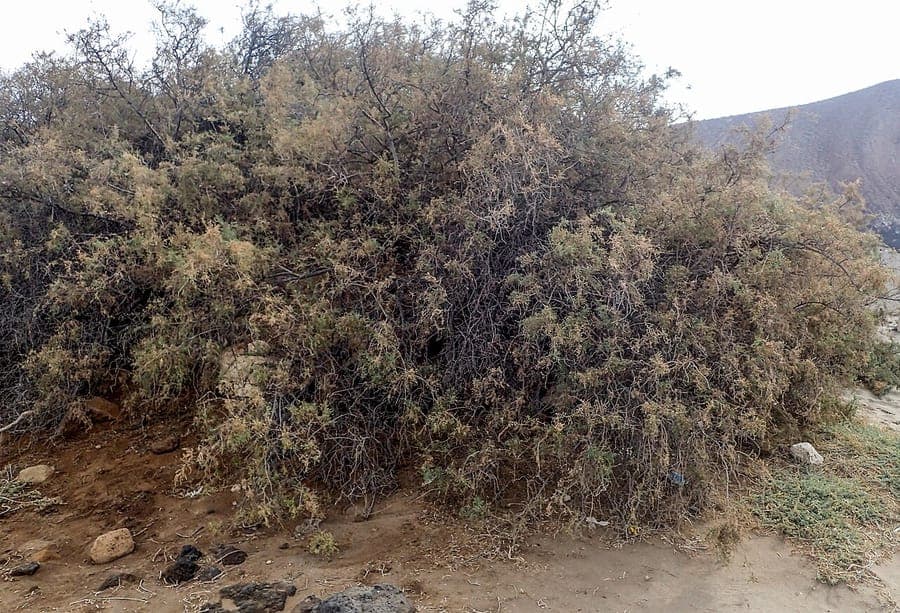
Original: Krzysztof Ziarnek, Kenraiz Derived: Peter Coxhead / CC BY-SA 4.0, via Wikimedia Commons
Canary Island tamarisk: complete guide
Tamarix canariensis
Want to see Canary Island tamarisk: complete guide in your garden?
1 minute, no credit card
The Canary Island tamarisk, botanically Tamarix canariensis, is an elegant and hardy shrub originating from Macaronesia and the Mediterranean through the Sahara. This plant is also known as saltcedar, tamarisk, and salt-cedar, indicating how adapted it is to extreme conditions. The tamarisk belongs to the Tamaricaceae family, a group of plants adapted to extreme conditions such as salt-rich soils and arid climates where few other plants can thrive. The plant is distributed across dozens of countries bordering the Mediterranean and has also become naturalized in other warm regions.
The shrub typically grows to a height of 3 to 6 meters, though under favorable conditions specimens may reach greater heights. The growth habit is open and graceful, with stiffly upright or slightly weeping branches that create a striking form even when not in bloom. The winter silhouette is particularly attractive in modern garden designs. The foliage is extremely fine and scale-like, often only 2 to 4 millimeters long, resulting in a delicate, airy texture unmatched by other shrubs. The leaf color ranges from green to blue-green, with many variants displaying a characteristic grey-green patina maintained throughout the year.
Blooming typically occurs from late spring through early summer, though in warm climates repeated flowering is possible and a second bloom may occur in autumn. The flowers are small, approximately 3 to 4 millimeters in diameter, but they appear in dense, cylindrical flower spikes up to 4 centimeters long. The color varies from white to deep pink depending on variety and growing conditions. These flower spikes are extremely abundant and cover the plant almost completely when in full bloom, making the entire shrub appear to glow. After pollination, small seed pods develop containing fine seeds dispersed by wind.
The Canary Island tamarisk is an extremely drought-tolerant plant, adapted to life in semi-arid to arid environments where water is scarce. In warm European regions, this shrub can survive almost entirely without artificial watering when planted in well-drained locations. The plant tolerates salt-rich soils exceptionally well, even more so than most other salt-tolerant plants, making it ideal for coastal garden and saline applications in degraded soils. Soil pH preference lies between 7.0 and 7.5, so neutral to alkaline. Atmospheric humidity can be low and presents no limitations to healthy growth.
Watering is only necessary during the first growing year of young plants and during extreme drought periods to help them establish deep roots. Established specimens actually require very little water, making them perfect for water-conscious gardening. Excessive watering can even be harmful, leading to disease and root problems. Fertilization is often unnecessary, especially in more nutrient-rich soils. In poor soils, a single annual light feeding with low-nitrogen fertilizer may be applied to stimulate growth.
Pruning can be performed as desired to maintain shape or keep the plant more compact. Hard pruning is well tolerated, and the plant regrows rapidly. Severe pruning immediately after blooming promotes compact growth and may improve subsequent flower production. Removing old growth helps keep the plant vital. Pest infestations are extremely rare, further underscoring the hardiness of this plant.
In warm parts of southern Europe, including coastal regions of France, Spain, Italy, and Greece, this tamarisk thrives in full sunlight. The plant has also been introduced to parts of the United States, particularly Texas, Louisiana, and the Carolinas, where it performs well in warm, dry climates. In cooler climates, specimens are rare outdoors but may be attempted in very sheltered, warm locations. They thrive better in well-drained, raised beds than in low, wet areas.
The Canary Island tamarisk is a spectacular choice for gardeners seeking elegance combined with drought tolerance. Its fine foliage and pink flowers add grace to any garden. With its extreme tolerance for drought, salt, and poor soils, it is ideal for ecological gardening and water-conscious landscape design. In Spain, Portugal, and France, these are popular garden plants now readily available through many online garden retailers.
Want to see Canary Island tamarisk: complete guide in your garden? Make a free design now.
Upload a photo, pick a style, and get a photorealistic design with plant list in under a minute.
No credit card required


Similar plants
Athel tamarisk: complete guide
Tamarix aphylla
Discover the Athel tamarisk, a remarkable desert tree with delicate feathery foliage and pink flowers. Highly drought and salt-tolerant, ideal for challenging landscapes and coastal gardens.
Four-Stamen Tamarisk: complete guide
Tamarix tetrandra
Tamarix tetrandra is an elegant shrub with fine, feathery white and purple flowers. Ideal for dry and salt-tolerant soils, this tamarisk offers year-round interest in gardens.
Tamarix chinensis: complete guide
Tamarix chinensis
Master the care of Tamarix chinensis (Chinese tamarisk) - an elegant shrub perfect for dry gardens with stunning pink flowers and minimal maintenance.