
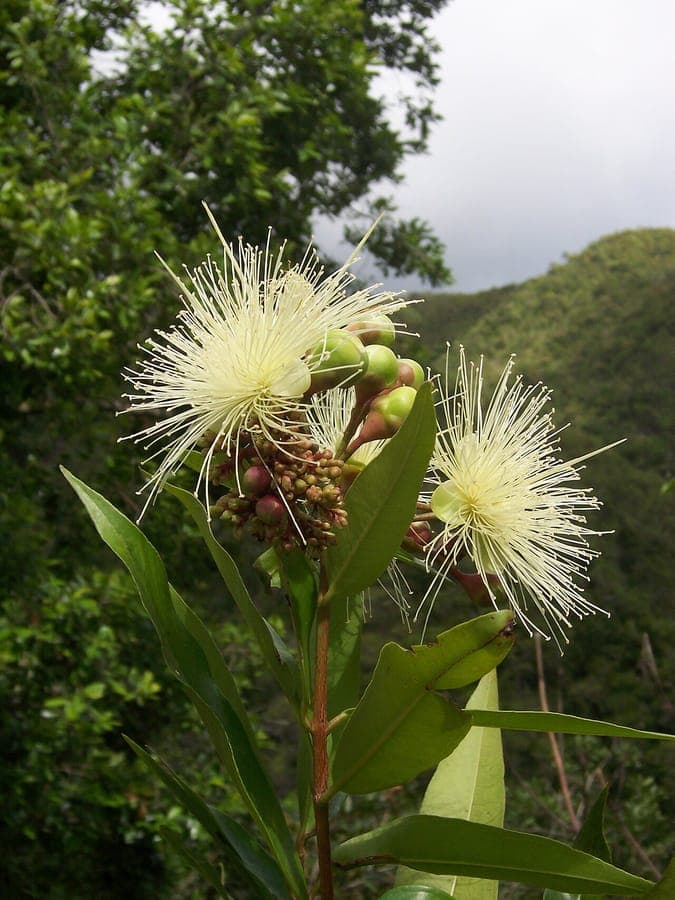
B.Navez / CC BY-SA 3.0, via Wikimedia Commons
Jambos: complete guide
Syzygium jambos
Want to see Jambos: complete guide in your garden?
1 minute, no credit card
The Jambos, scientifically known as Syzygium jambos, is a striking tropical tree originating from the Himalayan regions through South-Central China to West Malesia. This tree is also called the rose-apple, malabar plum, and jambos apple. As a member of the Myrtaceae family, it shares botanical lineage with myrtles and eucalypts, indicating a plant of considerable quality and character. The genus Syzygium comprises approximately 100 species of aromatic trees and shrubs distributed primarily throughout the Indo-Pacific region. The plant plays an important role in traditional medicine and cuisine across Asian cultures spanning many centuries and continues to be valued today.
The tree typically grows to a medium or large stature, often reaching heights of 7 to 12 meters in its native habitat, sometimes taller under optimal conditions. Its branching pattern is compact and orderly, creating an attractive form well-suited to landscape applications and container cultivation. The foliage consists of opposite, lanceolate to elliptic leaves, roughly 15 to 30 centimeters long and 5 to 10 centimeters wide. The leaves are glossy dark green on the upper surface and lighter green underneath, creating a pleasant visual contrast. They contain aromatic oils that release a pleasant fragrance when touched or crushed between the fingers. The leaf margins are entire and the petioles are short, approximately 1 to 2 centimeters long. In springtime, new leaves emerge with reddish to yellowish tinges before assuming their mature green coloration. This provides the tree with dynamic visual interest throughout the growing season.
The jambos blooms typically in early spring through early summer, depending on local climate and rainfall patterns. The flowers are spectacular and conspicuous, featuring elongated stamens in white to pinkish hues reaching up to 5 centimeters in length. These stamens give the flowers a silky, almost otherworldly appearance that makes them particularly attractive to pollinators. The flowers appear densely packed in compound inflorescences at the branch terminals. Following pollination, the characteristic fruits develop: bell-shaped to pear-shaped berries with diameters of 4 to 5 centimeters. The fruits transition from green through yellow-orange to bright red when fully mature. They emit a subtle rosy fragrance, explaining the alternative name "rose-apple." The flesh is white to cream-colored, spongy in texture, relatively low in nutrients though eaten in some cultural traditions. The fruits appear in large quantities, covering the entire tree when in full production, making mature specimens very ornamental.
Climate and growing conditions for Jambos: The jambos thrives in warm subtropical to tropical climates where minimum winter temperatures do not fall below 5 degrees Celsius. In European greenhouses or protected Mediterranean locations, select specimens can flourish outdoors, though frost protection is essential. The tree is adaptable to various soil types, though it prefers well-draining, moisture-retentive soils with pH values between 5.5 and 7.0. In cooler regions such as the United Kingdom or northern Europe, impressive results can be achieved in large containers placed in sunny locations during warm summers. The plant prefers full sun to partial shade and is adversely affected by strong winds due to its relatively brittle branch structure.
Watering and nutrition: Watering must be regular and consistent, especially during the growing and flowering periods. Younger trees need frequent irrigation to establish robust root systems, while the soil should never dry completely. Adult trees in tropical regions can tolerate drought stress thanks to their deeper root networks. Fertilization should occur monthly during the growing season using a balanced formula, such as a 10-10-10 NPK ratio. For fruit production, supplemental phosphorus and potassium can be beneficial. Organic fertilizer additions help improve soil structure and promote water retention.
Pruning and maintenance: Pruning is not essential, but young growth can be reduced to about 30 centimeters above ground if shaping is desired and to promote more compact growth. The tree responds well to vigorous pruning and will produce new shoots readily from dormant buds along the main trunk. Pest infestation is generally minimal, though scale insects and spider mites may occasionally appear in greenhouse conditions, especially in dry air. Treatment with insecticidal soaps or biological controls is typically sufficient. Fungal diseases can be problematic in humid conditions.
Cultivation in Europe and availability: Gardens in warm European regions, such as parts of Andalusia, Sicily, and the French Riviera, can cultivate jambos trees outdoors, though frost protection is essential during winter months. In the United Kingdom and cooler climates, they are best kept in large containers within warm glasshouses or conservatories maintaining temperatures above 10 degrees Celsius. Many garden centres stock specimens during the growing season, though availability is seasonal.
The jambos represents a fascinating and worthwhile addition to any tropical garden collection. Its striking flowers, interesting fruits, and attractive foliage make it both ornamental and functional. The plant requires warm conditions and is not suitable for unprotected outdoor cultivation in temperate zones. With proper care and sheltered placement, however, the jambos can flourish even in more moderate climates, offering a genuine reward for patient gardeners.
Want to see Jambos: complete guide in your garden? Make a free design now.
Upload a photo, pick a style, and get a photorealistic design with plant list in under a minute.
No credit card required


Similar plants
Flooded gum (Eucalyptus grandis): complete guide
Eucalyptus grandis
Everything about the flooded gum: fast growth, impressive stature and silvery bark. How to plant and care for this eucalyptus in your garden.
Yellow gum (Eucalyptus leucoxylon): complete guide
Eucalyptus leucoxylon
Everything about the yellow gum: showy flowers in winter, compact form and drought tolerance. How to grow and care for this eucalyptus in your garden.
Sydney blue gum (Eucalyptus saligna): complete guide
Eucalyptus saligna
Everything about the Sydney blue gum: extraordinary growth rate, beautiful grey-blue bark and impressive stature. How to plant and care for this eucalyptus.