
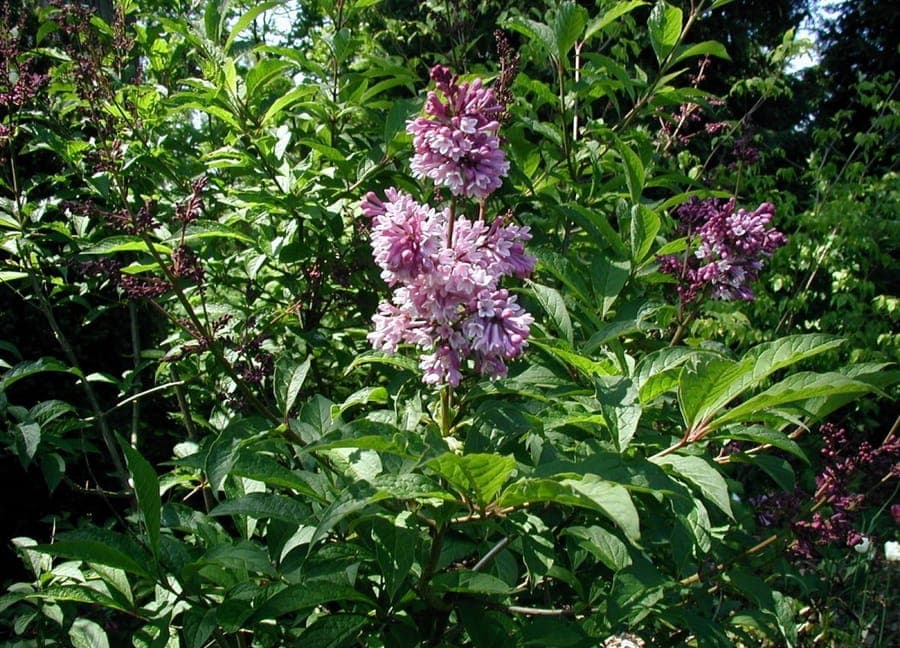
No machine-readable author provided. Sten assumed (based on copyright claims). / CC BY-SA 3.0, via Wikimedia Commons
Hungarian Lilac: complete guide
Syringa josikaea
Want to see Hungarian Lilac: complete guide in your garden?
1 minute, no credit card
Overview
Hungarian Lilac (Syringa josikaea) is an impressive, hardy flowering shrub native to the Carpathian Mountains of Romania and Ukraine. Distinguished from common lilac by its lateral flower panicles, refined bloom structure, and superior climate adaptation, Hungarian Lilac offers elegance and robustness few plants match. With dense growth habit, large glossy foliage, and extended flowering from May to June, this lilac provides substance and beauty with minimal maintenance.
Appearance and bloom
Hungarian Lilac grows to an impressive 3-5 metre shrub at maturity with 2-3 metre spread. The plant develops a natural, slightly branched form requiring minimal pruning. The foliage is remarkable: large (8-12 cm) lance-shaped leaves with deep glossy green colour throughout the growing season. In May-June, flower panicles appear at tips of young growth, reaching 15-25 cm long and densely packed with small, non-fragrant flowers in shades of light lilac to deep purple, sometimes with white markings. The bloom period extends 3-4 weeks, providing sustained colour.
Ideal location
Hungarian Lilac thrives in full sun to light shade, requiring 5-6 hours of direct daily sunlight for maximum flowering. In shadier situations, growth continues acceptably, though blooming reduces. Plant in locations with good air circulation to minimise fungal disease. The shrub tolerates strong winds well due to sturdy woody stems. Avoid very sheltered spots where air stagnation encourages fungal problems.
Soil
Hungarian Lilac grows well in nearly all garden soils from acidic to moderately alkaline (pH 5.5-7.5). The plant prefers well-draining soil; waterlogging is poorly tolerated. Heavy clay soils should be amended with sand and compost (20-30% total addition) for drainage improvement. At planting, incorporate compost (10-15 cm depth) and mulch with 5 cm bark mulch around the base. In nutrient-poor soils (sand), apply a thin compost layer (2-3 cm) annually each March for nutrient replenishment.
Watering
Once established (after 2 seasons), Hungarian Lilac is very drought-tolerant. During the first growing season, water regularly once weekly, more frequently if drought occurs. After establishment, water requirements drop dramatically. Water only during severe drought (3+ weeks without rain). The plant prefers less water to excess; overwatering leads to weak growth and fungal problems.
Free design
Want to see Hungarian Lilac: complete guide in your garden? Make a free design now.
Pruning
Hungarian Lilac requires minimal pruning thanks to its naturally elegant form. Annual maintenance pruning in March (after flowering completes): remove crowded, crossing branches and side shoots comprising about 30% of plant volume. This promotes air circulation and flowering. Avoid drastic cutbacks; the plant responds poorly to heavy pruning compared to other lilacs. Remove spent flower clusters immediately after blooming (June) for tidiness, though seed set can be ornamental.
Maintenance calendar
January-February: Winter dormancy. Minimal activity. March: Annual maintenance pruning (after frost risk passes). Remove dead wood and crossing branches. April-May: Flower panicles develop rapidly. Enjoy the spectacular display. June: Flowering ends. Remove faded flower clusters for neat appearance. July-August: Growth rest. Minimal watering unless extreme drought. September-October: Preparation for dormancy. No pruning. November-December: Complete dormancy. Plant sleeps.
Winter hardiness
Hungarian Lilac is very winter hardy to USDA Zone 3-4 (-35 to -25 degrees C). All Dutch, Belgian, and French gardens are well within the safe range. Even German highlands and Scandinavia support this plant easily. Winter damage is extremely rare in Europe.
Companion plants
Hungarian Lilac combines beautifully with: Other lilac varieties for staggered bloom, Forsythia (yellow flowers, April) for contrasting colour and timing, Philadelphus (Jasmine shrubs) for white fragrant flowers in June, Spiraea (spring bloomers) for contrasting form and colour, Yew hedge for dark green foliage background.
Closing
Hungarian Lilac is a substantial, robust flowering shrub for gardeners seeking impressive, low-maintenance bloom. With large foliage, extended flowering, and climate resilience, this Carpathian beauty deserves a prominent place in many gardens. Once established, it requires virtually no intervention beyond annual light pruning. Use gardenworld.app to find the perfect placement for your Hungarian Lilac.
Want to see Hungarian Lilac: complete guide in your garden? Make a free design now.
Upload a photo, pick a style, and get a photorealistic design with plant list in under a minute.
No credit card required


Similar plants
Rough menodora: complete guide
Menodora scabra
Full guide to Menodora scabra: a drought-tolerant desert subshrub with bright yellow flowers, ideal for rock gardens and xeriscapes.
Fraxinus dipetala: complete guide
Fraxinus dipetala
California ash or two-petal ash from southwestern USA. Beautiful spring flowers, drought-tolerant. Experimental choice for warm Mediterranean front gardens.
Syringa komarowii: complete guide
Syringa komarowii
Syringa komarowii is a striking lilac from central China with elegant flower spikes and lovely foliage. Discover the complete care guide here.