
Hardyplants at English Wikipedia / Public domain, via Wikimedia Commons
Western Snowberry: complete guide
Symphoricarpos occidentalis
Want to see Western Snowberry: complete guide in your garden?
1 minute, no credit card
Overview
Symphoricarpos occidentalis, called western snowberry or wolfberry, is a native North American shrub of great significance for landscape design and habitat restoration. Originally distributed across subarctic Canada to the western United States, this extremely hardy shrub offers winter interest through distinctive white berries, robust growth, and exceptional adaptation to difficult growing conditions.
Appearance and Bloom
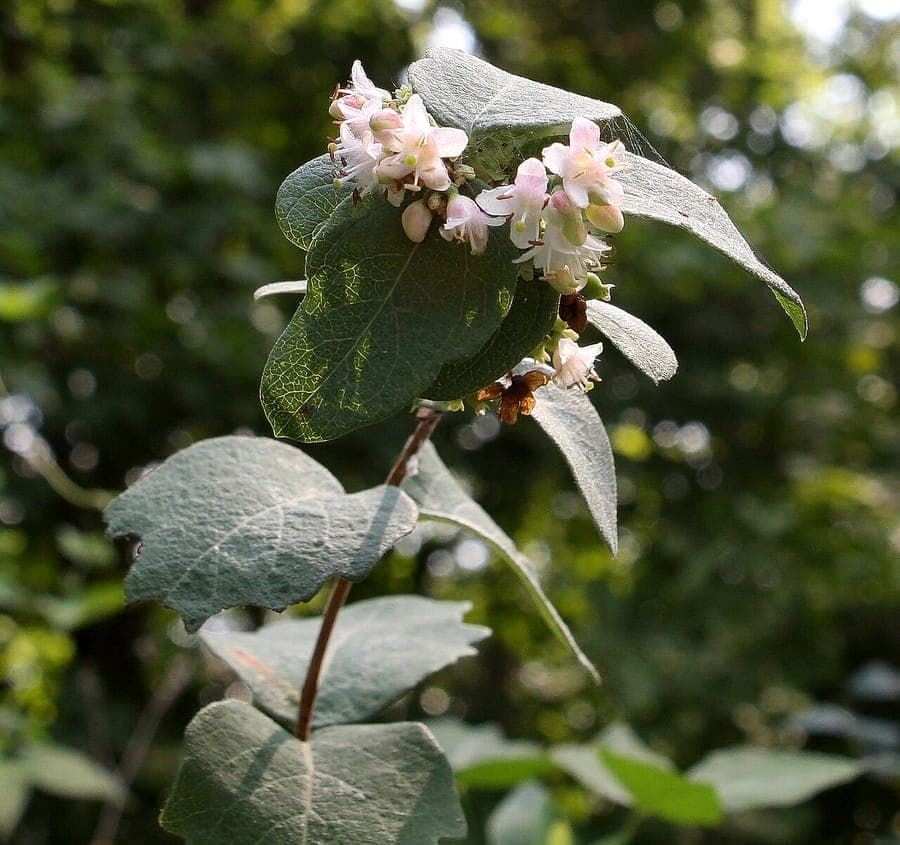
Western snowberry grows as a dense, low shrub, typically 1.2 to 1.8 meters tall with comparable width. Branches are thin, brownish, and elegantly arching. Leaves are small, oval, about 1 to 3 centimeters long, with subtle gray-green coloring. In fall, foliage turns purple-red before dropping. Flowers appear spring through early summer in small, pink, bell-shaped clusters. Following pollination, abundant white berries form, reaching approximately 1 centimeter diameter. These berries persist until deep winter, providing essential food for birds.
Ideal Location
Symphoricarpos occidentalis prefers full sun to partial shade. In hot climates, afternoon shade proves welcome, but in temperate regions, full sun is optimal. Wind tolerance is excellent; the shrub thrives in exposed, windy locations. In sheltered garden settings, growth accelerates and density increases.
Soil
This is where western snowberry shines: the plant thrives in virtually every soil type. Sandy, loamy, clayey, dry, or even moist soils are all acceptable. pH range is broad, from acidic (pH 6.6) to alkaline (pH 8). The shrub actually prefers less fertile soils, making it perfect for difficult sites where little else grows. Well-draining soil prevents only permanent waterlogging issues.
Free design
Want to see Western Snowberry: complete guide in your garden? Make a free design now.
Watering
Once established, Symphoricarpos occidentalis is quite drought tolerant and requires minimal artificial water in most climates. In temperate zones, natural rainfall suffices completely; in drier regions, water may help during extended drought, especially for young plants. Overwatering proves more dangerous than underwatering for this native shrub.
Pruning
Pruning is optional. The shrub naturally forms a compact, rounded shape. Heavy pruning can rejuvenate older specimens or encourage dense growth. Pruning after bloom helps promote more branching. Since berries persist until late winter, prune after fruiting to retain winter interest.
Maintenance Calendar
Spring: growth restarts; no special feeding needed. Summer: observe bloom and forming fruit; water during drought. Fall: enjoy foliage color and abundant white berries. Winter: no maintenance needed; berries feed winter birds.
Winter Hardiness
Western snowberry is extremely cold hardy, rated USDA hardiness zones 3-8, meaning it tolerates temperatures to minus 40 degrees Celsius. This critical attribute makes it suitable for very cold climates where tropical plants would die. The shrub is protected against snow damage through its low growth habit.
Companion Plants
Symphoricarpos occidentalis works beautifully in native plant collections, paired with other North American shrubs. Combine with other winter-berry producers such as ilex and cornus. In erosion control applications, plant in groups of three to five for maximum impact.
Closing Thoughts
Western snowberry is an undervalued shrub deserving much more attention in modern gardens. Winter berries, fall color, hardiness, and low maintenance requirements make it an excellent choice for all climates. Seek sources at native plant-focused nurseries or regional conservation organizations. Discover more about North American native plants at gardenworld.app. This characterful, hardy shrub is ideal for bird-friendly gardens. Learn more about sustainable native plant management at gardenworld.app.
Want to see Western Snowberry: complete guide in your garden? Make a free design now.
Upload a photo, pick a style, and get a photorealistic design with plant list in under a minute.
No credit card required


Similar plants
Yellow honeysuckle (Lonicera tragophylla): complete guide
Lonicera tragophylla
Meet yellow honeysuckle (Lonicera tragophylla): a Chinese climber with large golden flowers that thrives in partial shade.
Lonicera korolkowii: complete guide
Lonicera korolkowii Stapf
Discover blueleaf honeysuckle, a vigorous shrub with beautiful flowers. Guide on growing, shaping and why this Asian climbing plant is perfect for gardens.
Lonicera oblongifolia: complete guide
Lonicera oblongifolia Hook.
Discover swamp fly honeysuckle, a North American woodland plant. Guide on growing, caring and why this native species is valuable for gardens.