
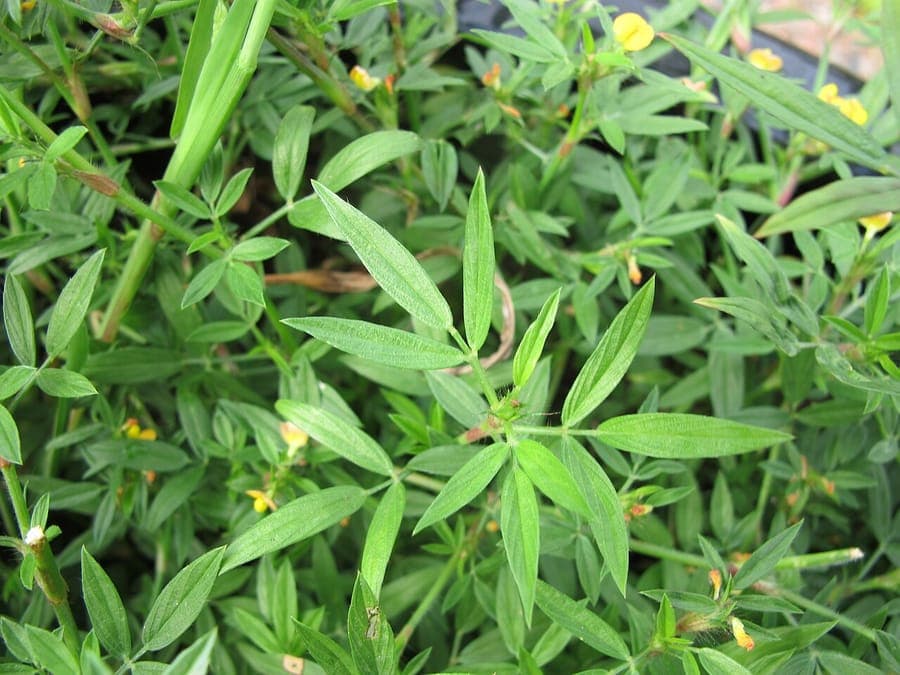
Btcpg / CC BY-SA 3.0, via Wikimedia Commons
Townsville Stylo: complete guide
Stylosanthes humilis
Want to see Townsville Stylo: complete guide in your garden?
1 minute, no credit card
Overview
Stylosanthes humilis, commonly called Townsville stylo, is an unassuming yet remarkably useful tropical plant originating from Mexico and Central America. Though not cultivated for beauty alone, this legume plays a vital role in sustainable agriculture, soil protection, and livestock nutrition across tropical and subtropical regions. As a natural nitrogen fixer, it enriches soil while serving as nutritious forage for cattle in extensive grazing systems.
Appearance and Bloom
Stylosanthes humilis grows as a low, compact shrub, typically 30 to 60 centimeters tall, though under ideal conditions reaching 90 centimeters. The plant develops thin, hairy stems covered with small, compound leaves characteristic of legumes. Foliage is bright green, fine-textured, lending an airy appearance. Flowers appear throughout the growing season in small yellow clusters nestled within leaves. These blooms are inconspicuous but highly fertile, followed by small, persistent pods containing viable seeds.
Ideal Location
Townsville stylo thrives in full sunlight. Without adequate light exposure, the plant refuses to fix nitrogen and grows weakly. Plant in open, unshaded areas receiving minimum six hours direct sunlight daily. Wind tolerance is excellent; the plant even spreads readily in windy environments. Partial shade significantly reduces productivity.
Soil
This crop thrives on marginal soils where many forage crops fail. Stylosanthes humilis prefers well-draining substrates, yet adapts to sandy, loamy, or even depleted soils. Acidic soils with low fertility present no obstacle; indeed, the plant thrives on pH 4.5 to 6.5 soils. Very alkaline soils (pH above 7.5) may cause iron-related chlorosis. Adding organic matter improves water retention in sandy soils. The plant does not require rich soils; it creates them through nitrogen fixation.
Watering
Once established, Stylosanthes humilis proves quite drought tolerant. In tropical regions, natural rainfall usually suffices. During extended droughts, supplemental irrigation may benefit young plants. In nursery conditions, water regularly but avoid waterlogging, which invites bacterial disease. Mature plants can survive extended dry seasons in most African and South American valleys without irrigation.
Free design
Want to see Townsville Stylo: complete guide in your garden? Make a free design now.
Pruning
Pruning is unnecessary for Stylosanthes humilis under normal circumstances. The plant naturally forms a neat, compact shape. Heavy grazing or cutting stimulates dense regrowth, intentionally used in pasture systems. Rows spaced 20 to 40 centimeters apart work well. In ground cover or erosion control applications, allow natural growth.
Maintenance Calendar
Spring-Summer: growth period with regular watering and natural nitrogen fixation. Fall: seeding and establishment of younger plants. Winter: in subtropical zones, growth may slow; minimal maintenance needed. Year-round: monitor for pest damage or disease; healthy stands rarely present problems.
Winter Hardiness
Stylosanthes humilis is not winter hardy in temperate zones. This plant is purely tropical and subtropical; frost temperatures kill it immediately. In zones where temperatures drop below 5°C, treat as annual. In tropical areas and warm subtropical regions (USDA zones 10-12), it may persist as perennial. Reseed each season for best seed production.
Companion Plants
Townsville stylo was traditionally sown with grasses in pasture systems, combined with Cenchrus ciliaris (buffel grass) and Bothriochloa pertusa (yellow bluestem). These combinations created balanced, nutritious pastures. In erosion control, it forms undercover beneath trees in agroforestry schemes.
Closing Thoughts
Stylosanthes humilis is no traditional ornamental garden plant, but a vital agricultural crop in tropical regions. For farmers and pastoralists in warm climates, this crop offers cost savings, soil improvement, and forage production in compact form. Find seed through agricultural suppliers in tropical regions. Learn more about sustainable tropical agriculture at gardenworld.app. This humble legume represents the future of regenerative tropical farming. Discover more about forage crops and soil health at gardenworld.app.
Want to see Townsville Stylo: complete guide in your garden? Make a free design now.
Upload a photo, pick a style, and get a photorealistic design with plant list in under a minute.
No credit card required


Similar plants
Tall Silky Lupine: complete guide
Lupinus elatus
Tall silky lupine is a fast-growing Californian perennial with silvery foliage and blue-purple flower spikes, ideal for a prairie-style garden.
Garfield Lupine: complete guide
Lupinus garfieldensis
The Garfield lupine is a rare, fast-growing American perennial for alkaline, dry grassland gardens, with striking blue flower spikes.
Lupinus elegans: complete guide
Lupinus elegans
Lupinus elegans, the elegant lupine, is a spectacular blooming plant from Mexico with blue flower spikes. Care, cultivation and garden use.