
Franz Eugen Köhler / Public domain, via Wikimedia Commons
Strychnine Tree: a toxic botanical rarity
Strychnos nux-vomica
Want to see Strychnine Tree: a toxic botanical rarity in your garden?
1 minute, no credit card
Strychnine Tree: a toxic botanical rarity
Overview
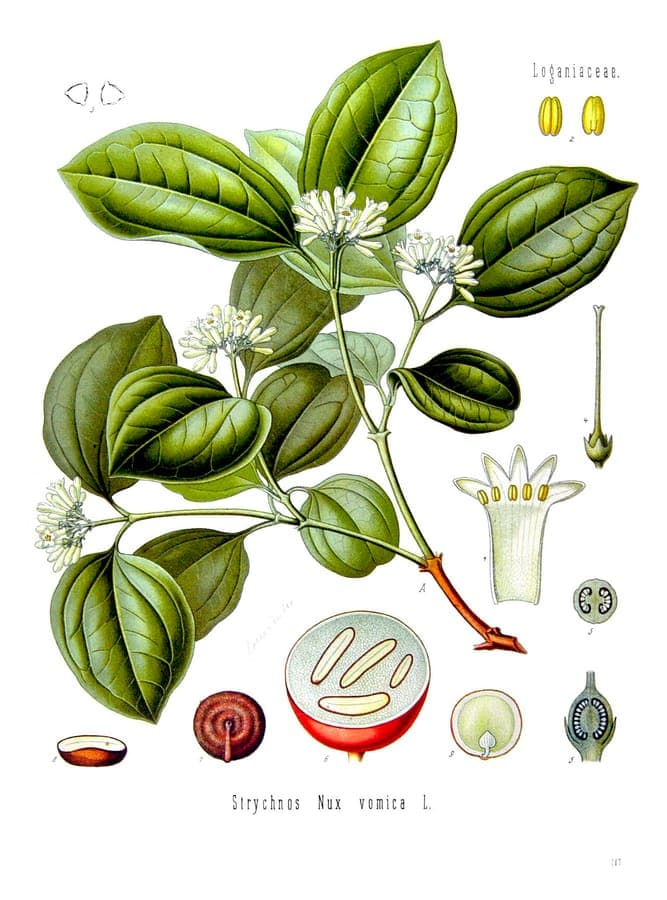
The Strychnine Tree (Strychnos nux-vomica), also known as the Nux-vomica tree, is a fascinating but extremely poisonous tree from the Loganiaceae family, native to the Indian subcontinent and Northern Malaysia. This tree is renowned for containing highly toxic seeds containing strychnine, a potent nervous system stimulant. Although historically used in traditional medicine and modern pharmaceuticals, this plant is far too dangerous for household use. This article serves educational purposes and warns of serious risks.
Appearance and properties
The Strychnine tree grows to approximately 15 meters tall with gray bark and dark green foliage. The leaves are opposite, oval, and approximately 7-13 centimeters long. Small, greenish-white flowers appear in clusters. The tree produces round fruits approximately 7-10 centimeters in diameter, turning orange-yellow when ripe. Each fruit contains 1-5 seeds, each approximately 2-3 centimeters in diameter, gray and hard. These seeds are extremely poisonous and contain strychnine and brucine.
Geographic distribution
The Strychnine tree is naturally found in India, Bangladesh, Myanmar, Thailand, Cambodia, Laos, Sri Lanka, and Vietnam. The tree was later introduced to many other tropical and subtropical countries, including China, Taiwan, the Philippines, and Trinidad-Tobago.
Free design
Want to see Strychnine Tree: a toxic botanical rarity in your garden? Make a free design now.
Toxicity - Critical warning
The Strychnine tree is EXTREMELY POISONOUS. The seeds contain strychnine (3-5%) and brucine. Only 30 milligrams of strychnine can be fatal to an adult human. There is NO ANTIDOTE. Symptoms of strychnine poisoning are horrific: spasms, muscle stiffness, asphyxiation from tetanic cramps, and usually death. This is NOT a plant for gardens, especially where children or animals are present.
Historical and medicinal use
Warning: DO NOT USE. Historically, strychnine in very small amounts (0.5-2 mg) was used as a stimulant, but this is particularly dangerous and obsolete. Modern medicines have safe alternatives. Traditional Ayurvedic and Chinese medicine used carefully referenced preparations, but this requires extreme caution and professional training.
Maintenance calendar
The Strychnine tree is NOT recommended for private gardens for safety reasons. In botanical gardens or research institutions where this tree is cultivated, professional care by trained personnel is required.
Winter hardiness
The tree grows in tropical and subtropical climates (zones 10-11) and is frost-sensitive.
Closing
The Strychnine tree is a botanically interesting plant, but EXTREMELY DANGEROUS. This tree must not be planted in home gardens or where children/animals have access. The toxicity is so severe that even handling seeds is risky without protective equipment. Research and botanical institutions may grow this plant under strict security measures. For safer garden alternatives, visit gardenworld.app.
Gardenworld.app will always recommend garden plants that are safe for families and animals.
Want to see Strychnine Tree: a toxic botanical rarity in your garden? Make a free design now.
Upload a photo, pick a style, and get a photorealistic design with plant list in under a minute.
No credit card required


Similar plants
Acer pycnanthum: complete guide
Acer pycnanthum
Acer pycnanthum, the Japanese swamp maple, is a fast-growing tree with early red flowers and brilliant autumn color, ideal for damp garden settings.
Freeman maple: complete guide
Acer × freemanii
Everything about the Freeman maple (Acer x freemanii): a fast-growing shade tree with spectacular autumn colour for large gardens.
Silver vine: complete guide
Actinidia polygama
Discover silver vine (Actinidia polygama): a hardy climbing plant with silvery foliage, loved by gardeners and cats alike.