
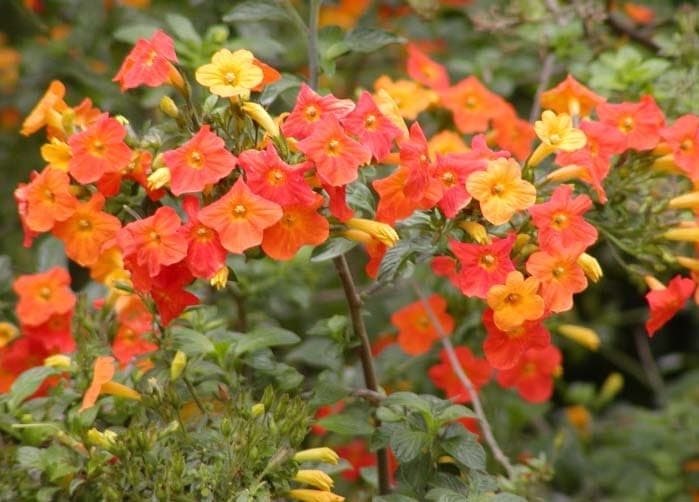
Stan Shebs / CC BY-SA 3.0, via Wikimedia Commons
Marmalade-bush: complete guide
Streptosolen jamesonii
Want to see Marmalade-bush: complete guide in your garden?
1 minute, no credit card
Overview
The Marmalade-bush (Streptosolen jamesonii), also known as "Orange-browallia" or "Firebush", is a spectacular climbing shrub native to Ecuador and Peru. This plant belongs to the Nightshade family (Solanaceae) and is renowned for its overwhelming mass of orange flowers set against dark green foliage. In warmer climate gardens, this plant is valued for its long-lasting blooms, rapid growth, and attraction of hummingbirds. The plant can become very voluminous and easily reaches 1.5-2 meters in height and width.
Appearance and bloom
The Marmalade-bush grows as a semi-climbing to upright shrub with fairly soft, greenish wood that can become dark brown. The leaves are elongated-lanceolate, medium-sized, and dark green with fine veining. The flowers are the highlight of this plant: small orange to reddish-orange tubes appearing in rich, bushy clusters. The flowers open continuously over a long period (May to October in warmer climates, even longer in tropical zones). The plant's appearance with the density of orange flowers truly resembles marmalade.
Ideal location
The Marmalade-bush thrives best in full sun with at least 6-8 hours of direct sunlight daily. The plant can grow in partial shade, but blooming becomes less abundant. This is a warmth-loving plant that grows best in USDA zones 9-11. In temperate climates, the plant must overwinter indoors or be regrown each year. Place the plant in a sheltered, warm spot protected from strong winds.
Soil
The Marmalade-bush grows best in well-draining, fertile soil. Standard garden soil enriched with compost works excellently. The plant tolerates various pH levels (pH 6.0-7.5) but thrives best in slightly acidic to neutral conditions. For container cultivation, use universal potting soil supplemented with organic material. The plant cannot grow in waterlogged conditions, which can cause root rot.
Watering
The Marmalade-bush loves regular moist conditions during the growing season. Water abundantly during spring and summer, especially when the plant is in full bloom. The plant cannot survive long without water in hot conditions. Check regularly whether the soil is drying out. In winter, especially indoors, watering can be drastically reduced. Always ensure good drainage to prevent root rot.
Free design
Want to see Marmalade-bush: complete guide in your garden? Make a free design now.
Pruning
Pruning is important to keep the Marmalade-bush healthy and compact, especially since the plant can grow vigorously. Prune in early spring (February-March) before main blooming. Remove old, weak growth and thin out overcrowded wood. After blooming, gentle pruning can be done to maintain shape. In container cultivation, more vigorous pruning can be used. Regular pinching of young shoots promotes compact, bushy growth.
Maintenance calendar
January-February: Keep plant indoors in temperate climates, perform vigorous pruning. March-May: Move plant outdoors to warm, sunny location, begin watering, apply moderate feeding. June-September: Water and feed regularly, monitor for spider mites and aphids, enjoy rich blooming. October-November: Gradually reduce watering, stop feeding. December: Bring plant indoors, minimal water.
Winter hardiness
The Marmalade-bush is not winter hardy in temperate climates and cannot tolerate frost. In USDA zone 8, the plant can survive with very heavy protection, but zones 9-11 are safer. In the Netherlands, Belgium, and northern regions, grow the plant in a pot and move it indoors when temperatures fall below 10°C. In southern European regions, the plant can grow outdoors permanently. For indoor overwintering, you need a minimum of 5-10°C.
Companion plants
The Marmalade-bush combines beautifully with other warmth-loving South American plants. Partner this plant with bougainvillea, lantana, and passion flowers. Underplant with marigolds or other low-growing flowering plants. In containers, combine this plant with ornamental grasses or other tropical plants. Avoid combinations with plants needing heavy shade, as you want to give the Marmalade-bush full sun.
Closing
The Marmalade-bush is a spectacular plant that transforms a garden with its rich blooming. With its rapid growth, long-lasting blooms, and attraction of hummingbirds and butterflies, it is an excellent choice for gardens in warm regions. For temperate climates, container cultivation is the key to success. Work with your GardenWorld designer to integrate this tropical beauty properly into your design!
Want to see Marmalade-bush: complete guide in your garden? Make a free design now.
Upload a photo, pick a style, and get a photorealistic design with plant list in under a minute.
No credit card required


Similar plants
Solanum dolichosepalum: complete guide
Solanum dolichosepalum
Discover Solanum dolichosepalum, an Andean nightshade with striking long sepals. Growing tips, hardiness, and companion planting for your patio.
Solanum ripense: complete guide
Solanum ripense
Discover Solanum ripense, a moisture-loving Andean nightshade for pond edges and conservatories. Growing tips, hardiness, and companions.
Solanum tomentosum: complete guide
Solanum tomentosum
Discover Solanum tomentosum, a thorny South African nightshade with felted leaves. Growing tips, hardiness, and companion planting ideas.