
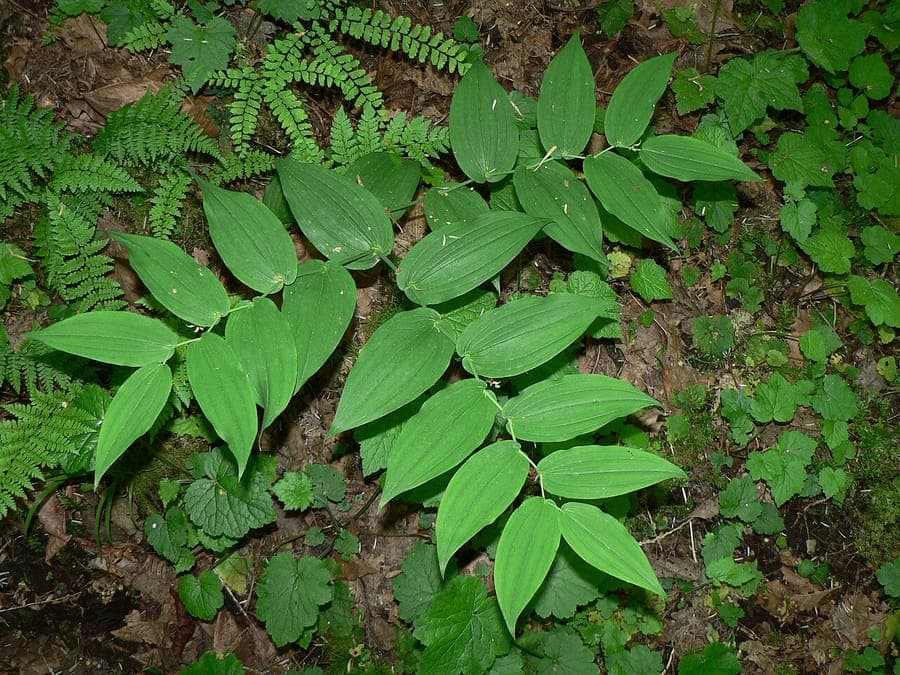
Walter Siegmund / CC BY 2.5, via Wikimedia Commons
Streptopus amplexifolius: complete guide
Streptopus amplexifolius
Want to see Streptopus amplexifolius: complete guide in your garden?
1 minute, no credit card
Overview
Streptopus amplexifolius, commonly known as clasping twisted stalk or liverberry, is an elegant woodland plant in the Liliaceae family (lilies and related families). This slender plant originates from temperate forests of the Northern Hemisphere and is celebrated for its green foliage, subtle flowers, and especially its decorative red fruits. With its preference for shade and moisture tolerance, it is an ideal choice for shaded woodland gardens.
Appearance and Bloom
Streptopus amplexifolius grows as a slender, upright plant reaching 40 to 80 centimeters in height. The stems are green, quite smooth, and have a characteristic "kinked" appearance due to how the leaves are arranged. The leaves are elongate, green, and clasp the stem halfway (amplexifolius literally means "clasping leaves"). Small white to pink flowers appear in May through June, followed by slender red berries.
Ideal Location
Streptopus amplexifolius thrives best in half-shade to full shade. This is a true woodland plant and grows excellently under trees or in other shaded corners. Avoid direct bright sun, especially in warmer climates.
Soil
This plant grows best in humus-rich, well-draining soil, such as that found in natural forests. Acidic to slightly acidic pH is suitable. Addition of compost or leaf mold significantly helps growth.
Free design
Want to see Streptopus amplexifolius: complete guide in your garden? Make a free design now.
Watering
Streptopus amplexifolius prefers moist soils and grows well along woodland streams and marshy areas. Regular watering is important, especially during dry periods. The plant tolerates moist conditions well, although not completely waterlogged soil.
Pruning
Minimal pruning needed - remove only dead or damaged stems. Let the plant grow in its natural form. Trimming can be done after fruiting to stimulate new growth in the following season.
Maintenance Calendar
April-May: Growth period with regular watering. June-July: Flowering and fruiting period. August-October: Fruit development with minimal intervention. November-March: Winter rest with minimal water needed.
Winter Hardiness
Streptopus amplexifolius is very winter hardy, tolerating temperatures down to -15 to -20 degrees Celsius. This makes it suitable for many cold regions and higher altitude gardens.
Companion Plants
Combine Streptopus amplexifolius with other woodland plants such as Maianthemum, Convallaria, and Helleborus. The red fruits will stand out beautifully against the green woodland understory. Plant it along woodland edges and in moist areas.
Closing Thoughts
Streptopus amplexifolius offers a subtle combination of elegant structure and decorative red fruits. For those seeking a woodland plant that requires minimal maintenance and thrives in shade, this is an ideal choice. The natural beauty of this plant makes it a valuable addition to any woodland garden landscape. For more plant ideas, visit gardenworld.app or consult local garden experts.
Want to see Streptopus amplexifolius: complete guide in your garden? Make a free design now.
Upload a photo, pick a style, and get a photorealistic design with plant list in under a minute.
No credit card required


Similar plants
Reverchon's gagea: complete guide
Gagea reverchonii
Full guide to Gagea reverchonii, Reverchon's gagea: rare Pyrenean bulb with bright yellow spring flowers, soil needs and companion planting.
Leafy gagea: complete guide
Gagea foliosa
Gagea foliosa is a rare Mediterranean bulb with bright yellow star-shaped flowers blooming February to March in well-drained rocky settings.
Tubular gagea: complete guide
Gagea fragifera
Gagea fragifera is a mountain bulb with golden-yellow star flowers blooming May to July on subalpine slopes from Europe to the Himalaya.