
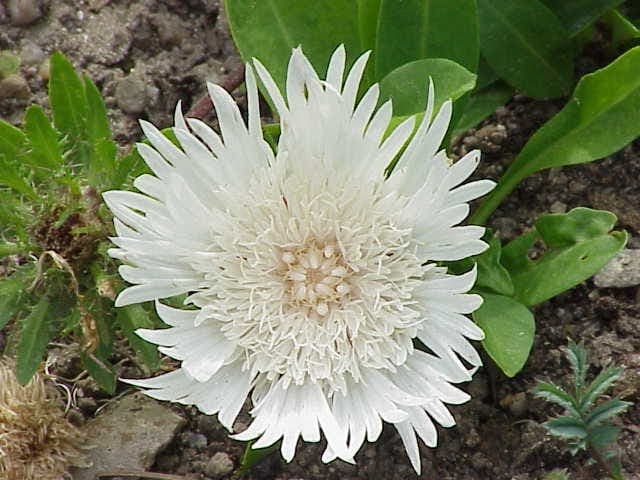
Kurt Stüber [1] / CC BY-SA 3.0, via Wikimedia Commons
Stokes' aster: complete guide
Stokesia laevis
Want to see Stokes' aster: complete guide in your garden?
1 minute, no credit card
Overview
Stokes' aster (Stokesia laevis) is one of the most rewarding summer-flowering perennials available to gardeners in temperate climates. Native to the southeastern United States - from South Carolina and Georgia south to Florida and west to Louisiana - it grows naturally in moist, open pine and oak woodlands. Despite this warm-climate origin, it proves reliably hardy across most of northern Europe when given good drainage, and its long flowering season - from June through September - makes it invaluable in any summer border.
The plant is named for the English physician and botanist Jonathan Stokes (1755-1831). Stokesia laevis is the sole member of its genus (monotypic), placing it in a unique position within the aster family (Asteraceae). Its flowers are unlike those of any other perennial: large, 8-12 cm across, with deeply fringed and feathery outer ray florets surrounding a compact central disc. The colour range runs from lavender-blue and violet through white and cream to soft yellow, depending on the cultivar. On gardenworld.app you can find planting designs that show Stokes' aster combined with complementary summer perennials for a continuous-colour border.
Appearance and bloom cycle
Stokesia laevis forms a neat, low rosette of lance-shaped, leathery leaves 30-40 cm across. The leaves are dark green and smooth (laevis means smooth in Latin), semi-evergreen in mild winters, which gives the plant decorative value even out of flower. Flower stems rise from the rosette to 30-60 cm, each bearing one or more of the distinctive blooms.
Flowering begins in June and continues through July, August and into September - or even early October in mild autumns. The blooms are produced in succession over many weeks, making Stokes' aster one of the longest-flowering perennials in the summer border. Deadheading spent flowers promptly encourages the formation of new buds and extends the display by several weeks. Popular cultivars include 'Blue Danube' (medium lavender-blue), 'Alba' (white), 'Peachie's Pick' (deep blue), 'Mel's Blue' (cream-yellow) and 'Purple Parasols' (deep violet-purple). Bees and butterflies visit the flowers regularly throughout the season.
Ideal location
Full sun is ideal for Stokes' aster, producing the most flowers and the most compact, sturdy growth. At least six hours of direct sunshine per day is recommended. Light partial shade (three to four hours of sun) is tolerated, but flowering is reduced and plants become slightly lax in growth. Deep shade is unsuitable.
A position with good air circulation reduces the risk of fungal issues in wetter climates. Stokes' aster is well-suited to the front or middle of a sunny border, to raised beds, and to south-facing slopes. It tolerates summer heat without complaint - its southeastern US habitat prepares it well for warm European summers. It also performs well in large containers on a sunny terrace, provided the pot has good drainage holes and is at least 30 cm in diameter.
Soil
Good drainage is the single most important soil requirement for Stokesia laevis. Waterlogged soil, particularly in winter, is the primary cause of plant failure. A light, sandy-to-humus-rich, free-draining soil is ideal. In heavier clay soils, work coarse grit or perlite into the top 30 cm before planting to improve drainage significantly.
A slightly acid to neutral soil pH of 5.5-6.5 is optimal. The plant has moderate fertility requirements: too much nitrogen stimulates excessive leafy growth at the expense of flowers. A single application of a balanced slow-release fertiliser in spring is sufficient for the whole season. Mulching around (but not touching) the crown helps regulate soil moisture in summer and insulates the roots in winter.
Watering
Stokes' aster is moderately drought-tolerant once established. In its first growing season, water thoroughly once a week during dry spells to encourage deep rooting. From the second year onwards, established plants are fairly self-sufficient and rarely need supplemental watering during normal northern European summers.
In prolonged dry spells of more than two weeks, give a thorough soaking once a week to keep plants performing well. In winter, the critical rule is to avoid waterlogging: more plants are lost to wet winter soils than to cold temperatures. Ensure drainage is adequate before winter sets in. A light mulch of bark over the root zone in autumn helps regulate soil moisture without retaining too much water.
Free design
Want to see Stokes' aster: complete guide in your garden? Make a free design now.
Pruning
Deadheading is the key maintenance task for Stokes' aster. As each flower fades, cut the stem back to the next side bud or to the base of the flower stem. This simple operation dramatically extends the flowering season, as it prevents the plant putting energy into seed production and instead stimulates the formation of new buds. With regular deadheading, a well-grown plant can flower continuously for 12-16 weeks.
In autumn, leave the foliage rosette intact after flowering ends: the semi-evergreen leaves provide winter interest and protect the crown from frost. Remove any winter-damaged leaves in early spring, along with the old flower stems. Every three to four years, divide large clumps in spring to maintain vigour and to propagate new plants. Divisions establish quickly and flower well in their first year after transplanting. Gardenworld.app offers detailed seasonal care guides for maintaining a healthy mixed border.
Maintenance calendar
January - February: plant is semi-dormant but retains its leaf rosette. In hard frosts, protect with a light covering of dry leaves or pine needles.
March - April: remove any winter-damaged leaves. Apply a balanced slow-release fertiliser or light compost dressing. Divide overcrowded clumps if needed.
May - June: flower stems rise rapidly; first flowers open in June. No intervention needed.
July - August: peak flowering. Deadhead spent blooms regularly to prolong the display.
September - October: late flowers on warm-weather cultivars. Allow some seed heads to develop if self-sowing is desired.
November - December: plant enters dormancy with leaf rosette intact. Apply a light mulch around the base if prolonged hard frost is expected.
Winter hardiness
Stokes' aster is rated to USDA zone 5, corresponding to minimum winter temperatures of around -28 degrees Celsius. In the UK, the Netherlands, Belgium and most of northern Europe (typically zones 7-8), it overwinters reliably without protection in well-drained soil. It is considerably hardier than its southeastern US origin might suggest.
The critical factor is drainage: a plant in free-draining soil at -15 degrees Celsius will survive without difficulty, while the same plant in waterlogged soil at -5 degrees Celsius may rot and die. In heavy soils, raise the planting slightly to ensure the crown sits just above the surrounding soil level. In pots, move containers to a sheltered spot or wrap them in horticultural fleece when temperatures threaten to fall below -10 degrees Celsius. Visit gardenworld.app to see how Stokes' aster can be incorporated into year-round garden designs that balance winter hardiness with summer impact.
Companion plants
Stokes' aster is a versatile companion plant. Its lavender-blue flowers create a cool, elegant contrast with warm-coloured perennials: Rudbeckia fulgida 'Goldsturm' (golden yellow), Hemerocallis cultivars (orange, yellow), and Coreopsis verticillata 'Moonbeam' (pale yellow). For a cooler colour palette, pair it with white Phlox paniculata, Veronicastrum virginicum and Agastache 'Blue Fortune'.
Low-growing neighbours at the front of the border might include Salvia nemorosa, Nepeta faassenii and Geranium 'Rozanne'. Taller background plants such as Miscanthus sinensis or Sanguisorba officinalis provide structure. In a pollinator border, Stokes' aster combines beautifully with Echinacea purpurea and Verbena bonariensis to attract an impressive range of bees and butterflies throughout the summer months.
Closing
Stokes' aster is a plant that earns its place in any sunny summer border. Its extended flowering season, elegant fringed blooms, low maintenance requirements and solid winter hardiness make it suitable for gardeners of all experience levels. Look for named cultivars at specialist perennial nurseries and good garden centres in spring, and plant in well-drained soil in full sun for the best results.
Want to see Stokes' aster: complete guide in your garden? Make a free design now.
Upload a photo, pick a style, and get a photorealistic design with plant list in under a minute.
10,000+ gardens designed already
No credit card required


Similar plants
Purple coneflower: complete guide
Echinacea purpurea
Everything about Purple Coneflower (Echinacea purpurea): planting, care, pruning and combinations. Expert tips for a thriving prairie-style garden.
Orange Coneflower: complete guide
Rudbeckia fulgida
Everything about Rudbeckia fulgida (orange coneflower): planting, care, combinations and bloom time. Practical tips for months of golden-yellow flowers.