
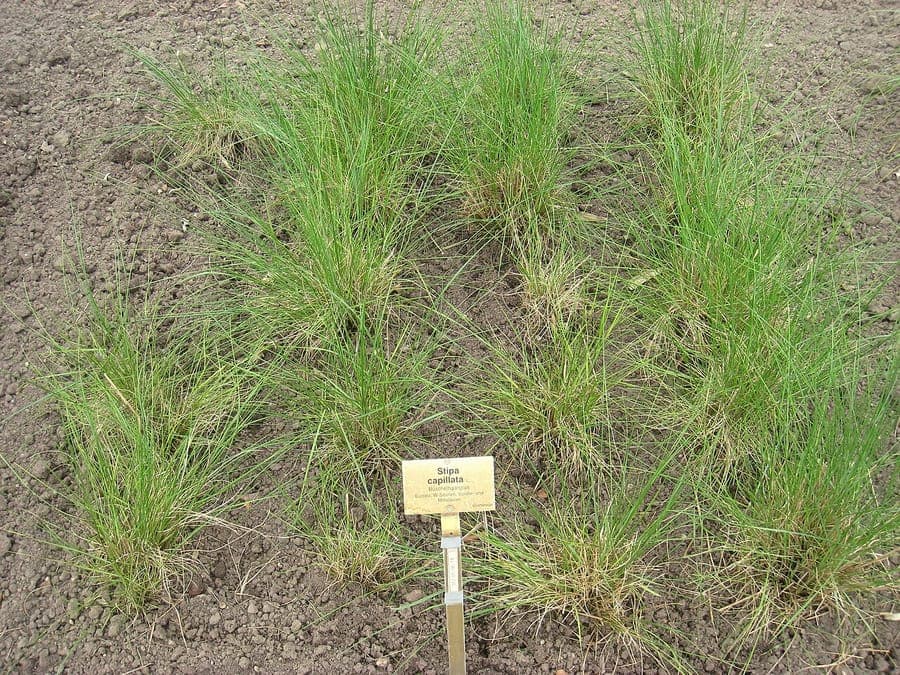
Daderot / Public domain, via Wikimedia Commons
Dwarf feather grass: complete guide
Stipa capillata
Want to see Dwarf feather grass: complete guide in your garden?
1 minute, no credit card
Overview
Stipa capillata, commonly known as dwarf feather grass, is a fine-textured, clump-forming grass that brings movement and softness to garden spaces. Native to parts of Central and Eastern Europe and northern China, it's well-adapted to temperate climates and performs reliably in USDA zones 5 through 9. Reaching 30 to 60 cm in height, it's ideal for the front of borders, rock gardens, or gravel schemes where its airy silhouette can shine. The plant forms tight tussocks and sends up slender flowering stems in early summer, crowned with delicate, hair-like plumes that catch the light and flutter with the slightest breeze.
One of the biggest draws for gardeners is its minimal care routine. Once established, it needs no supplemental watering, fertiliser, or staking. It's perfect for low-input gardens or naturalistic planting schemes. On gardenworld.app, you can design a planting layout that highlights grasses like Stipa capillata, using them to create rhythm and flow. It also integrates beautifully with stone paths and low walls, where the plumes reflect light and add seasonal interest.
Appearance & bloom cycle
The foliage emerges as narrow, thread-like blades in a soft green to greyish tone, arranged in a neat fountain shape. From late May through June, the flower stems rise above the leaves, reaching up to 60 cm. The inflorescences are silvery at first, then mature to a warm golden-brown that persists well into winter. Each plume can measure 30–40 cm long and has a silky, almost translucent quality in morning or evening light.
This grass is semi-evergreen in milder climates. The old growth and plumes provide structure through winter, especially when dusted with frost. Cut back the dead foliage in late winter - February to early March - before new shoots emerge. This keeps the plant tidy and encourages fresh growth. Avoid cutting too early, as the old foliage offers some winter protection.
Ideal location
Full sun is essential. The plant needs at least 6 hours of direct sunlight daily to flower well and maintain its upright form. In partial shade, it becomes leggy and flops over. Use it in sunny borders, dry slopes, or as part of a meadow-style planting. It also works in large containers, as long as there's excellent drainage.
On gardenworld.app, you can simulate sun exposure and wind patterns to find the best spot for your grasses. Dwarf feather grass is surprisingly resilient to wind due to its flexibility - it bends but rarely breaks.
Free design
Want to see Dwarf feather grass: complete guide in your garden? Make a free design now.
Soil requirements
It thrives in light, sandy, or gravelly soils with sharp drainage. Avoid heavy clay unless amended with grit or coarse sand. A pH range of 6.0 to 7.5 is optimal. Interestingly, rich soils can lead to weak, floppy growth - this grass prefers lean conditions. Don't add compost or fertiliser when planting; it will only encourage excessive leaf growth at the expense of flowering.
In containers, use a mix of two parts loam-based compost and one part horticultural grit. Ensure the pot has drainage holes. This species is excellent for xeriscaping and gravel gardens, where water conservation is key.
Watering
Water regularly for the first 4–6 weeks after planting to help roots establish. After that, it's fully drought-tolerant. In average UK or US summers, no additional watering is needed. Only during prolonged droughts (over 6 weeks without rain) should you give a deep soak. Overwatering, especially in winter, leads to crown rot. Water deeply but infrequently - never daily misting or light sprinkling.
Pruning
Cut back the old growth in late winter, around February or early March. Trim to about 10 cm from the ground using sharp secateurs. This removes old material and makes space for new shoots. You can leave a few plumes over winter for visual interest, but remove them before spring growth starts.
Maintenance calendar
- Jan: assess old plumes, check for waterlogged clumps
- Feb: begin cutting back if no heavy snow cover
- Mar: complete pruning, monitor for new growth
- Apr: new blades emerging, no feeding needed
- May: flower stems begin to elongate
- Jun: full bloom, plumes silvery-gold
- Jul-Aug: plumes mature, remain attractive in sunlight
- Sep: seed heads may disperse; plant remains drought-proof
- Oct: no action required
- Nov: old foliage provides winter texture
- Dec: structural presence in dormant garden
Winter hardiness
Hardy down to USDA zone 5 (-23°C). In zones 6–9, it overwinters with no issues. In wet, cold winters, poor drainage can cause root or crown rot. Ensure soil drains well. Potted plants may need protection - move to a sheltered spot or wrap the container. No mulch needed in ground plantings.
Companion plants
Pair with drought-tolerant perennials like Echinacea purpurea, Sedum 'Autumn Joy', or Salvia nemorosa. Front with low growers like Thymus or creeping Phlox. Avoid vigorous spreaders like mint or bamboo. On gardenworld.app, explore planting combinations that balance texture, height, and bloom time for year-round appeal.
Closing
Dwarf feather grass is a quiet achiever in the garden - subtle yet impactful. It adds rhythm, texture, and winter interest with almost no effort. Perfect for modern, eco-conscious designs. You'll find Stipa capillata at garden centres across the UK and US. Look for reputable growers - sometimes it's mislabelled as Stipa pennata, but capillata is shorter and more compact, ideal for smaller spaces.
Want to see Dwarf feather grass: complete guide in your garden? Make a free design now.
Upload a photo, pick a style, and get a photorealistic design with plant list in under a minute.
No credit card required


Similar plants
Sporobolus pungens: complete guide
Sporobolus pungens
Sporobolus pungens is a stoloniferous Mediterranean coastal grass with outstanding salt and drought tolerance, perfect for seaside and dry gardens.
Mediterranean aegilops: complete guide
Aegilops biuncialis
Everything about Aegilops biuncialis, a Mediterranean annual grass with ornamental spikes and outstanding drought tolerance for dry gardens.
Silver bluestem: complete guide
Bothriochloa saccharoides
Full guide to Bothriochloa saccharoides (silver bluestem): site, soil, watering, winter hardiness, pruning, and garden companions.