
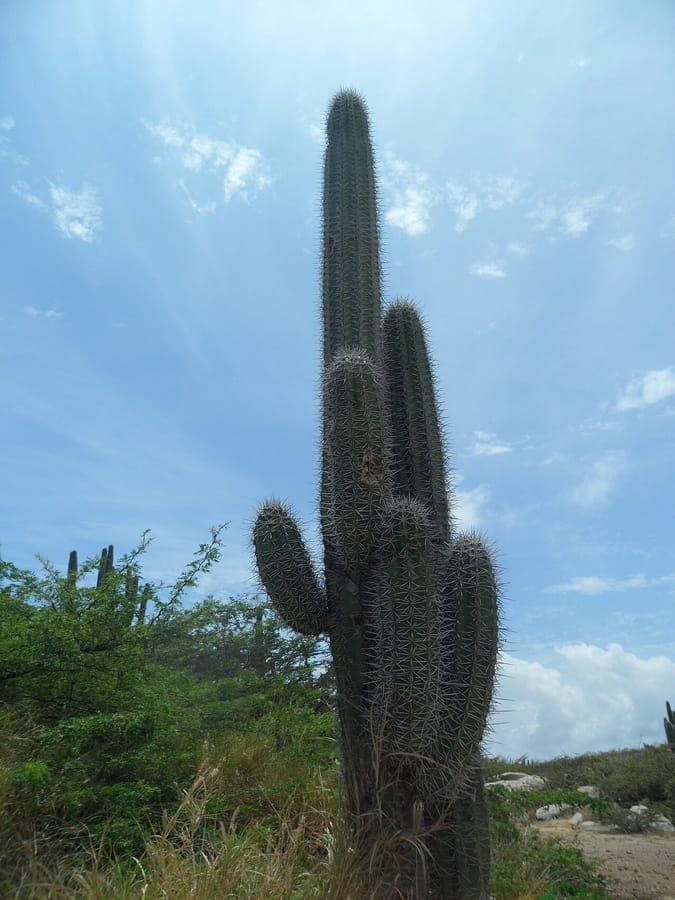
EgorovaSvetlana / CC BY-SA 4.0, via Wikimedia Commons
Stenocereus griseus: complete guide
Stenocereus griseus
Want to see Stenocereus griseus: complete guide in your garden?
1 minute, no credit card
Overview
Stenocereus griseus, also known as Tall Candelabra Cactus, Pitaya, or Zuilcactus, is a spectacular columnar cactus from the Cactaceae family. Native to Mexico through Venezuela and the Caribbean, this is one of the most dramatic cacti suitable for cultivation. With its columnar growth, large night-blooming flowers, and edible fruits, it offers far more than ornamental value alone.
This plant distinguishes itself through relatively rapid growth (for a cactus) and its ability to reach impressive heights. In natural habitat it can reach 5-10 meters, making it a must-have for those wanting vertical space and dramatic silhouettes.
Appearance and Bloom
The stem is upright and columnar, gray-green in color with deep ribs and distinct spine clusters. As the plant matures, lateral branches may form, creating a candelabrum-like appearance. The greenish color gives it its soft "grey" name.
Flowers bloom at night and are white to cream with yellow centers, highly fragrant, up to 10 centimeters in diameter. Following flowering, fruits develop that turn red-orange and are edible - they taste like mild mango.
The plant grows rapidly for a cactus and can reach considerable height in 5-10 years. In containers it grows somewhat slower but still impressively.
Ideal Location
Stenocereus griseus demands full sun - at least 8 hours of direct sunlight daily. Less sun leads to weak etiolated growth. The ideal scenario is against a south-facing wall where it receives maximum heat.
The plant also does well against hot east walls, though west walls are better for afternoon warmth. In containers on sunny terraces it thrives. Provide shelter from strong winds that could blow over this heavy plant. A protected garden or patio is ideal. In cold regions, plant in large containers you can move to protection.
Soil
Stenocereus griseus requires excellent drainage - this is the essential condition for cacti. Use cactus soil or create your own mixture of 60% sand, 30% potting soil, and 10% humus. pH can be slightly acidic to neutral (6.0 to 7.0).
Plant in large containers with abundant drainage holes. For garden planting, provide raised beds with excellent drainage. Stagnant water is the number one enemy of cacti. Do not add organic matter after planting - this promotes acidification and problems. The plant thrives better in poor soil.
Free design
Want to see Stenocereus griseus: complete guide in your garden? Make a free design now.
Watering
Stenocereus griseus is very drought-tolerant once established. During the growing season (May through October), water infrequently - only every two to three weeks. In winter, virtually no water is needed.
The cardinal rule: underwater rather than overwater. The plant will turn yellow or transparent if it receives too much water. If you doubt, wait another week before watering.
During very dry periods you can lightly mist with water - this simulates nighttime dew from its native habitat.
Pruning
Pruning is optional and not really necessary for this cactus. The plant usually grows as desired. If branches grow in unwanted directions, you can carefully remove them at the base.
Remove only dead or diseased parts. The plant heals slowly, so be careful. Use sterile tools and wear gloves - the spines are sharp.
Maintenance Calendar
March-April: Check drainage, prepare for growing season. May-October: Minimal watering, check for pests. June-August: May feed (cactus fertilizer) once monthly. October-November: Gradually reduce watering. December-February: Virtually no water, place in cool location.
Winter Hardiness
Stenocereus griseus can tolerate temperatures down to about 5 degrees Celsius for brief periods, but prolonged cold is fatal. In temperate regions, you must overwinter this plant indoors.
From October through May place the plant in a cool, bright location (5-15 degrees Celsius) where it needs minimal light. An unheated room windowsill or cold frame is ideal. Water almost not at all.
In May you can move it outside again. Place it first in partial shade for acclimation, then in full sun after a week.
Companion Plants
Stenocereus griseus combines well with:
- Other cacti for a succulent garden
- Agave for contrasting leaf forms
- Lampranthus for color contrast
- Jasmine around the base for fragrance
Closing Thoughts
The Tall Candelabra Cactus is a dramatic plant that transforms any garden. With rapid growth and spectacular night-blooming flowers, it is perfect for those wanting to fill vertical space with something truly different. Plant today and enjoy years of growth and exotic blooms! Let GardenWorld.app help you incorporate this remarkable cactus into your garden design.
Want to see Stenocereus griseus: complete guide in your garden? Make a free design now.
Upload a photo, pick a style, and get a photorealistic design with plant list in under a minute.
No credit card required


Similar plants
Plains prickly pear: complete guide
Opuntia polyacantha
All about plains prickly pear cactus: hardiness, soil, placement and care. One of the most cold-tolerant cacti for temperate gardens.
Saguaro: complete guide
Carnegiea gigantea
Everything about growing saguaro cactus: container care, watering, overwintering, and companion plants for this iconic desert giant.
Cylindropuntia imbricata: complete guide
Cylindropuntia imbricata
The Tree Cholla offers distinctive segmented stems and vibrant red flowers. A unique ornamental succulent perfect for sunny, dry gardens and large containers.