
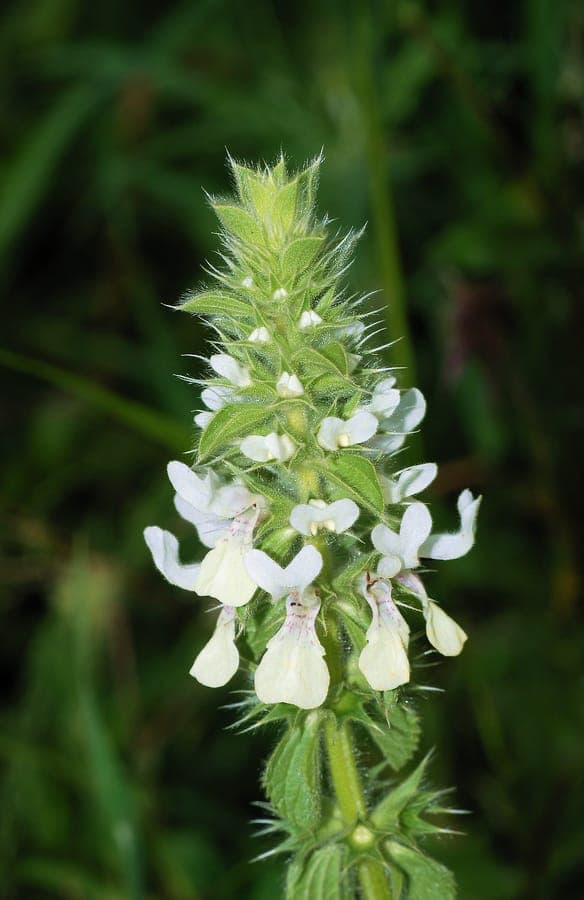
Alvesgaspar / CC BY-SA 3.0, via Wikimedia Commons
Italian hedgenettle: complete guide
Stachys ocymastrum
Want to see Italian hedgenettle: complete guide in your garden?
1 minute, no credit card
Overview
Italian hedgenettle (Stachys ocymastrum) is a Mediterranean herbaceous plant from the Lamiaceae family (deadnettle family). This small plant occurs naturally throughout the Mediterranean, from North Africa to Greece.
The plant is recognized for its compact growth, rough fuzzy leaves, and small yellow or purplish flowers. It naturally grows on rocky, dry slopes in Mediterranean landscapes. This makes it very suitable for xeric gardens, rock gardens, and sunny gravel gardens.
The plant is completely winter hardy and survives even severe winters without trouble. This makes it ideal for gardens in temperate climates.
Appearance and Bloom
Italian hedgenettle grows as a compact herbaceous plant typically reaching 20-40 centimeters tall. The stems are thick and roughly hairy. The leaves are small, greenish, and also rough in texture.
The flowers are small, forming dense flower spikes. Color varies from yellow to purple depending on the plant form. They bloom from May through summer. The scent is aromatic - both leaves and flowers have a pleasant fragrance.
Seeds form after flowering and can be collected, though self-seeding also occurs naturally.
Ideal Location
Italian hedgenettle is a true sun-lover. It performs best in completely sunny locations with at least 6 hours of direct sunlight daily.
The plant also tolerates semi-arid locations and rocky slopes where other plants struggle. This makes it ideal for difficult-to-manage corners.
Wind and full sun are actually preferred over protected locations. This fits with its Mediterranean origins.
Soil Requirements
Italian hedgenettle accepts poor, dry soils. Add sufficient sand and gravel to heavy clay soils to improve drainage. It also grows well on chalky soils.
The plant does not tolerate rich, moist soils well. On heavy clay, dig holes and add sand/gravel.
Well-drained soil is essential for success.
Free design
Want to see Italian hedgenettle: complete guide in your garden? Make a free design now.
Watering
Italian hedgenettle is very drought-tolerant once established. Regular watering during the first growing season helps roots establish. After that, irrigation can be reduced almost completely.
During very dry periods you can water, but usually it's unnecessary. In rainy regions it's typically self-sufficient.
From experience: Excess water damages more than drought.
Pruning
Light spring pruning keeps the plant compact. This is not necessary, but can help.
Remove flower spikes after blooming if you want to prevent seed setting.
Early pruning is generally not required.
Maintenance Calendar
Late spring: Plant out in warm soil. Ensure well-drained soil.
Summer: Flowering at peak. Minimal care needed. Leave flowers for insects.
Autumn: Flowering finished. Plant partially dies back in cold climates. Seed ripens.
Winter: Plant goes dormant. Completely hardy. No care needed.
Winter Hardiness
Italian hedgenettle is completely winter hardy in Europe. It tolerates frosts down to -15 degrees Celsius without damage.
The plant can even regrow from roots after severe winters.
This is a major advantage for gardens in temperate and northern climates.
Companion Plants
Italian hedgenettle fits excellently in Mediterranean plant combinations. Other small drought-tolerant herbs like lavender, sage, and santolina pair well.
Rocky slopes with alpine flora form its natural environment.
Conclusion
Italian hedgenettle is a carefree plant for gardens requiring minimal maintenance. Its compact growth and sunny flowers make it suitable for many situations. Particularly advantageous is its winter hardiness - it's a true survivor! Try it in your dry, sunny corner.
For sourcing: Many specialized herb and Mediterranean plant suppliers stock this. Online plant vendors also offer it. Visit gardenworld.app for plant sourcing guidance.
Want to see Italian hedgenettle: complete guide in your garden? Make a free design now.
Upload a photo, pick a style, and get a photorealistic design with plant list in under a minute.
No credit card required


Similar plants
Apple mint (Mentha x villosa): complete guide
Mentha x villosa
Meet apple mint (Mentha x villosa): a fruity-scented kitchen herb with woolly leaves, perfect for tea and mojitos.
Salvia peyronii: complete guide
Salvia peyronii
Discover Salvia peyronii, a rare Lebanese mountain sage. Growing tips, hardiness, and companion planting for a Mediterranean gravel garden.
Bigleaf mint (Mentha x rotundifolia): complete guide
Mentha x rotundifolia
Discover bigleaf mint: cultivation, care tips, and garden uses. Learn how to grow this aromatic herb with soft, hairy leaves.