
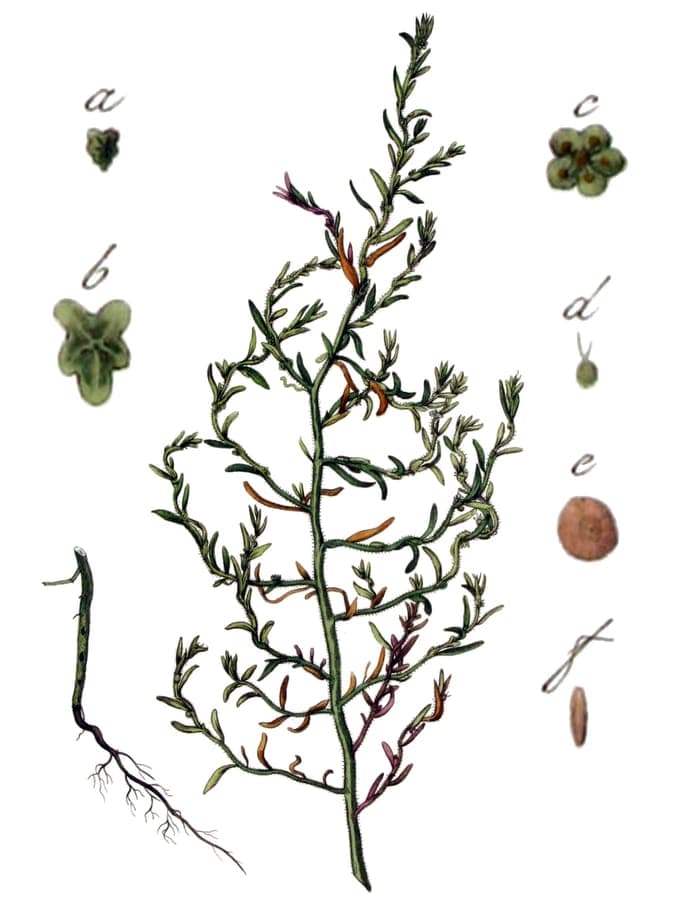
Christiaan Sepp (illustrator), Janus (Jan) Kops (1765–1849), Herman Christiaan van Hall (editors) / Public domain, via Wikimedia Commons
Hairy smotherweed: complete guide
Spirobassia hirsuta
Want to see Hairy smotherweed: complete guide in your garden?
1 minute, no credit card
Overview
Hairy smotherweed (Spirobassia hirsuta) is one of those botanical curiosities that most gardeners have never encountered but specialists find fascinating. A member of the Amaranthaceae family - the same family as amaranths, quinoa, and the common goosefoot - this annual plant occupies a very specific ecological niche: salty, dry, alkaline ground across an enormous natural range from the Mediterranean coast through Eastern Europe, the Caucasus, Central Asia, and West Siberia all the way to Xinjiang in northwest China. The species was originally described by Linnaeus and reclassified into its current genus by Freitag and Kadereit in 2011. Its older synonyms include Bassia hirsuta, Kochia hirsuta, and Echinopsilon hirsutus, reflecting the shifting taxonomy of the broader goosefoot group. At gardenworld.app you can discover planting designs for challenging dry and saline sites that make use of pioneering annuals like this one.
The epithet hirsuta is Latin for "hairy" or "rough", a direct reference to the dense covering of long soft hairs that coat the stems and leaves and give the plant its distinctive shaggy appearance. This hairiness is not merely cosmetic: the fine hairs trap a layer of still air around the leaf surface, reducing water loss in the hot, dry habitats where the plant thrives.
Appearance and bloom cycle
Spirobassia hirsuta grows as a compact, bushy annual reaching 20 to 50 cm in height. From a distance it looks like a small, densely furry rounded mound - pale grey-green in colour and almost woolly in texture. Up close the dense covering of soft white hairs is remarkable: every stem, leaf, and eventually every fruiting spike is wrapped in this protective coat. The leaves are narrow, linear to lance-shaped, roughly 1 to 3 cm long, arranged alternately along the stems. Flowers appear in August and September, borne in the leaf axils. They are small, green, wind-pollinated, and not individually showy. After pollination the fruiting structures are considerably more decorative: the five calyx segments spread outward in a star-like arrangement, creating the distinctive bristly or spiny fruiting spikes that give the plant its colloquial name of smotherweed. These persist and dry to an attractive straw-brown through autumn and winter.
Ideal location
Full sun and open conditions are essential. In nature, hairy smotherweed occupies coastal salt marshes, inland saline flats, limestone outcrops, stony road verges, and the margins of cultivated land in continental climates. In a garden context, choose a site with unobstructed sunlight for at least six hours a day. South-facing gravel gardens, coastal borders, gaps in paving, the edges of gravel driveways, and green roof plantings all suit this species well. It is intolerant of shade and will fail to thrive in positions where moisture accumulates. The plant's extraordinary tolerance for both salt and drought makes it valuable precisely where other species struggle.
Soil requirements
The Trefle data for this species shows a pH preference of 7.5 to 8.0, indicating a clear preference for alkaline, calcareous soils. Sandy, shell-rich, stony, or gravelly soils with excellent drainage are ideal. The plant actually performs better on poor, mineral-rich ground than on fertile garden soil: too much nitrogen produces lush but floppy plants that are more susceptible to disease. In garden conditions, a mix of limestone grit, sharp sand, and a small proportion of ordinary garden soil produces excellent results. Improve naturally acid soils with ground limestone or chalk before planting. Salt tolerance is a genuine asset: plants thrive in coastal gardens where salt spray or winter road salt would damage less robust species.
Free design
Want to see Hairy smotherweed: complete guide in your garden? Make a free design now.
Watering
Once established, hairy smotherweed is exceptionally drought-tolerant. In its native steppe habitats it survives summer months with almost no rainfall. After sowing or transplanting, water lightly to help seedlings establish, then step back and let the plant fend for itself. Supplementary watering is rarely needed in temperate European climates once plants are established. Avoid overwatering: too much moisture leads to rank, weak growth and increases the risk of damping off and root rots. If you are growing in containers, ensure the pot has good drainage holes and use a gritty substrate.
Care and pruning
As an annual, hairy smotherweed needs almost no pruning. Allow the plant to set seed in October - the decorative fruiting structures are worth keeping on the plant for as long as possible. If you want to prevent excessive self-seeding, collect the ripe seed before the stems shatter naturally. Collected seed can be stored dry in a paper envelope through winter and sown the following spring. The dead plants can remain standing through winter: their hairy, star-fruited silhouettes are unusually decorative when frosted, and they provide shelter for overwintering insects. Remove the dry skeletons in early spring before new seedlings emerge.
Maintenance calendar
February to March: sow seeds indoors in small pots of alkaline, gritty compost at 16 to 20 degrees Celsius. April to May: prick out and harden seedlings off; plant outside once frost risk has passed. May to June: plant out in full sun; minimal watering after planting. July: plants develop their compact bushy form; no intervention needed. August to September: flowering period; enjoy the hairy texture and developing fruiting spikes. October: collect seed if desired; otherwise leave plants for self-seeding. November to January: leave dead plants for insects and winter interest if desired.
Winter hardiness
As an annual, Spirobassia hirsuta does not need to be considered for winter hardiness in the traditional sense - it completes its life cycle in one growing season and dies after setting seed. The seeds, however, are extremely cold-hardy and overwinter reliably in the soil, germinating the following spring. In its native range the plant grows in areas with harsh continental winters, so the seeds are perfectly adapted to survive British, Dutch, Belgian, and German winters without any protection. Avoid deep digging in the area where plants self-seed, as this will bury or destroy the seed bank. At gardenworld.app you will find designs for pioneer and annual plantings that return reliably year after year through self-seeding.
Companion plants
Hairy smotherweed suits a pioneer, coastal, or steppe planting design. It partners well with other Amaranthaceae relatives that share its preference for saline and alkaline ground, such as Atriplex halimus and Kochia scoparia. In a dry gravel garden, low-growing Festuca glauca provides a contrasting blue-grey mat beneath the upright hairy stems. Gypsophila repens adds a soft cloud of tiny white flowers in early summer before the smotherweed takes centre stage. Sea lavender (Limonium) shares similar coastal habitat preferences and flowers at a similar time. Garden centres with a specialist interest in native and unusual plants are the most likely source for this species. At gardenworld.app our design team regularly specifies unusual pioneer species like this for ecologically minded and low-maintenance garden projects.
Closing thoughts
Hairy smotherweed is not a plant for every garden, but it is a plant for the curious and adventurous gardener. Its tolerance for conditions that defeat almost every other ornamental - salty soil, thin alkaline ground, summer drought, full blazing sun - makes it genuinely valuable in difficult spots. The hairy texture, compact form, and decorative fruiting spikes are distinctive and interesting from midsummer right through to the first hard frosts. If you want a garden that goes beyond the expected and reflects the remarkable diversity of European and Central Asian flora, hairy smotherweed deserves a place in your planting palette.
Want to see Hairy smotherweed: complete guide in your garden? Make a free design now.
Upload a photo, pick a style, and get a photorealistic design with plant list in under a minute.
10,000+ gardens designed already
No credit card required


Similar plants
Bassia laniflora (woolly summer-cypress): complete guide
Bassia laniflora
Full guide to Bassia laniflora: origin, appearance, ideal location, soil, watering and care for this drought-tolerant annual.
Suaeda spicata: complete guide
Suaeda spicata
Everything about Suaeda spicata (spiked seablite): a rare salt-tolerant coastal succulent from the western Mediterranean and Macaronesia.
California amaranth: complete guide
Amaranthus californicus
Full guide to California amaranth (Amaranthus californicus): growing tips, ideal location, soil needs, watering, and garden design ideas.