
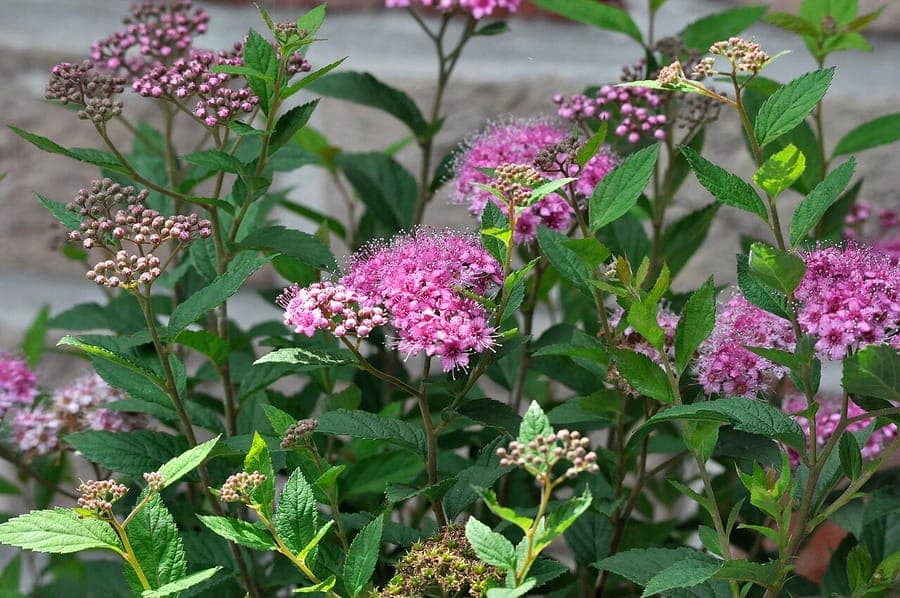
Paul Hermans / CC BY-SA 3.0, via Wikimedia Commons
Japanese spiraea: complete guide
Spiraea japonica
Want to see Japanese spiraea: complete guide in your garden?
1 minute, no credit card
Overview
Japanese spiraea (Spiraea japonica) is a dependable, hardy deciduous shrub that earns its place in gardens across temperate climates. Native to parts of China, Japan, and Myanmar, this Rosaceae family member has adapted well to UK, US, and European gardens. It's compact-rarely exceeding 90 cm in height-and ideal for borders, low hedges, or as ground-level accents in mixed beds. What makes it a favorite among gardeners is its resilience: it tolerates poor soil, drought, and urban conditions while delivering vibrant summer color.
On gardenworld.app, you can design a layout that showcases Japanese spiraea at its best-whether in a drought-tolerant scheme or a structured border with texture contrast. This shrub suits gardeners who want beauty without constant care. It's not flashy, but it's reliable, blooming year after year with minimal input.
Appearance & bloom cycle
Japanese spiraea grows in a dense, mounding habit with small, lance-shaped leaves that are dark green and finely toothed. In early to mid-summer, flat-topped clusters of tiny pink to reddish-pink flowers appear, creating a cloud-like effect. Bloom time runs from June to August, depending on the cultivar and local climate. Some varieties, like 'Anthony Waterer' or 'Goldflame', may rebloom lightly in late summer if pruned after the first flush.
After flowering, small seed capsules form, adding subtle winter interest. Foliage turns shades of red, orange, or purple in autumn, especially in sunnier spots. While not as showy as maples, the fall color still adds warmth. The bare, twiggy structure remains visible in winter, contributing to garden form during the off-season.
Ideal location
Plant Japanese spiraea in full sun to light shade. It performs best with at least 6 hours of direct sunlight daily-this ensures dense growth and abundant blooms. In too much shade, the plant becomes leggy and flowers sparsely. It works well in front borders, cottage gardens, or as a low hedge along walkways. Avoid overly sheltered spots where air doesn't circulate, as this can encourage fungal issues.
Soil requirements
This shrub is adaptable to a wide range of soils: sandy, loamy, or clay, as long as drainage is adequate. It dislikes waterlogged roots-poor drainage leads to root rot. The ideal pH is slightly acidic to neutral (5.5–7.0), but it tolerates mildly alkaline conditions. In heavy clay, amend the planting hole with compost or grit to improve drainage. In sandy soils, add compost to boost moisture and nutrient retention.
Free design
Want to see Japanese spiraea: complete guide in your garden? Make a free design now.
Watering
Once established, Japanese spiraea is drought tolerant. Newly planted shrubs need regular watering during their first growing season-about once a week during dry spells. Water deeply to encourage root development. After year one, supplemental watering is rarely needed except during prolonged droughts. A spring mulch of compost or bark helps retain moisture and suppress weeds.
Pruning
Prune in early spring before new growth emerges. Since it flowers on old wood, avoid heavy pruning in summer or fall. Instead, cut back about one-third of the oldest stems to the base to rejuvenate the plant and maintain shape. For a neater look, trim the remaining stems to 15–20 cm above ground. This hard pruning encourages vigorous new shoots and prevents the center from becoming woody and bare.
Maintenance calendar
- Jan–Feb: No action needed. Check for winter damage if extreme.
- Mar: Prune. Remove dead, damaged, or crossing stems.
- Apr: Apply a light layer of compost or organic fertilizer.
- May: Monitor for aphids or powdery mildew-rare but possible.
- Jun–Aug: Peak bloom. Avoid pruning now.
- Sep: Lightly feed with compost if rebloom is desired.
- Oct: Leave fallen leaves around the base for natural insulation.
- Nov–Dec: No maintenance required.
Winter hardiness
Japanese spiraea is hardy in USDA zones 4–8, surviving temperatures down to -34°C. It loses its leaves in winter but remains structurally sound. In colder zones, young plants may suffer tip dieback, but they reliably resprout from the base. No winter protection is needed, though a mulch layer helps newly planted shrubs through their first freeze.
Companion plants
Pair Japanese spiraea with plants that complement its form and bloom time. Lavender offers purple contrast and fragrance. Artemisia adds silvery foliage for texture. For pollinator appeal, plant with catmint, coneflower, or yarrow. It also works well with ornamental grasses like Festuca or Carex for soft contrast. Try combining it with taller shrubs like hydrangea or spirea 'Double Play' for layered depth. On gardenworld.app, you can explore pre-designed planting schemes that include these combinations for proven results.
Closing
Japanese spiraea is a workhorse shrub that delivers beauty with little demand. It's perfect for beginners and seasoned gardeners alike. With its long bloom season, adaptability, and resilience, it fits into nearly any garden style. Find it at local garden centres or trusted retailers like B&Q, Wyevale, or online nurseries. Use gardenworld.app to plan where it fits best in your garden-whether as a focal point or supporting player-and enjoy its quiet but consistent presence for years.
Want to see Japanese spiraea: complete guide in your garden? Make a free design now.
Upload a photo, pick a style, and get a photorealistic design with plant list in under a minute.
No credit card required


Similar plants
Siberian crab apple: complete guide
Malus x robusta
Complete guide to the Siberian crab apple (Malus x robusta): location, soil, pruning, winter hardiness and the best companion plants for your garden.
Chinese flowering crabapple (Malus x spectabilis): complete guide
Malus x spectabilis
Meet the Chinese flowering crabapple (Malus x spectabilis): a classic spring bloomer with carmine buds and pink blossom.
Potentilla crassinervia: complete guide
Potentilla crassinervia
Potentilla crassinervia, the Corsican cinquefoil, grows wild on Corsica and Sardinia's peaks. Discover how to grow this hardy alpine rock garden gem.