
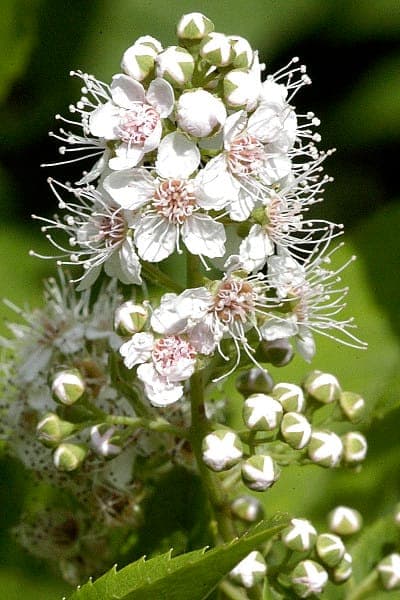
James K. Lindsey / CC BY-SA 3.0, via Wikimedia Commons
Meadowsweet: complete guide
Spiraea alba
Want to see Meadowsweet: complete guide in your garden?
1 minute, no credit card
Overview
Spiraea alba, commonly known as meadowsweet, is a resilient deciduous shrub that brings airy elegance to borders, rain gardens, and naturalistic plantings. A member of the Rosaceae family, it's native to moist woodlands and stream banks across parts of North America, including Maine, Indiana, and Manitoba. In the garden, it thrives with minimal fuss, reaching 120–180 cm in height and spreading 100–150 cm wide over time. Its upright, multi-stemmed habit makes it ideal for mid-border placement or as a soft screen.
Once established, meadowsweet shows strong drought tolerance, though it prefers consistent moisture. It's also a magnet for pollinators and resists deer browsing, making it a practical choice for wildlife gardens. You can use gardenworld.app to design a planting scheme that positions Spiraea alba where it gets optimal sun and space to develop its natural form.
Appearance & bloom cycle
From early June through late July, Spiraea alba produces delicate, feathery plumes of small white flowers. Each flower is about 5 mm across, pale yellow at the center, turning pure white. These panicles rise 10–15 cm above the foliage, creating a soft, cloud-like effect.
The leaves are narrow, lance-shaped, 4–8 cm long, with a glossy dark green upper surface and a slightly silvery underside. They emerge in spring with a bronze tint, mature to green, and turn a muted yellow in autumn - nothing dramatic, but a gentle shift. Young stems are reddish-brown and add subtle winter interest.
Ideal location
Meadowsweet grows best in full sun to light shade, scoring a 7 on the light scale (10 being full sun). Aim for at least 5–6 hours of direct sunlight daily. Too much shade leads to leggy growth and sparse flowering.
It's excellent for moist borders, damp meadow edges, or planted near downspouts in rain gardens. It also adapts well to urban gardens and larger containers (minimum 40x40x40 cm) if given enough root room. Use gardenworld.app to map out spacing - planting 1.2 meters apart in a staggered row ensures full coverage without overcrowding.
Soil requirements
Spiraea alba tolerates a wide pH range from 4.3 to 6.8 and grows well in loamy, sandy, or clay-loam soils as long as drainage is adequate. It handles occasional waterlogging but won't survive in perpetually soggy or compacted ground.
No fertilizer is needed at planting. A thin top-dressing of compost or leaf mould in spring helps maintain soil structure. Avoid high-nitrogen feeds, which promote weak, leafy growth at the expense of blooms.
Free design
Want to see Meadowsweet: complete guide in your garden? Make a free design now.
Watering
During the first growing season, water deeply 2–3 times per week, giving 10–15 liters per plant during dry spells. After 12 months, established shrubs need watering only during extended droughts lasting three weeks or more.
Use drip irrigation or water at the base in the morning to reduce evaporation and fungal risk. Mulch lightly with bark or wood chips to retain moisture - but keep mulch 5 cm away from the stem to prevent rot.
Pruning
Prune right after flowering, between late July and mid-August. Cut back one-third of the oldest stems to a healthy bud or lateral branch. This encourages new growth from the base and maintains a dense, upright shape.
Avoid spring pruning - you'll remove the current season's flower buds. Use sharp, clean secateurs and disinfect between cuts if disease is suspected. Remove any dead, damaged, or crossing stems during the same session.
Maintenance calendar
- January–February: Inspect for winter damage. Remove broken stems.
- March: Apply a thin layer of compost. Check soil compaction.
- April–May: Keep young plants moist. Watch for aphids on new shoots.
- June–July: Peak bloom period. Avoid pruning. Monitor for slugs on tender tips.
- August: Post-bloom pruning. Thin out oldest stems.
- September–October: Leave fallen leaves around the base as natural mulch.
- November–December: Minimal care. Ensure soil isn't waterlogged.
Winter hardiness
Meadowsweet is hardy in USDA zones 3 to 8, enduring winter lows down to -40°C. In zone 8 (most of the UK and northern US), it needs no winter protection. Young plants benefit from a light mulch layer in their first winter to prevent frost heave.
Avoid heavy wrapping or plastic covers - these trap moisture and encourage rot. The shrub's structure holds up well in snow, and its stems remain flexible.
Companion plants
Pair Spiraea alba with moisture-loving perennials like Eutrochium maculatum, Carex vulpinoidea, or Monarda fistulosa. For contrast, plant it beside dark-foliaged shrubs like Ilex glabra or golden Rudbeckia species.
Avoid invasive spreaders like mint or aggressive grasses that can choke its base. In mixed borders, it combines beautifully with Calamagrostis x acutiflora or tall sedges for texture and movement.
Closing
Meadowsweet is a low-maintenance shrub that delivers high impact with minimal input. Its airy blooms, wildlife value, and adaptability make it a smart pick for sustainable gardens. Buy healthy stock from trusted garden centres, and use gardenworld.app to plan spacing, sunlight, and companion pairings. With proper care, Spiraea alba will thrive for years, offering reliable summer beauty and structure.
Want to see Meadowsweet: complete guide in your garden? Make a free design now.
Upload a photo, pick a style, and get a photorealistic design with plant list in under a minute.
No credit card required


Similar plants
Siberian crab apple: complete guide
Malus x robusta
Complete guide to the Siberian crab apple (Malus x robusta): location, soil, pruning, winter hardiness and the best companion plants for your garden.
Chinese flowering crabapple (Malus x spectabilis): complete guide
Malus x spectabilis
Meet the Chinese flowering crabapple (Malus x spectabilis): a classic spring bloomer with carmine buds and pink blossom.
Potentilla crassinervia: complete guide
Potentilla crassinervia
Potentilla crassinervia, the Corsican cinquefoil, grows wild on Corsica and Sardinia's peaks. Discover how to grow this hardy alpine rock garden gem.