
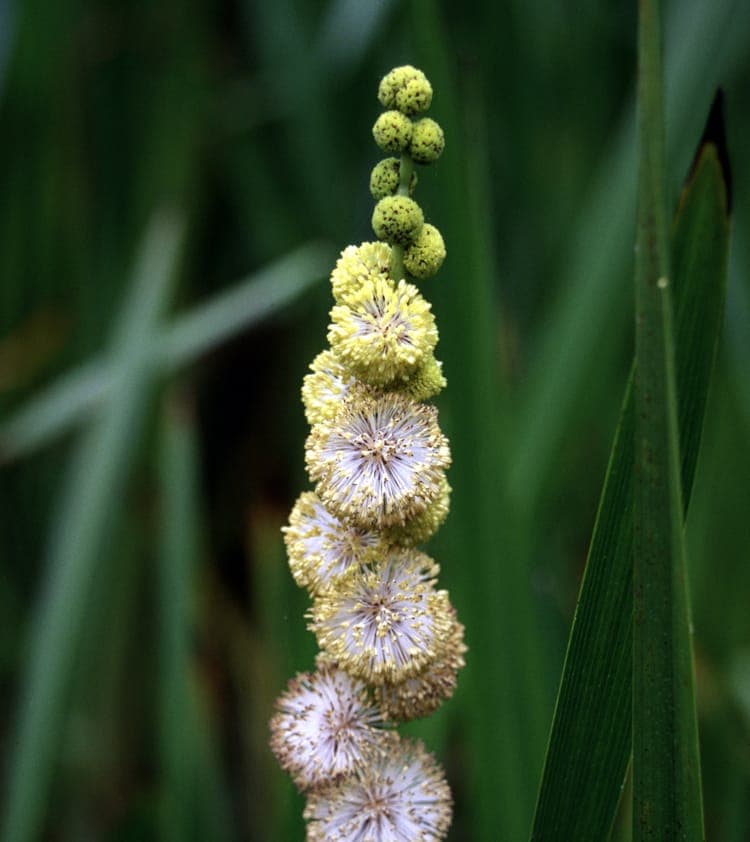
Gordon Leppig & Andrea J. Pickart / Public domain, via Wikimedia Commons
Broadfruit bur-reed: complete guide
Sparganium eurycarpum
Want to see Broadfruit bur-reed: complete guide in your garden?
1 minute, no credit card
Overview
Broadfruit bur-reed (Sparganium eurycarpum) is a vigorous aquatic plant in the family Typhaceae, closely related to cattails and bulrushes. Its common name refers to the spiky, spherical fruit heads that develop along the stems after flowering - one of the most distinctive features of this species. The plant is native across a vast range spanning most of North America from Canada down to Mexico, as well as parts of East Asia including Japan, Korea, and the Russian Far East.
In garden settings, Sparganium eurycarpum is valued for its bold structural presence along pond margins, wet meadow borders, and stream edges. It provides excellent cover for waterfowl, amphibians, and small mammals while also filtering nutrients from the water. If you are designing a naturalistic water garden, gardenworld.app offers design tools and inspiration to help integrate plants like this one into a cohesive scheme.
Appearance and bloom cycle
Broadfruit bur-reed grows upright stems reaching between 60 and 150 cm tall depending on water depth and nutrient levels. The strap-like leaves are stiff and broad, typically 15 to 25 mm wide, with a medium green to blue-green colour. The lower portions of the leaves are triangular in cross-section, which is one of the key characteristics that distinguishes Sparganium eurycarpum from related species like the branched bur-reed (Sparganium erectum).
Flowers appear from June to August and are inconspicuous green globes arranged alternately along the stem: male flower heads at the top and female flower heads lower down. After pollination, the female heads develop into the characteristic bur-like fruits - tightly packed nutlets fused into a spiny ball - that remain on the plant from August through October. These persistent fruits are decorative in their own right and are dispersed by water currents and by animals passing through the vegetation.
Ideal location
Broadfruit bur-reed thrives in full sun to light shade, with its roots permanently submerged or in saturated soil. The ideal planting depth is between 5 and 40 cm of water above the root zone. The plant also grows well in gently moving water along ditches or slow-flowing streams, making it suitable for a wider range of wetland restoration projects.
In garden settings, this plant works best in larger ponds or in a dedicated bog garden zone. It can also be grown in large planting baskets submerged in a pond, which limits the spread and makes management easier. Because the plant spreads via horizontal rhizomes, some form of containment is advisable in smaller water features to prevent it from crowding out neighbouring plants.
Soil
Sparganium eurycarpum tolerates a wide range of soil types as long as moisture is guaranteed. It grows best in heavy clay or silty soils that are rich in organic matter, with a soil pH between 5.0 and 8.5. In nutrient-poor sandy substrates the plant grows noticeably weaker and produces fewer fruit heads.
For pond planting, standard aquatic compost or heavy loam is ideal. Avoid very rich composts that could encourage excessive leafy growth at the expense of flowering and fruiting. In nature, the plant typically colonises banks of accumulated organic silt along lake margins and slow rivers.
Watering
As an aquatic plant, broadfruit bur-reed requires a permanent water supply. The roots must remain moist or submerged throughout the year. During periods of drought when a pond level drops temporarily, the plant can survive short dry spells by drawing on reserves in its rhizome, but prolonged exposure to dry conditions will cause it to die back significantly.
In a garden pond, maintaining a stable water level is the most important care task. Fluctuations of up to 20 cm above the rhizome are not a problem. In ponds fed primarily by rainfall, supplementary watering during dry summers may be needed to maintain adequate water depth over the planting area.
Free design
Want to see Broadfruit bur-reed: complete guide in your garden? Make a free design now.
Pruning
Little pruning is required for broadfruit bur-reed. At the end of the growing season in October or November, cut back dead stems and leaves to water level. This prevents decomposing plant material from lowering water quality and oxygen levels in the pond over winter.
If the plant spreads more than desired through its underground rhizomes, thin it out in early spring (March) by digging out sections of the root mass with a sturdy spade. The plant recovers quickly from this treatment. Annual drastic cutting-back is unnecessary; intervene only when the plant threatens to overwhelm the available space.
Maintenance calendar
January-February: The plant is dormant underground. No action needed.
March: Remove excess rhizome growth if necessary. This is the best time to divide or replant.
April-May: New foliage emerges. Check water levels and remove any dead material left over from winter.
June-August: Flowering period. The plant is in full growth. Ensure stable water levels.
September-October: Fruits ripen. Leave the spiky heads in place as long as possible for ornamental interest and for birds that feed on the seeds.
November: Cut back dead stems to water level. Visit gardenworld.app to explore pond planting combinations for year-round interest.
December: Winter dormancy. Remove any floating debris from the pond surface to prevent oxygen depletion.
Winter hardiness
Broadfruit bur-reed is extremely frost-tolerant. The plant grows in USDA hardiness zones 3 to 9, meaning it withstands winter temperatures as low as -40 degrees Celsius at the cold extreme. Across most of temperate Europe, including the United Kingdom, the Netherlands, Belgium, and France, winters are not severe enough to cause any damage to well-established plants.
In very shallow ponds that might freeze solid to the bottom, it is worth moving potted specimens to a frost-free shed or protecting the pond floor with insulating material. In ponds deeper than 40 cm, no additional winter protection is needed as the rhizome remains safely insulated by water and soil.
Companion plants
Broadfruit bur-reed makes an excellent companion for other native wetland plants. Good neighbours include the common cattail (Typha latifolia) for a similar bold vertical statement, yellow flag iris (Iris pseudacorus) for colour in late spring, and water forget-me-not (Myosotis scorpioides) as a low-growing carpeting plant in the shallower margins.
For textural variety, combine with water mint (Mentha aquatica) or arrowhead (Sagittaria sagittifolia). In larger naturalistic plantings, it pairs well with common reed (Phragmites australis) and bulrush (Schoenoplectus lacustris), though these all need ample space to avoid competition. Garden centres often stock several of these companion species together as part of a marginal plant collection.
Closing
Broadfruit bur-reed is a plant that rewards patience and space. Given the right conditions - open water, a firm substrate, and full sun - it establishes quickly and delivers years of structural interest, wildlife value, and seasonal beauty with its spiky autumn fruit heads. It is a cornerstone species for any serious naturalistic pond or wetland garden.
Ready to plan a water garden that incorporates plants like Sparganium eurycarpum? Use the design tools on gardenworld.app to create a tailor-made layout for your outdoor space, including marginal and aquatic planting zones.
Want to see Broadfruit bur-reed: complete guide in your garden? Make a free design now.
Upload a photo, pick a style, and get a photorealistic design with plant list in under a minute.
10,000+ gardens designed already
No credit card required


Similar plants
American bur-reed: complete guide
Sparganium americanum
Everything about Sparganium americanum: location, soil, care and use of this robust North American aquatic plant in ponds and water margins.
Narrow-leaf cattail: complete guide
Typha domingensis
Narrow-leaf cattail is a water plant from tropical and subtropical Africa with characteristic brown flower spikes. Ideal for marsh gardens, shorelines and water gardens. Very hardy.
Laxmann's bulrush: complete guide
Typha laxmannii
Laxmann's bulrush is an elegant wetland plant with compact brown flowerheads arranged in tight clusters. Perfect for pond edges and shallow water up to 1.5 meters deep.