
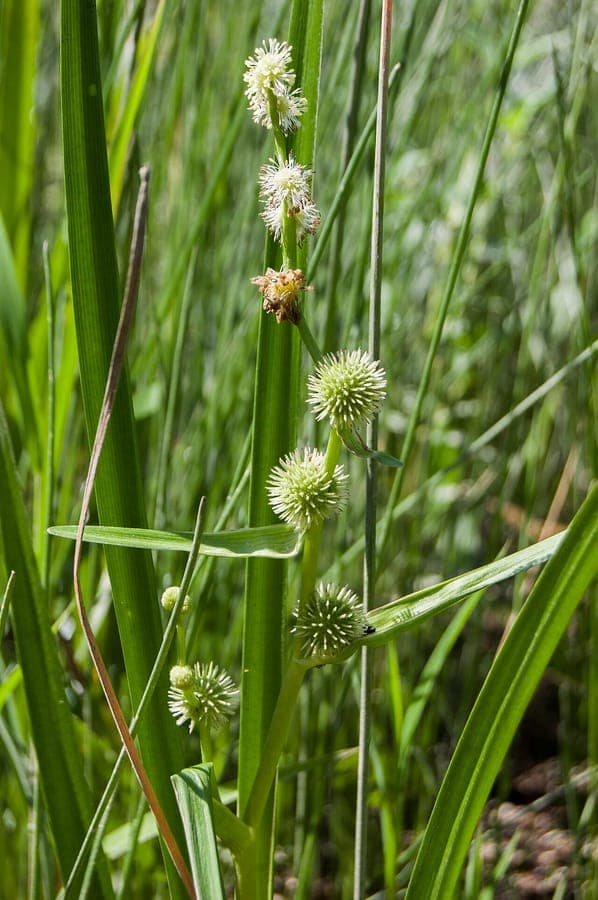
jillllybean / CC BY-SA 2.0, via Wikimedia Commons
American bur-reed: complete guide
Sparganium americanum
Want to see American bur-reed: complete guide in your garden?
1 minute, no credit card
Overview
Sparganium americanum, commonly known as American bur-reed, American burreed or Nuttall's burrweed, is a native aquatic and marginal plant of North America. It belongs to the family Typhaceae - the same family as the bulrushes and cattails (Typha) - and was formally described by the botanist Thomas Nuttall in 1818. Its native range covers central and eastern Canada from Manitoba and Quebec through to Nova Scotia, Newfoundland and Prince Edward Island, and extends across the central and eastern United States from Maine south to Florida and west to Kansas and Texas. Isolated populations have also been recorded in Mexico (Sinaloa and Durango) and Colombia.
In the wild, American bur-reed grows along the margins of streams, rivers, ditches, ponds, lakes and marshes, growing partly submerged and partly emergent above the waterline. It is a true aquatic marginal that thrives in shallow water and the wet margin zone. Its most distinctive features are the spherical, spiny-looking fruit heads that develop after flowering - the 'burs' that give the plant its common name.
For the garden pond owner and water garden designer, Sparganium americanum is a rewarding and ecologically valuable marginal plant. It provides habitat and food for waterfowl and other wildlife, contributes structural interest to the pond margin, and is fully winter-hardy in the climatic conditions of northwest Europe. At gardenworld.app, this species features in water garden and naturalistic pond design palettes, paired with native marginal and aquatic plants.
Appearance and bloom cycle
Sparganium americanum is a perennial herbaceous aquatic plant. Depending on water depth and growing conditions, the emergent leaves and flowering stems reach 30 to 100 cm above the water surface. The leaves are strap-shaped, upright to floating, light green with a prominent midrib. In deeper water the leaves may become more spreading and partially floating rather than strictly upright.
The flowers are green and inconspicuous individually. They are arranged in spherical clusters along the flowering stem in a pattern that clearly separates male and female flower heads: male heads (which produce pollen) are positioned higher up the stem, while female heads (which will develop into fruits) are lower. The plant is thus monoecious - carrying both sexes but in separate flower structures on the same plant. Flowering occurs in early summer, typically from May through July.
After pollination, the female flower heads develop into the characteristic spherical, spiky fruit heads - the burs. These ripen through late summer, from August into October, and mature from green to brownish before breaking apart into individual one-seeded nutlets. These nutlets float and are dispersed by water movement, making the plant an effective coloniser along watercourses.
Ideal location
Sparganium americanum is a genuine aquatic marginal and is happiest with its roots in water or permanently saturated soil. It performs best at pond and stream margins in full sun to light partial shade. Excellent situations include:
- Shallow pond margins with 10 to 30 cm of water depth
- Stream and ditch edges with slow to moderate flow
- Reed beds and marsh plantings
- Wet garden corners that receive intermittent flooding or are permanently waterlogged
- Pond margins alongside cattail (Typha) and yellow flag iris (Iris pseudacorus)
In deeper water, the leaves tend to float rather than stand erect. The plant adapts to variable water depth but performs best in the shallow marginal zone of 5 to 30 cm. Full sun encourages flowering and fruiting; in partial shade the plant grows vigorously but produces fewer flowers and fruit heads.
For the naturalistic garden pond, Sparganium americanum occupies the classic emergent marginal niche - the zone immediately at the water's edge where the character of a natural pond is most clearly expressed.
Soil
American bur-reed is undemanding as to soil type. It grows well in clay, silt and sandy soils, as long as the substrate is permanently moist to wet. The pH tolerance range is 4.9 to 7.3, accommodating mildly acidic to neutral conditions. In practice, the clay-rich substrate of most garden pond baskets or natural pond sediments is entirely suitable.
Supplementary fertilisation is not normally needed: marginal plants extract nutrients directly from the sediment and the water column. Over-fertilising a pond encourages algae growth, which harms the entire pond ecosystem. Aim for a balanced pond with organically rich but not over-enriched substrate.
For planted basket culture: use specialist aquatic compost or heavy clay-loam soil, not ordinary potting compost, which will float and cloud the water. Top the basket with a layer of washed pea gravel or smooth pebbles to keep the soil in place and prevent fish from disturbing it.
Watering
As an aquatic marginal, Sparganium americanum does not require supplemental watering - it grows in or immediately adjacent to water by definition. The key management task is maintaining appropriate water levels in the pond or water feature, particularly during dry summer periods when evaporation is high and top-up may be needed.
In shallow garden ponds and at stream edges, water levels can fluctuate significantly. American bur-reed is well adapted to seasonal variation in water depth. It tolerates short periods of the marginal zone drying out, but extended drought causes leaf scorch and reduced vigour. If the pond level drops noticeably below normal, top up with tap water, rainwater or mains water as appropriate.
In naturalistic rain gardens or low-lying wet garden areas, the plant benefits automatically from rainfall and can complete its growth cycle without any active management during a typical growing season.
Free design
Want to see American bur-reed: complete guide in your garden? Make a free design now.
Pruning
Sparganium americanum requires very little pruning. Once flowering and fruiting are complete in mid to late summer, the flower stems and spent fruit heads can be cut back if a tidier appearance is wanted. However, leaving the dry stems and fruit heads through autumn and into winter has real wildlife value: the structure provides shelter for overwintering invertebrates and the fruit heads supply seeds to waterfowl.
In late winter or early spring (February to March), before new growth begins, cut back the previous season's dead stems to just above the waterline or soil level. This is also the best moment to control the spread of the plant if it is expanding beyond the desired area.
Sparganium americanum can become quite vigorous in favourable conditions, spreading through its underground rhizomes. To control spread, grow it in a pond basket, or cut back the outer rhizome runners each spring. Left unchecked in an open pond margin it will gradually extend its territory, which may or may not be desirable depending on the size and style of the water feature.
Maintenance calendar
January to February: Plant in winter dormancy. Leave dead stems for wildlife. Check pond water level.
March: Remove last season's dead stems. Divide or reduce rhizomes if spread needs controlling. Check pond baskets for integrity.
April: New shoots emerge. Monitor water level. No fertilisation needed.
May to June: Flowering period. Green spherical flower heads appear along the stems, with male and female clusters clearly differentiated.
July: Fruit development. The characteristic spiny bur-like fruit heads become visible.
August to September: Fruit heads ripen from green to brown. Maintain pond water levels. Seeds begin dispersing.
October: Fruit heads break apart. Nutlets disperse via water. Plant foliage begins to die back.
November to December: Plant enters dormancy. Stems can be left for winter wildlife value.
Winter hardiness
Sparganium americanum is extremely winter-hardy - one of the most cold-tolerant aquatic marginals available. Native to cold-temperate Canada and the northeastern United States, it is rated for USDA hardiness zones 3 to 8, tolerating sustained temperatures well below -20 degrees Celsius. In northwest European conditions, including the Netherlands and Belgium (USDA zone 8 and parts of zone 7), it overwinters without any protection whatsoever.
The rhizomes overwinter beneath the water and sediment, safely insulated from air frosts. In garden ponds of 60 cm or more in depth, the overwinter survival of Sparganium americanum is essentially guaranteed, even in the coldest winters experienced in the region. Shallow container water features that freeze solid are a different matter and would threaten most aquatic plants, but in a standard garden pond this is not a concern.
Companion plants
Sparganium americanum works beautifully alongside other marginal and aquatic plants in a naturally planted pond margin:
- Typha latifolia (common cattail/bulrush): the classic tall emergent marginal for natural-looking ponds, with similar growing requirements.
- Iris pseudacorus (yellow flag iris): earlier-flowering, bold yellow blooms that contrast well with the green bur fruits of Sparganium.
- Carex riparia (greater pond sedge): a lower-growing marginal that fills the transitional zone between the taller marginals and dry land.
- Alisma plantago-aquatica (common water plantain): delicate pinkish-white flowers on open branching stems, providing a lighter companion to the structural bur-reed.
- Mentha aquatica (water mint): fragrant, low-growing marginal herb that colonises the wet margin and attracts bees and butterflies.
For a fully ecologically functional pond margin, combining plants at different water depth zones - submerged, emergent, and damp marginal - gives the richest result. Specialist aquatic plant nurseries stock Sparganium americanum alongside these companion species. Visit gardenworld.app for design inspiration and personalised planting plans for your garden pond and water features.
Closing
Sparganium americanum is a robust, ecologically valuable aquatic marginal plant that brings a naturalistic quality to any garden pond. Its distinctive spiky fruit heads, upright foliage and modest green flowers give the pond margin a genuinely wild character. It is fully winter-hardy, low-maintenance, and plays a meaningful role as food and habitat for waterfowl, fish and invertebrates.
For anyone planning a garden pond or water margin that combines visual appeal with genuine ecological value, American bur-reed is an excellent choice. For more ideas on designing ponds and water features that work for your outdoor space, visit gardenworld.app, where personalised garden design plans are created around your own photos and requirements.
Want to see American bur-reed: complete guide in your garden? Make a free design now.
Upload a photo, pick a style, and get a photorealistic design with plant list in under a minute.
10,000+ gardens designed already
No credit card required


Similar plants
Broadfruit bur-reed: complete guide
Sparganium eurycarpum
Everything about broadfruit bur-reed (Sparganium eurycarpum): location, soil, care, and use in ponds and waterside plantings.
Narrow-leaf cattail: complete guide
Typha domingensis
Narrow-leaf cattail is a water plant from tropical and subtropical Africa with characteristic brown flower spikes. Ideal for marsh gardens, shorelines and water gardens. Very hardy.
Laxmann's bulrush: complete guide
Typha laxmannii
Laxmann's bulrush is an elegant wetland plant with compact brown flowerheads arranged in tight clusters. Perfect for pond edges and shallow water up to 1.5 meters deep.