
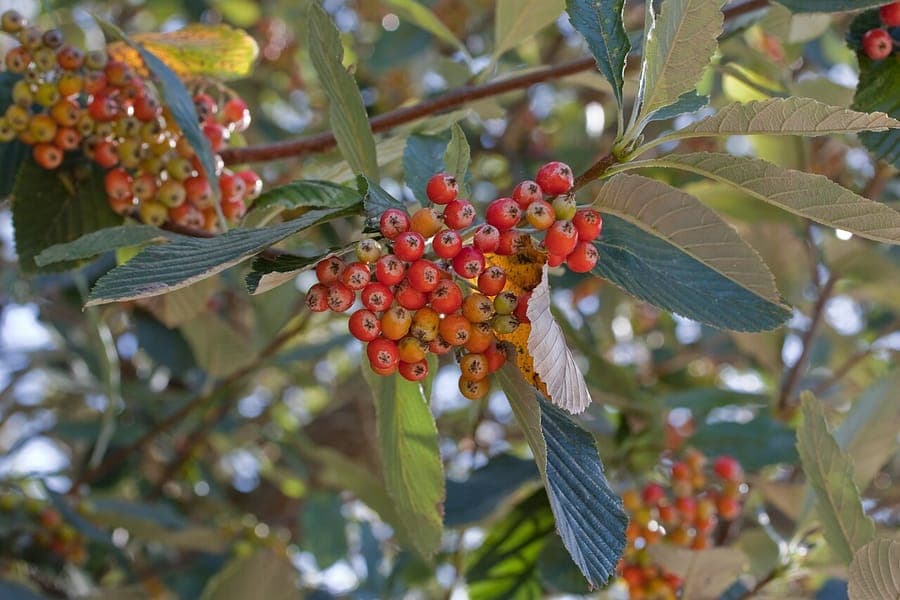
Julie Anne Workman / CC BY-SA 3.0, via Wikimedia Commons
Chess-apple: complete guide
Sorbus aria
Want to see Chess-apple: complete guide in your garden?
1 minute, no credit card
Overview
Sorbus aria, commonly known as Chess-apple, is a stately, medium-sized deciduous tree that brings year-round interest to the garden. Belonging to the Rosaceae family, it typically reaches 8–12 m in height and 6–8 m in spread over 20–30 years. Its slow but steady growth makes it ideal for long-term landscape planning. Native to southern and central Europe, it thrives in USDA hardiness zones 6 to 8, handling winter lows down to -23°C without issue.
This tree is often used as a specimen in lawns, along drives, or as a boundary marker. It's not fussy, fits well in both rural and urban gardens, and adds architectural form without overwhelming smaller spaces. On gardenworld.app, you can simulate how a Chess-apple integrates into your garden layout, including canopy spread and seasonal shade patterns.
Appearance & bloom cycle
The Chess-apple has simple, deeply lobed leaves that are dark green and glossy on top, with a striking silvery-white underside - giving the foliage a shimmering effect in the wind. In late spring, usually May, clusters of small white flowers appear. Each flower has five petals and emits a mild, sweet fragrance that attracts bees, hoverflies, and other pollinators.
By autumn, these flowers develop into small (about 1 cm), round, orange-red berries. While technically edible, they're astringent and rarely eaten by humans. Birds, especially thrushes and blackbirds, love them and often strip the tree by midwinter. The fall foliage turns a modest yellow to brown, but the persistent berries and silvery leaves extend visual appeal into the colder months.
Ideal location
Plant in full sun for best flowering and dense canopy development. Light shade is tolerated, though growth will be slower and flowering reduced. The tree handles exposure well and is suitable for coastal and urban areas thanks to its tolerance of wind and pollution. Allow at least 3–4 m clearance from buildings or paved areas to accommodate root spread.
Avoid planting directly under roof overhangs where rainwater runoff could create overly dry soil. On gardenworld.app, you can overlay your garden's sun map to pinpoint the optimal spot for your Chess-apple, ensuring it thrives for decades.
Soil requirements
Sorbus aria is adaptable to a wide range of soil types - sandy, loamy, or clay - as long as drainage is good. It dislikes waterlogged conditions, which can lead to root rot. The ideal pH is between 5.5 and 7.0 (slightly acidic to neutral).
When planting, avoid amending the soil with compost or fertilizer. Rich soil encourages soft growth that's vulnerable to frost and pests. Backfill with native soil, and mix in a bit of horticultural grit if drainage is poor. Mulch with bark or wood chips after planting to retain moisture and suppress weeds.
Free design
Want to see Chess-apple: complete guide in your garden? Make a free design now.
Watering
Water newly planted trees deeply once a week during the first growing season, providing at least 10 litres per session. After year one, the Chess-apple is highly drought-tolerant and rarely needs supplemental watering, except during prolonged dry spells (over 4 weeks without rain).
Use a slow soak method - like a drip hose - to encourage deep root development. Avoid frequent shallow watering, which promotes weak surface roots.
Pruning
Minimal pruning is required. The natural form is attractive and balanced. Only remove dead, damaged, or crossing branches, ideally in late summer or early autumn after the growing season ends. Avoid winter pruning, as open wounds can invite fungal infections.
If shaping is necessary, do light formative pruning in August or September. Never remove more than 20% of the canopy in a single year. Use clean, sharp tools and make clean cuts just outside the branch collar.
Maintenance calendar
- January: Check for structural damage. No action needed.
- February: Inspect young trunks for frost cracks. Wrap with hessian if needed.
- March: Loosen compacted soil around the base. Add mulch if depleted.
- April: Monitor bud break. No feeding required.
- May: Tree blooms. Keep an eye on pollinator activity. Water young trees if dry.
- June: Check for aphids or mildew. Treat only if severe.
- July: Water established trees only during extended drought.
- August: Light pruning permitted. No fertiliser.
- September: Final health check. Leave fallen leaves as natural mulch.
- October: Berries ripen. Birds begin feeding.
- November: Protect young trunks from rodents with spiral guards.
- December: Winter inspection. No watering.
Winter hardiness
Extremely hardy in USDA zones 6–8. Mature trees handle temperatures down to -23°C with ease. Young trees may suffer bark splitting in severe winters - wrap the trunk with breathable material for the first 2–3 winters. Once established, no winter protection is needed.
Companion plants
Underplant with shade-tolerant, drought-resistant perennials such as Helleborus, Geranium phaeum, or Alchemilla mollis. Ferns like Dryopteris filix-mas work well in damper spots. For full sun at the drip line, try Echinacea purpurea, Salvia nemorosa, or ornamental grasses like Stipa tenuissima.
Avoid heavy root competition from plants like ivy or invasive groundcovers. The Chess-apple needs space for its roots to spread without fighting for resources.
Closing
The Chess-apple is a reliable, low-maintenance tree that offers beauty in every season. With silvery foliage, spring blossoms, and wildlife-friendly berries, it's a smart choice for any garden. Purchase from reputable garden centres such as B&Q, Wyevale, or local nurseries, where staff can advise on rootball size and planting depth. With proper placement and care, your Chess-apple will stand tall for generations.
Want to see Chess-apple: complete guide in your garden? Make a free design now.
Upload a photo, pick a style, and get a photorealistic design with plant list in under a minute.
No credit card required


Similar plants
Siberian crab apple: complete guide
Malus x robusta
Complete guide to the Siberian crab apple (Malus x robusta): location, soil, pruning, winter hardiness and the best companion plants for your garden.
Chinese flowering crabapple (Malus x spectabilis): complete guide
Malus x spectabilis
Meet the Chinese flowering crabapple (Malus x spectabilis): a classic spring bloomer with carmine buds and pink blossom.
Potentilla crassinervia: complete guide
Potentilla crassinervia
Potentilla crassinervia, the Corsican cinquefoil, grows wild on Corsica and Sardinia's peaks. Discover how to grow this hardy alpine rock garden gem.