
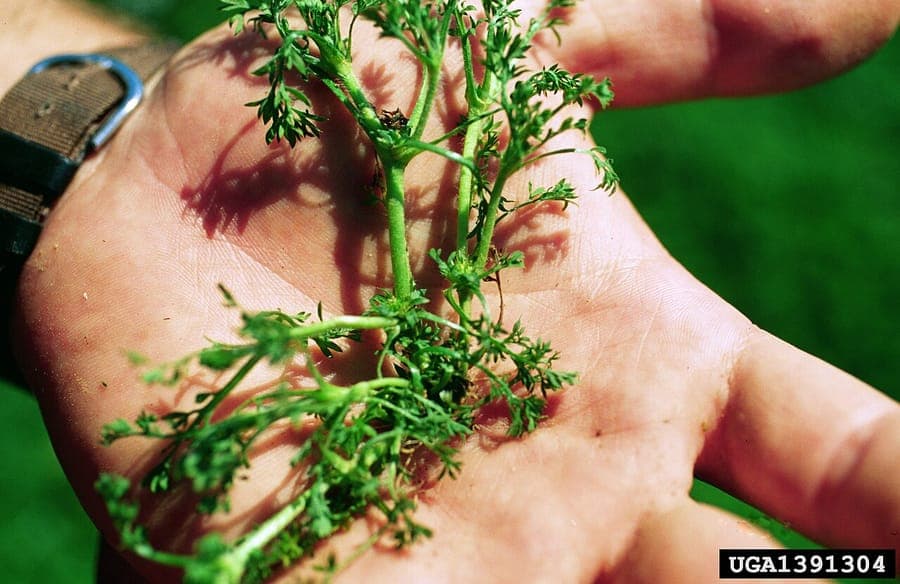
John D. Byrd, Mississippi State University, Bugwood.org / CC BY 3.0 us, via Wikimedia Commons
Field Burweed: complete guide
Soliva sessilis
Want to see Field Burweed: complete guide in your garden?
1 minute, no credit card
Overview
Soliva sessilis, commonly known as Field Burweed or Lawn Burweed, is a small herbaceous plant native to Peru and South America. While not naturally occurring in Europe, it has become well-established in many temperate regions, often appearing in lawns, pavement cracks, and disturbed ground. This tiny plant is remarkable for its distinctive seed structure and its surprising ability to adapt to varied environmental conditions.
Although many consider it a nuisance weed, plant enthusiasts and ecologists recognize it as an interesting organism that has successfully colonized much of the world, demonstrating the power of efficient seed dispersal mechanisms.
Appearance & Bloom
Soliva sessilis grows as a flat rosette, rarely exceeding 10-15 cm in height. The leaves are finely divided, almost feathery in appearance, giving the plant a delicate look despite its toughness. Growth habit is compact and dense, ideal for adapting to dry conditions.
The flowers are small and inconspicuous, yellowish-green in color, and scattered across the plant. What makes this plant truly special are its seed heads. These bear distinctive needle-like or spine-like structures, which explains the common names "burweed" and "prickly soliva." These needle-like appendages aid in dispersal - they readily attach to animal fur and clothing, allowing the plant to travel to new locations.
Flowering occurs over a long period, typically from spring through summer depending on climate.
Ideal Location
Soliva sessilis thrives in sunny to partially shaded spots. This plant is not fussy about location and grows anywhere other plants struggle. Dry lawns, pavements, crevices in stone, and disturbed ground all suit it perfectly.
While it grows well in warm locations, it can also tolerate cold winters. It has become naturalized across much of Europe, including Belgium and the Netherlands.
Soil
The soil can range from poor to moderately fertile. Soliva sessilis is not particular and grows on sand, loam, and stony soils alike. It prefers well-drained soil over waterlogged conditions. Waterlogging is definitely to be avoided - this plant thrives in dry conditions.
A neutral to slightly acidic soil is optimal, though the plant tolerates pH values up to 8. Given its robust nature, soil preparation is essentially unnecessary.
Free design
Want to see Field Burweed: complete guide in your garden? Make a free design now.
Watering
Watering is minimal for Soliva sessilis. This drought-tolerant plant can survive extended dry periods and actually prefers dry conditions. During the growing season, you can water occasionally if conditions are extremely dry, but this is not really necessary.
The plant is ideal for dry gardens or situations where you want minimal input. Water perhaps once every two weeks during growth, if at all.
Pruning
Pruning is not necessary for Soliva sessilis. The plant grows naturally compact and forms an attractive shape on its own. You might remove spent flowers for neatness, but this is entirely optional.
Because the plant remains small and doesn't show invasive growth habits, you can safely let it develop to its natural form.
Maintenance Calendar
- Spring: Check plant survival after winter. Good drainage prevents problems from winter wet.
- Summer: Minimal watering if needed. Remove spent flowers.
- Autumn: No maintenance required. Plant prepares for dormancy.
- Winter: Plant may die back or persist as a seed, depending on climate.
Winter Hardiness
Soliva sessilis tolerates moderate frosts, though it's not truly cold-hardy. In much of northern Europe it survives winter, especially with good drainage and absence of prolonged waterlogging.
In colder regions, the plant may disappear underground over winter, re-appearing the following spring from seeds.
Companion Plants
Soliva sessilis pairs well with other drought-tolerant species:
- Other small Asteraceae species
- Alpine sedums and stonecrops
- Drought-tolerant succulents
- Low meadows or wildflower mixes
Avoid placing it near water-loving or moisture-demanding plants, as their care needs differ significantly.
Final Thoughts
While many dismiss Soliva sessilis as a weed, this robust little plant deserves more recognition. It's perfect for eco-minded gardeners, those seeking drought-tolerant plants, or anyone interested in plants that aid their own dispersal. With minimal maintenance, it grows in places where little else survives, making it a valuable addition to dry, ecological gardens.
Available from:
- Specialty plant retailers (wildflower sections)
- Garden centers (in wildflower seed mixes)
- Gardenworld.app (for inspiration on drought-tolerant gardens)
Want to see Field Burweed: complete guide in your garden? Make a free design now.
Upload a photo, pick a style, and get a photorealistic design with plant list in under a minute.
No credit card required


Similar plants
Calendula stellata: complete guide
Calendula stellata
Complete guide to Calendula stellata, the star-flowered marigold from Sicily: location, soil, watering and companion planting tips.
Korean chrysanthemum: complete guide
Chrysanthemum x rubellum
Chrysanthemum x rubellum is a hardy autumn perennial with single pink to copper flowers from August to November. Care and combinations.
Helianthus divaricatus: complete guide
Helianthus divaricatus
Helianthus divaricatus is a North American woodland sunflower with yellow summer blooms, ideal for naturalistic borders and shady edges.