
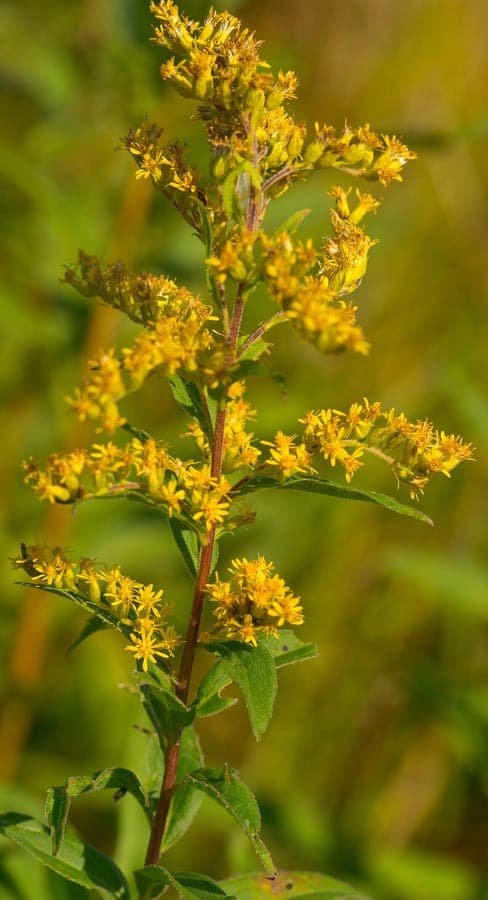
Joshua Mayer from Madison, WI, USA / CC BY-SA 2.0, via Wikimedia Commons
Showy goldenrod: complete guide
Solidago speciosa
Want to see Showy goldenrod: complete guide in your garden?
1 minute, no credit card
Overview
Showy goldenrod (Solidago speciosa) is one of the most rewarding late-season perennials you can grow. While the common goldenrod (Solidago canadensis) has become invasive in many European countries, its cousin Solidago speciosa behaves far more elegantly in the garden: it forms tidy, non-spreading clumps and produces upright plumes of brilliant golden-yellow flowers from August through October. The species name 'speciosa' is Latin for beautiful or showy - a name that is entirely deserved.
Native to the central and eastern United States - from Minnesota and Wisconsin south to Alabama and Georgia - showy goldenrod grows naturally in open prairies, dry meadows, and open woodland edges. This prairie heritage makes it tough, drought-tolerant and well-suited to garden life once established. It is a plant that attracts attention without demanding fuss: sun, good drainage, and minimal feeding are its primary requirements. On gardenworld.app you can explore planting designs that combine goldenrod with other prairie perennials for a naturalistic, low-maintenance border.
Appearance and bloom cycle
Showy goldenrod is a distinctive plant at every stage of the season. In spring, clumps of basal leaves emerge from the ground - dark green, lance-shaped, and smooth to the touch. The stems are noticeably reddish-purple at the base, a detail that adds interest before the flowers appear. By midsummer the stems have reached their full height of 80-120 cm, erect and sturdy enough to stand without staking even in exposed positions.
Flowering begins in August and continues until the first frosts of October. Unlike many goldenrods whose flower heads arch forward, the plumes of Solidago speciosa stand upright, resembling golden torches. The individual flowers are tiny, densely packed on each stem, and visited constantly by bumblebees, honeybees, butterflies and hoverflies. After flowering, the seedheads develop a silvery-plumed appearance that catches the light in the low autumn sun and provides food for seed-eating birds into winter.
Ideal location
Showy goldenrod demands full sun. Six or more hours of direct sunlight per day is essential for compact, self-supporting growth and abundant flowering. In partial shade the stems become lax and floppy, and the flower display is noticeably reduced. Choose an open, sunny border position - south or west-facing aspects are ideal in most northern European gardens.
The plant's prairie background makes it well-suited to spots that become hot and dry in summer, such as gravel gardens, south-facing slopes, or the sheltered corners around paved areas. Avoid low-lying positions where water collects after rain, as prolonged wet conditions around the roots can cause problems. Once established, showy goldenrod is one of the most drought-tolerant perennials available at garden centres, making it excellent for low-water planting schemes.
Soil
Solidago speciosa is extremely unfussy about soil. It thrives in lean, well-drained soils that most other perennials would find unsuitable: poor sandy soils, gravelly banks, thin soils over chalk or limestone. Rich, heavily manured soils actually produce rank, floppy plants with disappointing flowers. If your soil is naturally fertile, it is worth limiting organic matter additions and relying on the plant's natural toughness.
For heavy clay soils, improve drainage by digging in coarse grit or horticultural sand to a depth of 30 cm before planting. A soil pH between 5.5 and 7.0 is optimal, but the plant tolerates slightly alkaline conditions without complaint. Avoid waterlogged ground at all costs - good drainage is far more important than soil fertility for this species.
Watering
In its first growing season, showy goldenrod benefits from regular watering to help it establish a deep root system. During dry spells, water thoroughly once a week, ensuring the moisture penetrates to at least 15-20 cm depth. Deep, infrequent watering is always preferable to light, frequent spraying, as it encourages roots to grow downwards rather than remaining at the surface.
Once established in its second year, the plant is largely self-sufficient. In average summers you may not need to water at all; in prolonged drought, fortnightly watering of mature plants is sufficient. Overwatering in summer, and especially in winter, is far more damaging than underwatering. A 5 cm mulch of bark or gravel around the base helps retain soil moisture in summer while improving drainage in wet winter conditions.
Free design
Want to see Showy goldenrod: complete guide in your garden? Make a free design now.
Pruning
Showy goldenrod requires very little in the way of cutting back. The recommended approach is to leave the stems standing through winter: the seedheads are decorative and provide food for birds, and the hollow stems shelter overwintering insects. Cut the old stems back to just above ground level in early spring, when you can see the fresh basal shoots beginning to emerge - typically in March or early April.
If you want a more compact plant that flowers a little later in the season, try the "Chelsea chop": cut all stems back by one third in late May or early June. This delays flowering by two to three weeks and produces a bushier plant with more, slightly smaller flower spikes. The technique is named after the timing of the Chelsea Flower Show and is widely used by professional gardeners to extend or stagger the flowering season of late perennials.
Maintenance calendar
January - February: plant is fully dormant; leave stems standing for winter interest and wildlife value.
March - April: cut old stems to ground level as new basal growth appears. Apply a thin layer of compost around the base.
May - June: rapid stem elongation. Optional Chelsea chop in late May for a more compact plant.
July - August: stems reach full height; flower buds swell and open from August onwards.
September - October: peak flowering; a magnet for late-season pollinators.
November - December: seedheads develop; leave for birds or cut back if a tidier look is preferred.
Winter hardiness
Showy goldenrod is extremely cold-hardy, rated to USDA zone 3, which corresponds to minimum temperatures of around -37 degrees Celsius. In the UK, northern Europe and the Netherlands, where winters rarely fall below -15 degrees Celsius, this plant is entirely reliable without any protection. Its deeply anchored, fleshy rhizomes insulate it effectively against ground frost.
The only winter risk is excessive moisture: plants in heavy, poorly drained soil may suffer from root rot during a wet winter. Good drainage at planting time is the best preventative measure. For potted plants, move containers to a sheltered spot during the coldest months, or insulate the pot with fleece or bubble wrap to prevent the rootball from freezing solid. Established plants in the ground need no winter treatment whatsoever. Visit gardenworld.app to discover complementary plants that offer winter interest alongside the seedheads of goldenrod.
Companion plants
Showy goldenrod is a natural partner for other late-season prairie plants. The classic combination is with purple or blue asters: Symphyotrichum novae-angliae (New England aster) in purple or pink provides a dramatic colour contrast with the golden spires. Rudbeckia fulgida 'Goldsturm' echoes the yellow but adds a darker central cone. Echinacea purpurea, which finishes flowering as the goldenrod begins, leaves behind attractive seedheads that extend the partnership through the season.
For height and movement, plant Miscanthus sinensis or Panicum virgatum 'Shenandoah' nearby. Low-growing Sedum (Hylotelephium) 'Herbstfreude' makes an excellent foreground plant, and its flat, pink flower heads attract the same bees and butterflies as the goldenrod. In wilder plantings, Agastache foeniculum, Veronicastrum virginicum and Penstemon digitalis all complement the upright habit of Solidago speciosa.
Closing
Showy goldenrod deserves far more prominence in garden planting than it currently receives. It is tough, virtually maintenance-free once established, of exceptional value to pollinators, and spectacularly beautiful in autumn. Whether you are creating a prairie planting, a wildlife garden, or simply looking for a reliable late-season perennial that fills a sunny border with colour, Solidago speciosa delivers. Look for it at specialist perennial nurseries and quality garden centres in late spring or early summer.
Want to see Showy goldenrod: complete guide in your garden? Make a free design now.
Upload a photo, pick a style, and get a photorealistic design with plant list in under a minute.
10,000+ gardens designed already
No credit card required


Similar plants
Canadian goldenrod: complete guide
Solidago canadensis
Canadian goldenrod is a vigorous perennial with golden flowers blooming from August onward. A reliable autumn choice that feeds pollinators.
Purple coneflower: complete guide
Echinacea purpurea
Everything about Purple Coneflower (Echinacea purpurea): planting, care, pruning and combinations. Expert tips for a thriving prairie-style garden.
Orange Coneflower: complete guide
Rudbeckia fulgida
Everything about Rudbeckia fulgida (orange coneflower): planting, care, combinations and bloom time. Practical tips for months of golden-yellow flowers.