
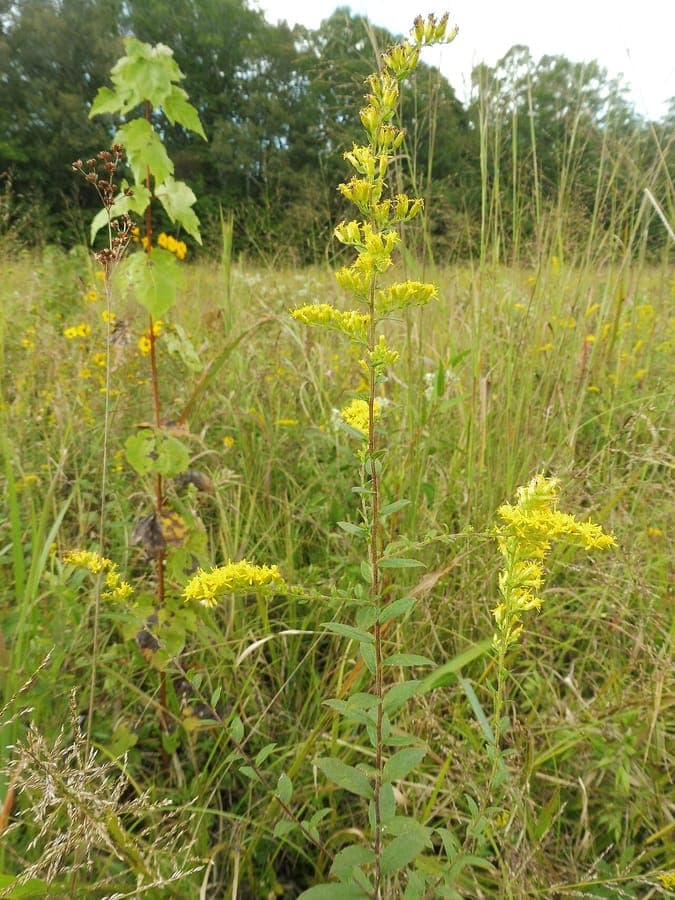
Mason Brock (Masebrock) / Public domain, via Wikimedia Commons
Solidago rugosa: complete guide
Solidago rugosa
Want to see Solidago rugosa: complete guide in your garden?
1 minute, no credit card
Overview
Solidago rugosa, also known as Rough-stem goldenrod, Rough goldenrod, or Wrinkle-leaf goldenrod, is a captivating native wildflower from the Asteraceae family. Hailing from eastern North America from Canada through the Carolinas, this plant is perfectly adapted to temperate climates. With its golden flowers and rapid growth, it is an essential element in wildflower gardens and pollinator-friendly landscapes.
This plant is often incorrectly associated with allergies, but its pollen is too heavy to be wind-dispersed - it's an undeserved reputation. The plant attracts bees, butterflies, and other pollinators and is incredibly valuable for supporting garden biodiversity.
Appearance and Bloom
The leaves of Solidago rugosa are lance-shaped with a rough surface (rugose means wrinkled), distinguishing it from other goldenrod species. They are dark green and can reach 25 centimeters long. The stems are reddish-tinted and sturdy.
The flowers are the true highlight: golden-yellow tiny flowers in dense plumes arranged in a pyramid shape. They appear from August through October, precisely when many other flowers have vanished. The bloom period is extended - sometimes two months or more.
The plant reaches heights of 90 to 150 centimeters, making it perfect for border backgrounds and massed plantings.
Ideal Location
Solidago rugosa is very flexible regarding location. It grows in full sun and partial shade, though it blooms best in complete sun with at least 6 hours of direct sunlight daily. In full shade, it may still grow but will produce significantly fewer flowers.
This is an extremely robust plant that grows almost anywhere - the only thing it cannot tolerate is permanent waterlogging. Plant it in borders, massed plantings, or as specimens. In wildflower gardens, it is a must-have.
The plant is also suitable for cut flower production - harvest stems at peak bloom for long vase life.
Soil
Solidago rugosa is highly adaptable and grows in virtually all soil types, from acidic to neutral to alkaline (pH 5 to 7.5). It thrives in poor soil and requires minimal feeding. This makes it perfect for difficult areas in the garden.
The plant appreciates good drainage - it can succumb to fungal diseases in waterlogged soil. If you have heavy clay soil, add sand when planting. Organic additions help but are not essential. This plant is excellent for areas where you don't want to fertilize other plants.
Free design
Want to see Solidago rugosa: complete guide in your garden? Make a free design now.
Watering
Once Solidago rugosa is established, it is extremely drought-tolerant. Water is only needed during the first month after planting and during very dry summers. In normal summers, no supplemental watering is needed.
Overwatering is harmful and can lead to disease. Let the plant regulate its own moisture balance. This is a special advantage for dry gardens or water-conscious gardeners.
Pruning
Pruning is optional. You can let the plant grow naturally and leave seed heads for birds. If you prefer a neater appearance, cut stems back to about 30 centimeters in March-April, creating a bushier, more compact plant.
Remove spent flower heads if desired, but this is not necessary. The plant will naturally die back in winter, which is completely normal.
Maintenance Calendar
March-April: Optional pruning, check drainage. May: Monitor young plant growth. June-August: Full growth, minimal staking needed for tall cultivars. August-October: Bloom period, enjoy golden plumes. November-February: Plant dies back, leave seed heads for birds.
Winter Hardiness
Solidago rugosa is fully winter hardy in temperate regions. It easily tolerates temperatures to -15 degrees Celsius and survives all winters without protection. The plant is rhizomatous and returns from roots each year.
Above-ground parts die back in winter - completely normal. Prune dead stems in March or leave them as bird food.
Companion Plants
Solidago rugosa combines beautifully with:
- Asters for blue-yellow contrast
- Echinacea for red-orange-yellow harmonies
- Sedum for late-season blooms
- Grasses for structure and texture
- Wildflower mixes for ecological gardens
Closing Thoughts
Rough-stem goldenrod is an essential plant for wildflower gardens. Hardy, easy to grow, and fantastic for pollinators, it asks only for space to flourish. Plant it en masse for real impact. Let GardenWorld.app help you create a wildflower garden that attracts bees and butterflies!
Want to see Solidago rugosa: complete guide in your garden? Make a free design now.
Upload a photo, pick a style, and get a photorealistic design with plant list in under a minute.
No credit card required


Similar plants
Calendula stellata: complete guide
Calendula stellata
Complete guide to Calendula stellata, the star-flowered marigold from Sicily: location, soil, watering and companion planting tips.
Korean chrysanthemum: complete guide
Chrysanthemum x rubellum
Chrysanthemum x rubellum is a hardy autumn perennial with single pink to copper flowers from August to November. Care and combinations.
Helianthus divaricatus: complete guide
Helianthus divaricatus
Helianthus divaricatus is a North American woodland sunflower with yellow summer blooms, ideal for naturalistic borders and shady edges.