
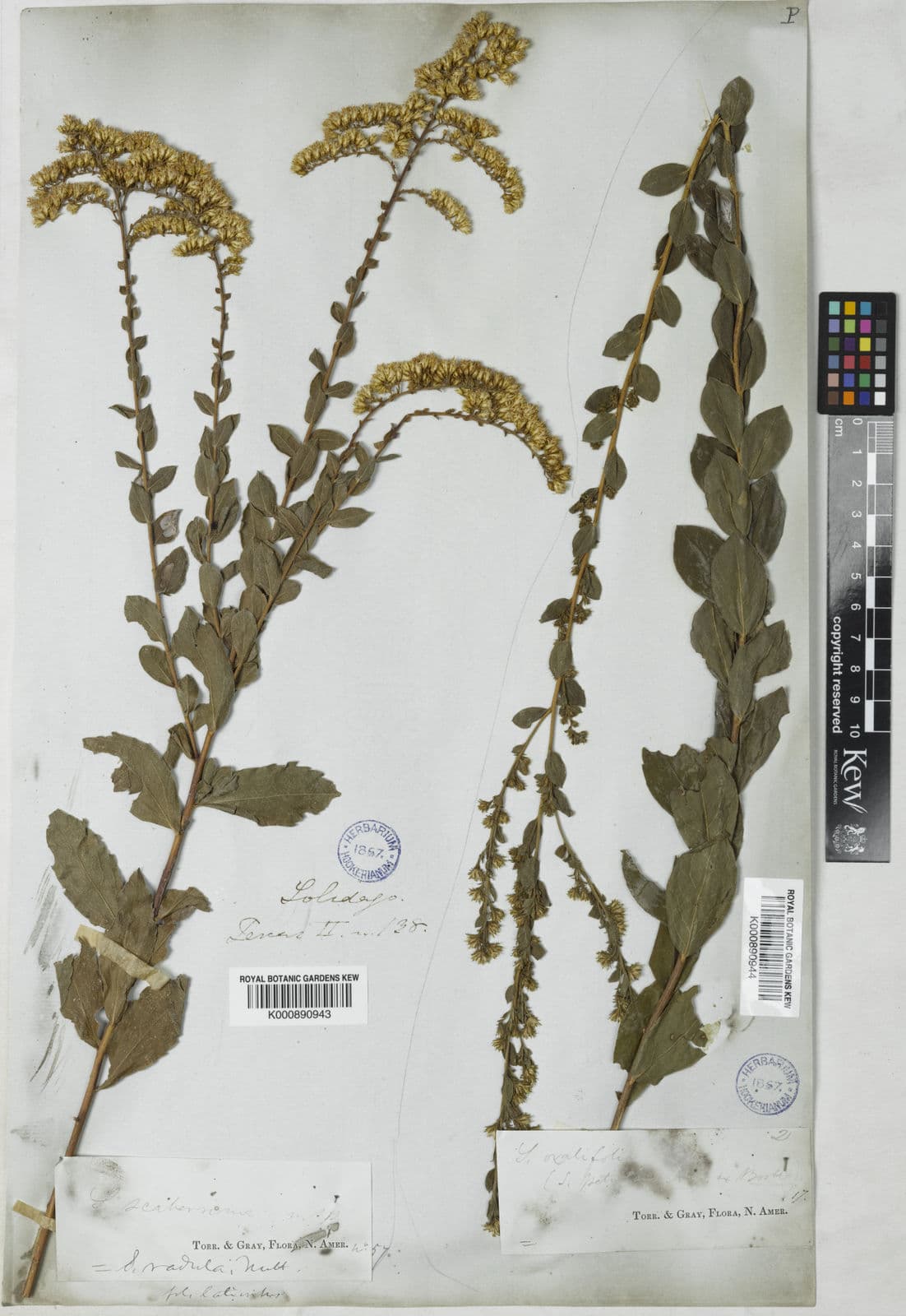
Solidago radula (Rough-stemmed goldenrod): complete guide
Solidago radula
Want to see Solidago radula (Rough-stemmed goldenrod): complete guide in your garden?
1 minute, no credit card
Overview
Rough-stemmed goldenrod, scientifically named Solidago radula, is a fascinating perennial from the Asteraceae family. This American native species owes its name "radula" to its sharp, rough-textured leaves that feel like sandpaper. The plant grows naturally in the central and southeastern United States.
This goldenrod is less known than some relatives, but highly valuable for mainstream garden lovers seeking something unique. With its characteristic rough leaves and elegant blooms, it offers a compelling addition to any front yard.
Appearance & Bloom
Rough-stemmed goldenrod reaches heights of 60 to 100 centimeters and forms a dense, upright plant. The most striking feature is the characteristically rough leaves - upon close examination, they feel rough like sandpaper. This texture immediately distinguishes Solidago radula from smooth-leaved relatives.
Flowers appear in September and October, forming golden-yellow vertical plumes containing hundreds of small blooms. The flowering is equally abundant as in other goldenrods, providing a spectacular autumn display.
Following bloom, characteristic seed heads with feathery aigrettes form, offering bird food deep into winter. This process is also visually attractive for bird enthusiasts.
Ideal Location
Rough-stemmed goldenrod thrives best in full sun. A minimum of six to eight hours of direct sun daily is ideal for optimal blooming. The plant can grow in partial shade but will bloom less abundantly.
This species prefers dry to moderately moist locations. The plant is commonly found in open grasslands and forest edges in its natural range. In gardens, it grows well on raised borders and drier areas.
Rough-stemmed goldenrod is very frost-resistant and grows without issues in temperate climates.
Soil
Rough-stemmed goldenrod grows well on sandy and clayey soils. The plant tolerates poor soils exceptionally well - in fact, excessively fertile soils can lead to excessive vegetative growth.
Good drainage is crucial. Prolonged waterlogged conditions are poorly tolerated, especially in winter. For wet sites, elevation helps. The plant accepts neutral to acidic soils.
Addition of organic matter is beneficial, but fertilizers are unnecessary and can even be detrimental.
Watering
Once the plant is well-established, supplemental water is usually unnecessary. Rough-stemmed goldenrod is drought-tolerant. Regular rainfall is typically sufficient.
During very dry periods, supplemental water can be beneficial. However, avoid stagnant water, which the plant definitely does not appreciate. Ensure well-drained soils.
Minimal water is needed in winter.
Pruning
In early spring, stems can be cut back to 30-40 centimeters height for more compact growth. This also helps prevent stem breakage during strong winds.
After blooming concludes, faded flower clusters can be removed, though some seed heads can remain for bird food. Regular pruning helps keep the plant vigorous.
Damaged or diseased leaves and branches can be removed at any time of year.
Maintenance Calendar
March-April: Prune previous year's growth. Add compost as needed.
May-June: Active growth period. Weed control.
July-August: Bloom preparation. Regular monitoring.
September-October: Peak bloom and bird visitation.
November-February: Dormancy. Leave seed heads for bird food.
Winter Hardiness
Rough-stemmed goldenrod is fully winter-hardy to USDA zone 5 (approximately -25 degrees Celsius). In temperate regions, it behaves as a true winter survivor.
The plant can grow for years without any winter protection. Extremely cold periods may damage above-ground parts, but the root system remains intact.
Free design
Want to see Solidago radula (Rough-stemmed goldenrod): complete guide in your garden? Make a free design now.
Companion Plants
Rough-stemmed goldenrod combines well with these garden plants:
- Asters: For additional autumn color
- Sedum: For low, structural greenery
- Ornamental grasses: For texture and movement
- Rudbeckia: For yellow-orange contrast accents
- Echinacea: For connected seed heads
- Coreopsis: For yellow contrast
These combinations create a versatile autumn landscape.
Propagation
Rough-stemmed goldenrod propagates easily through division of the root clump, best done in March or October. Lift the clump, split it into sections of 10 to 15 centimeters with adequate roots and shoots, and replant at a spacing of 40 to 50 centimeters. For best results, plant new divisions in early spring so they have a full growing season to root in before winter arrives.
Growing from seed is another option: collect the fluffy seed in September or October once seed heads have turned brown. Sow indoors in February at 16 to 18 degrees Celsius or directly outdoors in March and April. Seedlings typically do not bloom until their second growing season. Taking cuttings from young basal shoots in May is also possible, though division remains more reliable and faster for this species.
Pests, Diseases and Cultivars
Solidago radula suffers little from pests and diseases, partly thanks to its rough leaf texture, which deters many leaf-feeding insects. Powdery mildew can appear in August and September if plants are crowded; allow adequate spacing and avoid overhead watering. Rust, recognizable by orange spore spots on the underside of leaves, occurs occasionally but is rarely serious.
Aphids sometimes settle on young shoots in May and June but also attract ladybirds and hoverflies that provide natural control. Unlike some related species, Solidago radula rarely requires chemical treatment, making it an excellent choice for ecological gardens that avoid pesticide use.
Few specific cultivars of this less widely cultivated species exist, but gardeners seeking a more refined goldenrod can consider Solidago 'Golden Baby' or Solidago 'Peter Pan', both compact selections that combine well with the wilder Solidago radula in a mixed border. In the border, combine rough-stemmed goldenrod with low-growing sedum or ornamental grasses to hide the somewhat bare lower stems that appear by late summer, and allow for a mature spread of roughly 60 to 90 centimeters when spacing it against neighboring plants. Look for Solidago radula at quality garden centers, though this species remains less common than other goldenrods, so specialist native plant nurseries are often the better source. This broader mature size also makes the species well suited to loose group plantings in a larger border, rather than being used only as a single specimen plant, and it pairs particularly well with plants that flower earlier in summer, extending seasonal interest throughout the growing season from early summer right into late autumn.
Conclusion
Rough-stemmed goldenrod is an underappreciated plant that can add significant value to gardens with sandy or dry soils. With minimal care, it blooms for years and offers bird food.
Look for Solidago radula at quality garden centers, though this species is less common. Worth the effort to find.
Want more plant advice? Visit gardenworld.app for professional design of your garden. Also see gardenworld.app for more inspiration.
Want to see Solidago radula (Rough-stemmed goldenrod): complete guide in your garden? Make a free design now.
Upload a photo, pick a style, and get a photorealistic design with plant list in under a minute.
10,000+ gardens designed already
No credit card required


Similar plants
Calendula stellata: complete guide
Calendula stellata
Complete guide to Calendula stellata, the star-flowered marigold from Sicily: location, soil, watering and companion planting tips.
Korean chrysanthemum: complete guide
Chrysanthemum x rubellum
Chrysanthemum x rubellum is a hardy autumn perennial with single pink to copper flowers from August to November. Care and combinations.
Helianthus divaricatus: complete guide
Helianthus divaricatus
Helianthus divaricatus is a North American woodland sunflower with yellow summer blooms, ideal for naturalistic borders and shady edges.