
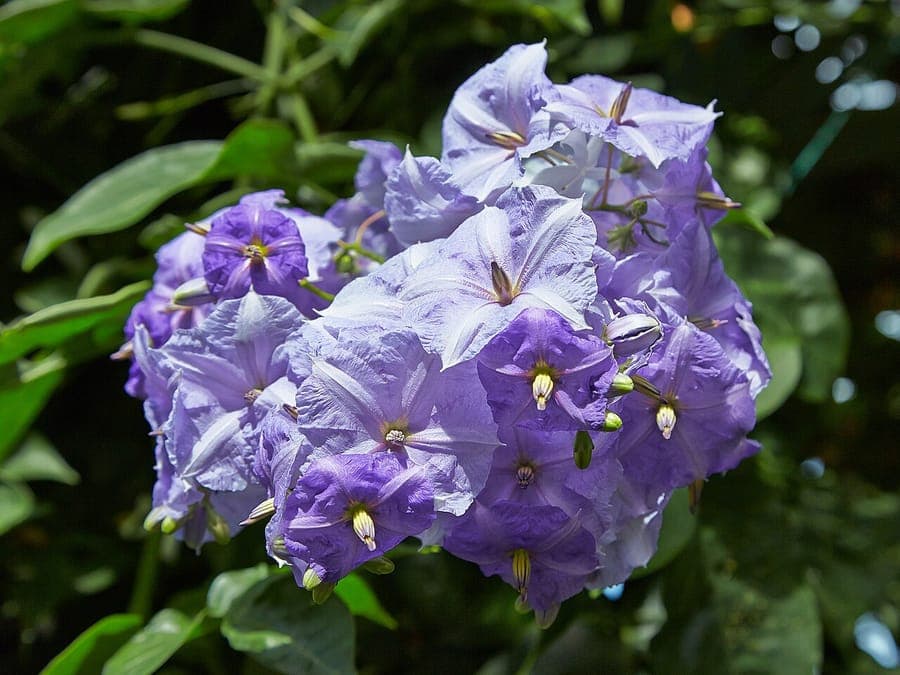
C T Johansson / CC BY 3.0, via Wikimedia Commons
Costa rican nightshade: complete guide
Solanum wendlandii
Want to see Costa rican nightshade: complete guide in your garden?
1 minute, no credit card
Overview
Solanum wendlandii, commonly known as Costa rican nightshade, is a fast-growing climbing vine native to Central America, including regions of Mexico, Costa Rica, and Panama. While it's not a household name in temperate gardens, it's gaining popularity among adventurous UK and European gardeners looking to add a tropical flair to their outdoor spaces. With its vigorous growth and striking blue flowers, it's a standout climber that thrives in containers or trained against pergolas and fences.
This Solanaceae family member isn't just ornamental – it's a conversation starter. But don't let its exotic looks fool you; it's surprisingly manageable once you understand its needs. The key is treating it like a tender perennial: grow it outdoors in summer, bring it in before frost, and give it a cool, bright rest over winter. It's not hardy below USDA zone 10, so in cooler climates like the UK or Northern Europe, it must be overwintered indoors.
On gardenworld.app, you can design a garden layout that integrates Solanum wendlandii with the right support structure and companion planting to maximize its visual impact.
Appearance & bloom cycle
This vine can reach 3–4 meters in a single growing season when given proper care. It produces glossy, dark green leaves about 5–8 cm long, arranged alternately along slender, twining stems. From July to September, it bursts into clusters of star-shaped, deep violet-blue flowers with bright yellow centres. Each flower is about 2–3 cm across, and they appear in large, drooping panicles that attract bees and hoverflies.
The blooming period can extend into October in warm summers, especially if you deadhead spent flowers and keep the plant well-fed. After flowering, small round berries form – initially green, turning glossy purple-black. These berries are toxic if ingested, so keep them away from children and pets.
Despite the toxicity, the plant remains attractive throughout the season, creating a dense, leafy screen perfect for privacy or backdrop planting.
Ideal location
For best results, plant Solanum wendlandii in full sun to light shade. It needs at least 5–6 hours of direct sunlight daily to bloom well. A south- or southeast-facing wall, pergola, or trellis is ideal. In containers, use a pot at least 40 cm in diameter with a sturdy support – bamboo canes, a metal grid, or a wooden obelisk all work well.
Avoid deep shade, which leads to leggy growth and poor flowering. Also, protect it from strong winds, which can damage the tender stems. If you're growing it on a patio or balcony, ensure the container is stable – this vine gains weight quickly as it grows.
Soil requirements
Use a rich, well-draining potting mix. A blend of loam-based compost (like John Innes No. 2), perlite, and a bit of well-rotted manure works well. The ideal pH is slightly acidic to neutral (6.0–7.0). In garden beds, amend the soil with compost before planting to improve fertility and drainage.
If growing in a container, refresh the top 5–10 cm of soil each spring. Poor drainage leads to root rot, especially in wet autumns, so ensure pots have adequate drainage holes.
Free design
Want to see Costa rican nightshade: complete guide in your garden? Make a free design now.
Watering
Keep the soil consistently moist during the growing season (May to September). Water deeply when the top 3–5 cm of soil feels dry. Container plants dry out faster, so check daily in hot weather. Avoid waterlogging – let excess water drain freely.
Reduce watering significantly in autumn as growth slows. During winter dormancy (October to February), water only enough to prevent the rootball from drying out completely. Overwatering in cold conditions is the most common cause of failure.
Pruning
Prune hard in late winter or early spring (February–March) to encourage bushy growth and abundant flowering. Cut all stems back to 30–50 cm above the soil or pot rim. Remove any dead or weak growth. Use clean, sharp secateurs to prevent disease transmission.
You can also pinch back young shoots in summer to promote branching. Don't compost prunings with berries – dispose of them safely due to toxicity.
Maintenance calendar
- Jan: Dormant. Minimal water. Check for pests.
- Feb: Prune hard. Repot if rootbound.
- Mar: Start feeding as new growth appears. Begin acclimatising to outdoor conditions.
- Apr: Move outdoors after frost risk passes. Use slow-release fertiliser.
- May: Water regularly. Watch for aphids or whitefly.
- Jun: Support new growth. Begin liquid feed every 1–2 weeks.
- Jul–Sep: Peak bloom. Continue feeding and watering. Deadhead to prolong flowering.
- Oct: Reduce watering. Bring indoors before first frost.
- Nov–Dec: Overwinter at 5–10°C in a bright spot. Water sparingly.
Winter hardiness
Solanum wendlandii is not frost tolerant. It's hardy only in USDA zones 10–12. In the UK and most of Europe, it must be overwintered indoors. Keep it in a cool, bright location like a greenhouse, sunroom, or conservatory. Temperatures between 5–10°C are ideal. Avoid heating it too much – warmth encourages weak, leggy growth.
If you don't have space, consider treating it as an annual, though this is less sustainable.
Companion plants
Pair it with drought-tolerant, sun-loving perennials like Salvia nemorosa, Echinacea, or ornamental grasses. It also looks great with other climbers such as passionflower or jasmine. Avoid invasive groundcovers that might compete for nutrients.
On gardenworld.app, you can visualise how Solanum wendlandii fits into your garden design with compatible plants and structures, helping you create a balanced, thriving space.
Closing
Solanum wendlandii isn't for the faint-hearted, but it rewards effort with stunning blooms and lush growth. With proper pruning, consistent watering, and winter protection, it can become a garden favourite. Buy healthy young plants in spring from reputable garden centres like those found across the UK, and avoid bargain bins where plants may be stressed. With a little attention and the right setup, this tropical climber can bring exotic drama to your garden year after year.
Want to see Costa rican nightshade: complete guide in your garden? Make a free design now.
Upload a photo, pick a style, and get a photorealistic design with plant list in under a minute.
No credit card required


Similar plants
Solanum dolichosepalum: complete guide
Solanum dolichosepalum
Discover Solanum dolichosepalum, an Andean nightshade with striking long sepals. Growing tips, hardiness, and companion planting for your patio.
Solanum ripense: complete guide
Solanum ripense
Discover Solanum ripense, a moisture-loving Andean nightshade for pond edges and conservatories. Growing tips, hardiness, and companions.
Solanum tomentosum: complete guide
Solanum tomentosum
Discover Solanum tomentosum, a thorny South African nightshade with felted leaves. Growing tips, hardiness, and companion planting ideas.