
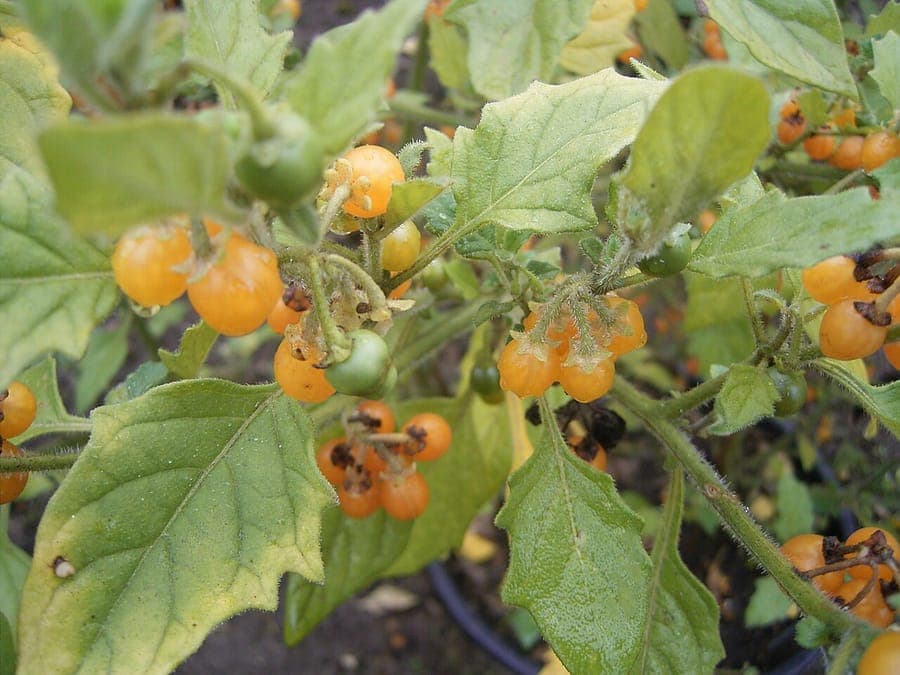
No machine-readable author provided. TeunSpaans assumed (based on copyright claims). / CC BY 2.5, via Wikimedia Commons
Red nightshade: complete guide
Solanum villosum
Want to see Red nightshade: complete guide in your garden?
1 minute, no credit card
Overview
Solanum villosum, commonly known as Red nightshade, is an annual herbaceous plant from the Solanaceae family. Native to parts of Europe, North Africa, and Western Asia, it occasionally pops up in gardens across the UK and North America, often near compost heaps or along garden edges. While it's not a typical bedding plant, its wild charm makes it a good fit for cottage gardens or naturalistic planting schemes. The plant grows 30 to 60 cm tall and spreads 20 to 40 cm wide. All parts, especially the bright orange berries, are toxic-keep them away from children and pets.
On gardenworld.app, you can design a garden layout that safely incorporates Red nightshade, placing it in less accessible areas while still enjoying its seasonal interest. The platform helps balance aesthetics with safety, especially in family-friendly gardens.
Appearance & bloom cycle
Red nightshade has soft, hairy stems and oval to lance-shaped leaves, 3 to 8 cm long, with a slightly toothed margin. Its foliage has a grey-green hue and feels fuzzy to the touch. From June to August, small white flowers with a central yellow cone bloom in clusters of 3 to 6. Each flower is about 1 cm across.
By late summer, the flowers develop into round berries, 6 to 8 mm in diameter. They start green, turn yellow, and ripen to a vibrant orange or red by September. These berries often persist into November, adding late-season colour. However, they are poisonous and should never be consumed.
Ideal location
Red nightshade thrives in partial shade to full sun, ideally receiving 4 to 6 hours of sunlight daily. It performs best in sheltered spots with dappled light-think under shrubs, along garden fences, or near shed walls. In full sun, it needs consistent moisture to avoid stress. In deep shade, flowering and fruiting will be poor.
Use gardenworld.app to map sunlight patterns in your garden and find the perfect spot where Red nightshade gets enough light without drying out.
Soil requirements
This plant prefers fertile, well-drained soil that retains moisture without becoming waterlogged. A pH between 5.5 and 7.0 is ideal. In heavy clay, mix in compost or grit to improve drainage. In sandy soil, add organic matter like composted manure to boost water retention.
It often self-seeds in nutrient-rich spots-like old compost piles or garden borders where kitchen waste has been buried. Avoid planting near aggressive species like bindweed or ground elder that will outcompete it.
Free design
Want to see Red nightshade: complete guide in your garden? Make a free design now.
Watering
During the growing season (May to September), water Red nightshade weekly, or twice a week in hot, dry spells. Early morning watering reduces evaporation and fungal risks. Use rainwater when possible. Never let the soil dry out completely-drought stress causes stunted growth and poor berry production.
If you're using irrigation, a drip system works best to keep foliage dry and prevent disease.
Pruning
Pruning isn't necessary for shape or health, as Red nightshade is an annual. However, if you want to limit self-seeding, deadhead the flowers before berries form. Wear gloves when handling the plant-some people experience skin irritation from contact with the foliage.
At season's end, cut back dead stems to ground level with sterilised shears. Dispose of berry-bearing stems carefully to prevent accidental ingestion by wildlife or pets.
Maintenance calendar
- March–April: Watch for seedlings. Thin or transplant as needed.
- May: Apply a balanced liquid fertiliser once to support early growth.
- June–July: Flowers appear. Maintain consistent soil moisture.
- August–September: Berries ripen. Monitor for slugs on young shoots.
- October–November: Remove dead foliage. Collect or destroy berries to reduce toxicity risks.
Winter hardiness
Red nightshade is not winter-hardy as a mature plant. It dies back after setting seed, usually by late autumn. However, its seeds survive winter in USDA zones 6 to 9, germinating in spring when soil temperatures reach 12°C, typically in April or May.
The plant doesn't require protection, but mulching lightly over potential seed areas can help retain moisture for germination.
Companion plants
Pair Red nightshade with other self-seeding annuals or perennials like calendula, yarrow, or forget-me-nots. These share similar growing conditions and create a relaxed, cottage-garden feel. Avoid planting near edible nightshades like tomatoes or potatoes-while cross-pollination isn't a risk, the visual similarity could cause confusion.
It also works well in wildlife gardens, attracting pollinators during bloom. Birds may eat the berries, though they're mildly toxic-plant with caution in areas frequented by pets.
Closing
Red nightshade isn't a showstopper, but it has subtle appeal in the right setting. Its fuzzy foliage, delicate flowers, and bright berries add texture and seasonal change to informal corners. While its toxicity demands caution, careful placement makes it a safe and interesting addition. Consider it for a wild patch or border edge, and explore gardenworld.app to design a layout that highlights its natural charm without compromising safety.
Want to see Red nightshade: complete guide in your garden? Make a free design now.
Upload a photo, pick a style, and get a photorealistic design with plant list in under a minute.
No credit card required


Similar plants
Solanum dolichosepalum: complete guide
Solanum dolichosepalum
Discover Solanum dolichosepalum, an Andean nightshade with striking long sepals. Growing tips, hardiness, and companion planting for your patio.
Solanum ripense: complete guide
Solanum ripense
Discover Solanum ripense, a moisture-loving Andean nightshade for pond edges and conservatories. Growing tips, hardiness, and companions.
Solanum tomentosum: complete guide
Solanum tomentosum
Discover Solanum tomentosum, a thorny South African nightshade with felted leaves. Growing tips, hardiness, and companion planting ideas.