
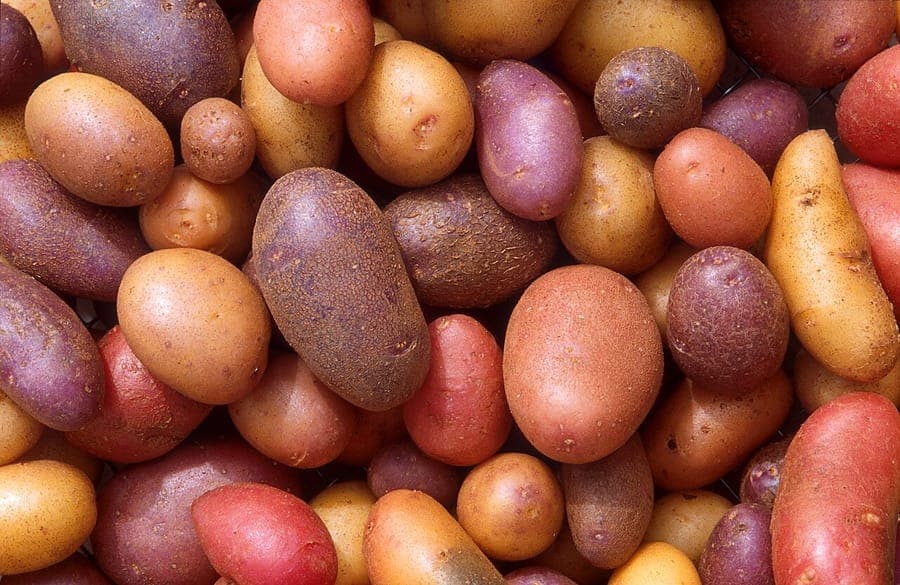
Scott Bauer, USDA ARS / Public domain, via Wikimedia Commons
Potato: complete guide
Solanum tuberosum
Want to see Potato: complete guide in your garden?
1 minute, no credit card
Overview
Solanum tuberosum, better known as the potato, is a staple in gardens across temperate zones. Native to the Andes-from northern Chile through Peru, Bolivia, and into southern Colombia-it's now grown worldwide. As a member of the Solanaceae family, it shares traits with tomatoes and peppers, but its true value lies underground: the edible tubers we all know and love. Potatoes grow as herbaceous forbs or subshrubs, reaching 30–80 cm tall, depending on variety. They're not true roots but modified stolons that swell into tubers under the soil.
Despite their simplicity, potatoes demand thoughtful planning. They respond well to deep soil prep, consistent watering, and smart crop rotation. If you're mapping out your garden layout, gardenworld.app lets you design a custom plan that accounts for potato spacing, sun exposure, and companion planting.
Appearance & bloom cycle
Potato plants feature bushy, upright stems with dark green, pinnate leaves. In midsummer-typically June to August-they may produce small flowers in white, pink, or pale purple. While not essential for tuber development, flowering signals that tuber initiation is underway. Don't rely on blooms as a harvest indicator, though-timing depends on variety and conditions.
Potato types fall into three categories: earlies, second earlies, and maincrops. Early varieties like 'Rocket' are ready in 10–12 weeks and best for fresh eating. Second earlies, such as 'Maris Peer', mature in 13–15 weeks. Maincrop types like 'Desirée' take 16–20 weeks and store well through winter. Tubers vary in shape (oval, round, elongated) and skin color (white, yellow, red, purple).
Ideal location
Potatoes thrive in full sun-rate 8 out of 10 on the light scale. Aim for 6–8 hours of direct sunlight daily. Choose a site with good air circulation and avoid shaded areas, which encourage fungal issues. Space plants 30 cm apart, with 70 cm between rows. Never plant potatoes where tomatoes, peppers, or eggplants grew in the past two years to reduce disease risk.
A well-planned plot prevents overcrowding and optimizes sunlight. Using gardenworld.app, you can simulate sun paths and visualize planting zones to ensure your potato bed gets ideal exposure.
Soil requirements
Ideal soil is loose, deep, and well-draining, with a pH between 5.0 and 6.0. While potatoes tolerate up to pH 7.5, higher alkalinity increases scab risk. Avoid heavy clay-amend with compost and coarse sand to improve texture. Work the soil to 30 cm depth, incorporating 5–8 liters of compost per m².
Never use fresh manure-it promotes leafy growth over tuber development. Practice crop rotation: don't grow potatoes in the same spot more than once every 3–4 years. This reduces soil-borne diseases and nutrient depletion.
Free design
Want to see Potato: complete guide in your garden? Make a free design now.
Watering
Consistent moisture is key, especially during tuber formation (4–8 weeks after planting). Provide 20–25 liters of water per m² weekly, split over 2–3 deep soakings. Avoid overhead watering-it spreads blight. Instead, use drip lines or water at the base.
Stop watering 2–3 weeks before harvest when foliage yellows. Excess moisture late in the season leads to rot and poor storage. In dry summers, monitor soil moisture down to 15 cm-dry patches hinder tuber expansion.
Pruning
Potatoes don't require pruning, but you can pinch back tops if plants exceed 60 cm and risk flopping. This strengthens stems and redirects energy to tubers. Remove diseased or yellowing leaves promptly to limit disease spread. Wear gloves when handling foliage-some people react to solanine in the sap.
Maintenance calendar
- March–April: Chit (pre-sprout) seed potatoes on a bright windowsill.
- May: Plant when soil reaches 8°C. Space 30 cm apart in rows 70 cm apart.
- June–July: Earth up-mound soil around stems to prevent greening of tubers.
- July–August: Monitor for pests and water regularly during dry spells.
- August–September: Harvest earlies 10–12 weeks after planting; maincrops after foliage dies back.
- October: Clear plant debris and prepare for next season's rotation.
Winter hardiness
Potatoes are tender annuals, hardy only in USDA zones 3–10 as seasonal crops. They won't survive frost. In colder zones, plant after the last frost (late April–May) and harvest before the first fall frost (September–October). Store unused seed potatoes at 4–8°C in a dark, ventilated space.
Companion plants
Good companions include beans, corn, cabbage, and marigolds. Beans fix nitrogen, corn provides light shelter, and marigolds deter nematodes and Colorado potato beetles. Avoid planting near cucumbers, pumpkins, or tomatoes-they increase disease pressure.
Interplant with herbs like basil or tansy to repel pests naturally. A diverse planting scheme improves resilience and yield.
Closing
Growing potatoes isn't just about digging holes and waiting. It's about timing, soil health, and observation. Choose certified seed potatoes-never supermarket ones, which may be treated. Buy from trusted garden centres or online suppliers for disease-free stock.
For best results, plan ahead. Use tools like gardenworld.app to map sunlight, organize crop rotation, and track planting dates. Whether you're after fresh salad potatoes or long-keeping baking types, a thoughtful approach pays off in flavour and yield.
Want to see Potato: complete guide in your garden? Make a free design now.
Upload a photo, pick a style, and get a photorealistic design with plant list in under a minute.
No credit card required


Similar plants
Solanum dolichosepalum: complete guide
Solanum dolichosepalum
Discover Solanum dolichosepalum, an Andean nightshade with striking long sepals. Growing tips, hardiness, and companion planting for your patio.
Solanum ripense: complete guide
Solanum ripense
Discover Solanum ripense, a moisture-loving Andean nightshade for pond edges and conservatories. Growing tips, hardiness, and companions.
Solanum tomentosum: complete guide
Solanum tomentosum
Discover Solanum tomentosum, a thorny South African nightshade with felted leaves. Growing tips, hardiness, and companion planting ideas.