
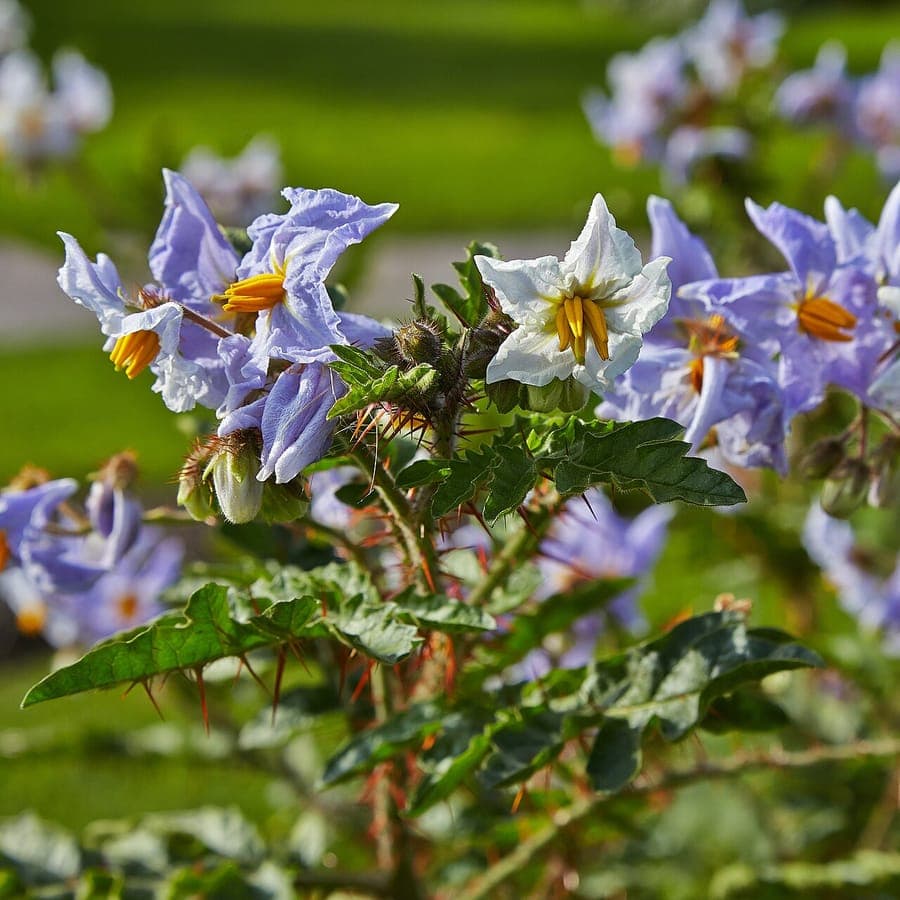
C T Johansson / CC BY 3.0, via Wikimedia Commons
Sticky nightshade: complete guide
Solanum sisymbriifolium
Want to see Sticky nightshade: complete guide in your garden?
1 minute, no credit card
Overview
Sticky nightshade (Solanum sisymbriifolium) is an upright, herbaceous annual that hails from South America-specifically Argentina, Bolivia, Chile, and parts of Brazil. It's a member of the Solanaceae family, making it a relative of tomatoes, eggplants, and potatoes. In the UK and northern Europe, it behaves as a half-hardy annual, reaching heights between 60 and 100 cm. The plant earns its name from the sticky, glandular hairs that cover its stems and leaves, often trapping small insects. While not carnivorous, this feature helps protect it from pests and gives it a distinctive texture.
On gardenworld.app, you can plan a seasonal garden layout that incorporates sticky nightshade as both a decorative accent and a functional trap crop.
Appearance & bloom cycle
This plant has deeply lobed, fern-like foliage that resembles wild rocket-hence the species name sisymbriifolium. The leaves and stems are armed with small prickles and coated in a sticky resin. From June through October, it produces attractive, star-shaped white flowers with bright yellow stamens in the center. These flowers are highly attractive to pollinators like bees and hoverflies.
Following pollination, round, cherry-sized orange berries (1–1.5 cm in diameter) develop and persist well into autumn. These berries are showy and add vibrant color to borders, but they are toxic to humans and pets, so keep them away from children and curious animals. The plant's entire life cycle, from germination to fruiting, lasts one growing season.
Ideal location
Sticky nightshade thrives in full sun-aim for at least 6 hours of direct sunlight per day. A south- or west-facing border works best. It tolerates light shade but will produce fewer flowers and become leggy. It's excellent in cottage gardens, wildlife borders, or as a temporary filler in vegetable plots.
It also grows well in containers with a minimum diameter of 30 cm, provided there's adequate drainage. Avoid overcrowding; space plants 30–40 cm apart to allow good air circulation.
Soil requirements
This plant isn't fussy about soil type but prefers well-drained, moderately fertile ground. It tolerates sandy or loamy soils but struggles in heavy, waterlogged clay. Amend clay soils with grit or compost to improve drainage.
The ideal pH range is between 5.5 and 7.5. Avoid high-nutrient soils or excessive fertiliser-rich conditions promote lush foliage at the expense of flowers and fruit. It performs best in average to poor soils, which enhance its natural pest resistance.
Free design
Want to see Sticky nightshade: complete guide in your garden? Make a free design now.
Watering
Once established, sticky nightshade is drought-tolerant. Water young plants regularly during the first few weeks after sowing or transplanting. After that, it only needs supplemental watering during prolonged dry spells, especially in containers.
Water deeply but infrequently-around 2–3 times per week during hot periods. Always water at the base to avoid wetting the foliage, which can encourage fungal issues due to the plant's sticky coating.
Pruning
Pruning isn't essential, but deadheading spent flowers can encourage prolonged blooming. If you want to prevent self-seeding, cut off the developing berries before they ripen. Otherwise, allow some to drop naturally to replenish next year's crop.
Wear gloves when handling the plant-its prickles and sticky hairs can irritate skin. Wash hands thoroughly after contact.
Maintenance calendar
- March–April: Sow seeds indoors at 18–22°C. Use a well-drained seed mix.
- May: Harden off seedlings. Plant out after the last frost (late May in most UK zones).
- June–July: Flowers appear. Monitor for aphids, though the plant rarely suffers serious infestations.
- August–September: Berries form. Decide whether to leave them for self-seeding or remove them.
- October–November: Plants die back. Cut down or compost after frost.
Using gardenworld.app, you can set up custom alerts for each stage of care, tailored to your local weather and soil conditions.
Winter hardiness
Sticky nightshade is not frost-hardy and won't survive temperatures below -2°C. In USDA zones 8–10, it may behave as a short-lived perennial, but in cooler climates (zones 6–7), it's strictly an annual. However, it self-seeds readily, and seeds survive winter cold, germinating when soil temperatures exceed 15°C in spring.
No winter protection is needed. Simply let nature take its course or collect seeds for next year.
Companion plants
Pair sticky nightshade with sun-loving, drought-tolerant perennials like lavender, yarrow, or sedum. Its spiky texture contrasts beautifully with soft mounds of nepeta or alchemilla.
It's also a brilliant companion in vegetable gardens. As a trap crop for potato cyst nematodes (Globodera spp.), plant it around your potato beds in spring. The nematodes are attracted to its roots but cannot complete their life cycle, effectively reducing soil infestation. Remove and destroy the plants before berries form to prevent seed spread.
Closing
Sticky nightshade is a dual-purpose plant: ornamental and functional. It brings long-lasting color, supports pollinators, and helps manage soil pests naturally. Just be mindful of its toxicity and spiky nature when placing it in family-friendly gardens.
Seeds and young plants are available at garden centres across the UK. For reliable stock, check with local suppliers or order online. With minimal effort, this bold plant will return year after year-thanks to its enthusiastic self-seeding habit.
Want to see Sticky nightshade: complete guide in your garden? Make a free design now.
Upload a photo, pick a style, and get a photorealistic design with plant list in under a minute.
10,000+ gardens designed already
No credit card required


Similar plants
Solanum dolichosepalum: complete guide
Solanum dolichosepalum
Discover Solanum dolichosepalum, an Andean nightshade with striking long sepals. Growing tips, hardiness, and companion planting for your patio.
Solanum ripense: complete guide
Solanum ripense
Discover Solanum ripense, a moisture-loving Andean nightshade for pond edges and conservatories. Growing tips, hardiness, and companions.
Solanum tomentosum: complete guide
Solanum tomentosum
Discover Solanum tomentosum, a thorny South African nightshade with felted leaves. Growing tips, hardiness, and companion planting ideas.