
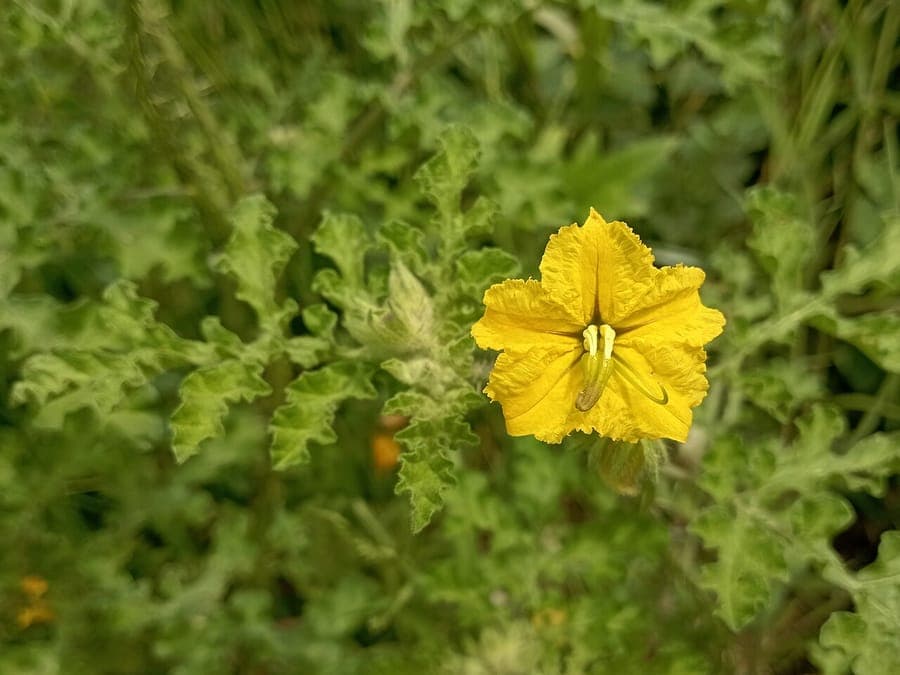
Juan Carlos Fonseca Mata / CC BY-SA 4.0, via Wikimedia Commons
Beaked-sandbur: complete guide
Solanum rostratum
Want to see Beaked-sandbur: complete guide in your garden?
1 minute, no credit card
Overview
Solanum rostratum, commonly known as beaked-sandbur, is a rugged annual or short-lived perennial from the nightshade family (Solanaceae). Native to arid regions of the southern and central United States – including Arizona, Kansas, and Georgia – it thrives in harsh, sun-baked conditions. While not a common sight in UK or European gardens, it's gaining attention among gardeners who value drought resilience and bold texture. On gardenworld.app you can design a garden layout that highlights this plant's architectural form, especially in xeriscaping or gravel gardens.
This plant is covered in fine, irritating hairs and armed with sharp prickles along the stems and leaves, making it a natural deterrent to deer and rabbits. All parts, especially the small green berries, are toxic. Keep it away from pets and small children. Despite its tough appearance, it's surprisingly easy to grow if you match it with the right conditions.
Appearance & bloom cycle
Beaked-sandbur grows 30–60 cm tall with a spread of about 40 cm. Its deeply lobed, grey-green leaves are densely hairy, giving them a silvery appearance and helping reduce water loss. From June to September, bright yellow star-shaped flowers, 2–3 cm across, bloom in clusters. Each flower has a distinctive dark yellow or purplish centre, adding contrast.
After pollination, the flowers develop into elongated, pointed green berries – the 'beak' that gives the plant its common name. These harden and turn brown by autumn, often persisting into winter and providing visual interest when other plants have died back. The overall effect is wild and architectural, perfect for naturalistic planting schemes.
Ideal location
Full sun is non-negotiable. Beaked-sandbur needs at least 6–8 hours of direct sunlight daily to flower well and stay compact. It performs best in hot, dry spots – think gravel paths, sunny borders, or south-facing slopes. Avoid shaded or damp areas, where it becomes leggy and prone to fungal diseases like powdery mildew.
If you're growing it in a cooler climate, plant it against a warm wall or near paving that absorbs and radiates heat. On gardenworld.app you can use the sun exposure tool to find the hottest, driest zones in your garden, ideal for this sun-worshipper.
Soil requirements
The soil must be well-drained and preferably sandy or gravelly. It tolerates poor, infertile soils but struggles in heavy clay or water-retentive loam. Ideal pH range is 6.0 to 7.5. If your soil is heavy, amend the planting hole with sharp sand or grit to improve drainage. Do not enrich the soil with compost or manure – this plant evolved in nutrient-scarce conditions and excess fertility can lead to weak, floppy growth.
Free design
Want to see Beaked-sandbur: complete guide in your garden? Make a free design now.
Watering
Once established, beaked-sandbur is highly drought-tolerant. Water only during prolonged dry spells in the first growing season. Young plants in May and June may need a deep soak once a week if no rain falls. After that, let nature take over. Overwatering is a common mistake – wet roots in cool soil can quickly lead to rot.
Pruning
Pruning isn't necessary. The plant has a naturally bushy, open habit. Only remove dead or damaged stems in early spring, wearing gloves and long sleeves to avoid skin irritation from the prickles and hairs. Don't cut it back hard – it reseeds readily and new growth emerges from the base or soil seed bank.
Maintenance calendar
- January: Dormant. No action needed.
- February: Check for old stems; remove if they block new growth.
- March: Loosen soil gently; prepare for spring.
- April: Sow seeds directly when soil warms above 15°C.
- May: Watch for seedlings; protect from late frosts.
- June: Flowers appear; check for aphids.
- July–August: Peak bloom; water only in extreme drought.
- September: Berries form; reduce watering.
- October: Leave plants standing for winter texture.
- November–December: Plants die back; seeds drop into soil.
Winter hardiness
Beaked-sandbur is not reliably perennial in cooler zones. In USDA zones 5–9 it may survive mild winters as a biennial, but in most gardens it behaves as an annual. The seeds overwinter in the soil and germinate the following spring. In the UK (equivalent to zone 8b), mature plants rarely survive frost, but self-seeding can create a naturalised patch over time.
Companion plants
Pair with other drought-tolerant perennials like Echinacea, Rudbeckia, Salvia officinalis, or ornamental grasses such as Stipa tenuissima. These share similar needs for sun and dry soil. Avoid moisture-loving plants like Astilbe or ferns. The contrast between soft grasses and the spiky form of Solanum rostratum creates dynamic visual interest.
Closing
Beaked-sandbur isn't for every garden, but if you're designing a low-water, high-impact space, it's a standout choice. It asks for little and gives bold texture, long bloom time, and wildlife deterrence. Just respect its thorns and toxins. Find seeds or young plants at garden centres like those carrying specialist drought-tolerant stock. With the right spot and care, Solanum rostratum becomes a resilient, eye-catching feature in your garden.
Want to see Beaked-sandbur: complete guide in your garden? Make a free design now.
Upload a photo, pick a style, and get a photorealistic design with plant list in under a minute.
No credit card required


Similar plants
Solanum dolichosepalum: complete guide
Solanum dolichosepalum
Discover Solanum dolichosepalum, an Andean nightshade with striking long sepals. Growing tips, hardiness, and companion planting for your patio.
Solanum ripense: complete guide
Solanum ripense
Discover Solanum ripense, a moisture-loving Andean nightshade for pond edges and conservatories. Growing tips, hardiness, and companions.
Solanum tomentosum: complete guide
Solanum tomentosum
Discover Solanum tomentosum, a thorny South African nightshade with felted leaves. Growing tips, hardiness, and companion planting ideas.