
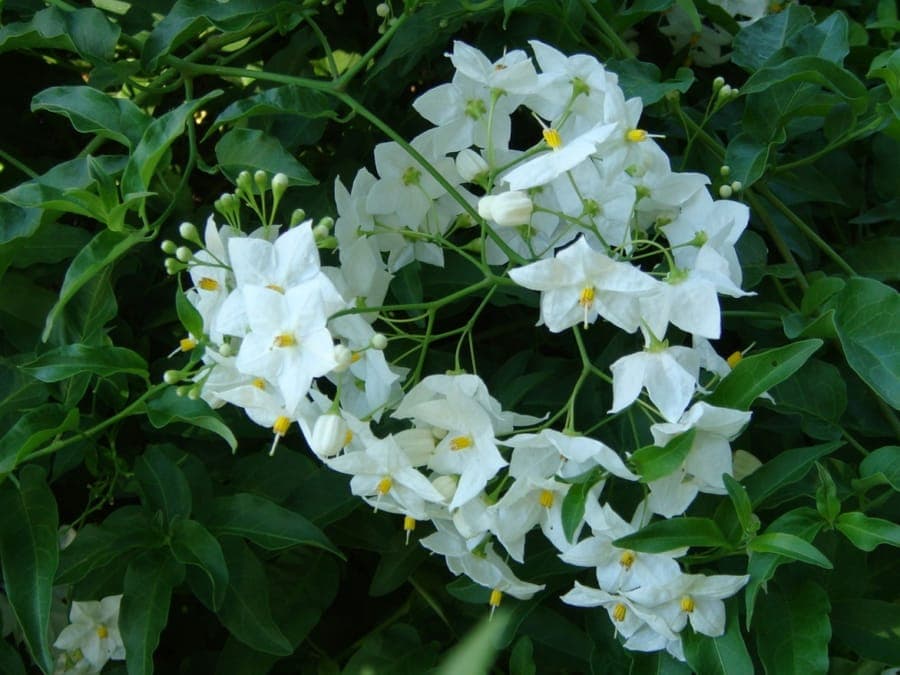
RoyFocker / Public domain, via Wikimedia Commons
Potato-vine: complete guide
Solanum laxum
Want to see Potato-vine: complete guide in your garden?
1 minute, no credit card
Overview
Solanum laxum, commonly known as potato-vine, is a surprisingly elegant climber from the nightshade family (Solanaceae). While its relatives like tomatoes and potatoes are grown for edible produce, this species shines through ornamental charm-showy clusters of jasmine-like blooms and a graceful, twining habit. Native to South America-specifically northeastern Argentina, southern and southeastern Brazil, Paraguay, and Uruguay-this vine thrives in temperate gardens when given proper support and care.
It's a smart pick for gardeners who want a fast-growing, manageable climber without the invasiveness of ivy or wisteria. On gardenworld.app, you can design a garden layout that perfectly frames the potato-vine's growth pattern and bloom season.
Appearance & bloom cycle
Solanum laxum produces small, star-shaped white flowers from June through October, resembling true jasmine in both form and scent. Each bloom is 2–3 cm wide, with five crisp petals and a dark central eye that adds depth. The fragrance is subtle but noticeable on warm summer evenings, making it ideal for patios or near doorways.
Its leaves are glossy, ovate, and 4–8 cm long, arranged densely along slender twining stems. After flowering, small orange berries may form-these are toxic if ingested, so keep them away from pets and children. The vine climbs 3–4 meters when supported, using its flexible stems to wrap around structures. Without support, it can sprawl as a loose groundcover.
Ideal location
Plant in full sun to partial shade. For best flowering, aim for 5–6 hours of direct sunlight daily. A south- or west-facing trellis, pergola, or fence works well. In hot inland areas, afternoon shade in July and August helps prevent leaf scorch.
This plant benefits from wind protection. Avoid exposed, windy corners unless you provide a sturdy support like a wooden lattice or wire mesh. On gardenworld.app, you can simulate different trellis styles and placement options to see how the vine integrates with other garden elements.
Soil requirements
Potato-vine isn't fussy about soil but performs best in well-drained, humus-rich ground with a pH of 5.5–7.0. Avoid heavy clay soils that stay soggy, as these promote root rot. If planting in clay, amend with grit or composted bark to improve drainage.
In containers, use a mix of quality potting soil and perlite or coarse sand. Always ensure pots have drainage holes. Refresh the top layer of soil every spring to replenish nutrients.
Free design
Want to see Potato-vine: complete guide in your garden? Make a free design now.
Watering
Water young plants frequently during the first growing season-about 10–15 liters per week during dry spells. Established vines are drought-tolerant but bloom more heavily with consistent moisture. Deep weekly watering encourages strong root development. Avoid shallow sprinkling, which leads to weak root systems.
Check soil moisture by inserting your finger 2–3 cm deep. If it feels dry, it's time to water. Reduce frequency in autumn and winter when growth slows.
Pruning
Prune in late winter or early spring before new growth starts. Since Solanum laxum flowers on new wood, avoid heavy pruning in autumn, which would remove next season's blooms. Remove dead, damaged, or tangled stems, and cut back overly long shoots to maintain shape.
Use clean, sharp secateurs and make cuts just above an outward-facing bud to encourage an open, airy structure. Limit height to 3.5 meters if needed for space.
Maintenance calendar
- Jan: Inspect for winter damage, tidy up loose stems
- Feb: Prepare tools, check support structure
- Mar: Prune, apply balanced slow-release fertilizer
- Apr: Monitor new growth, begin regular watering
- May: Watch for slugs, increase water as temps rise
- Jun: Flowers appear, maintain consistent moisture
- Jul: Peak bloom, deep water during dry weeks
- Aug: Continue care, apply autumn feed if needed
- Sep: Stop pruning, allow berries to develop
- Oct: Reduce watering, collect fallen leaves
- Nov: Mulch root zone with compost or straw
- Dec: Dormant period, minimal intervention
Winter hardiness
Solanum laxum is borderline hardy in the UK and northern Europe, surviving USDA zones 8b–10. In zone 8b (−9°C), it may die back to the ground in harsh winters but often regrows from the base in spring. In colder zones, grow in a container and move to a cool, bright greenhouse or shed (2–8°C) over winter. Reduce watering to once every two weeks.
For in-ground plants in cooler regions, apply a thick mulch over the root area to insulate against freeze-thaw cycles.
Companion plants
Pair with light climbers like Clematis 'Pixie' or early-flowering honeysuckle. At the base, use drought-tolerant perennials like Nepeta or Salvia to contrast texture. Avoid aggressive growers like ivy or bindweed that could smother it. It also looks elegant trained over low stone walls with trailing thyme at its feet.
Closing
Solanum laxum is an underrated gem for cottage gardens, urban courtyards, or trellised balconies. Its airy bloom clusters and glossy foliage bring charm without high maintenance. Buy from trusted garden centres or online suppliers-look for healthy, green-stemmed plants in spring. Remember: while it looks harmless, the berries are poisonous. With the right spot and care, this vine will become a summer highlight. Use gardenworld.app to visualize spacing, companion plants, and seasonal changes before planting.
Want to see Potato-vine: complete guide in your garden? Make a free design now.
Upload a photo, pick a style, and get a photorealistic design with plant list in under a minute.
No credit card required


Similar plants
Solanum dolichosepalum: complete guide
Solanum dolichosepalum
Discover Solanum dolichosepalum, an Andean nightshade with striking long sepals. Growing tips, hardiness, and companion planting for your patio.
Solanum ripense: complete guide
Solanum ripense
Discover Solanum ripense, a moisture-loving Andean nightshade for pond edges and conservatories. Growing tips, hardiness, and companions.
Solanum tomentosum: complete guide
Solanum tomentosum
Discover Solanum tomentosum, a thorny South African nightshade with felted leaves. Growing tips, hardiness, and companion planting ideas.