
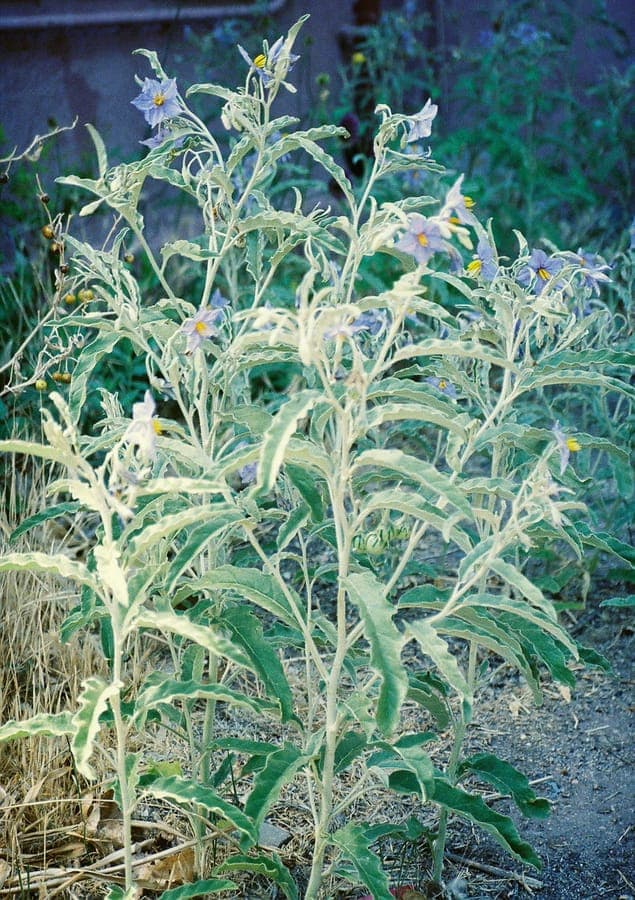
No machine-readable author provided. JerryFriedman assumed (based on copyright claims). / CC BY 2.5, via Wikimedia Commons
Prairie-berry: complete guide
Solanum elaeagnifolium
Want to see Prairie-berry: complete guide in your garden?
1 minute, no credit card
Overview
Solanum elaeagnifolium, commonly known as prairie-berry, is a resilient perennial from the nightshade family. Native to arid regions of the southern US and South America - including Arizona, Arkansas, and Argentina - it thrives in hot, dry conditions where many garden plants struggle. While often dismissed as a weed, its ornamental value lies in its striking silvery foliage and bright yellow blooms. It's not widely stocked in standard garden centres, but niche growers and online suppliers are starting to offer it for xeriscaping and low-water gardens. On gardenworld.app, you can design a layout that incorporates prairie-berry into dry garden zones where soil drainage and sun exposure match its needs.
Appearance & bloom cycle
Prairie-berry grows 30 to 60 cm tall with a spread of up to 40 cm. Its lance-shaped leaves are densely covered in fine, silvery hairs, giving the plant a soft, shimmering texture. From June through September, it produces star-shaped yellow flowers, 2 to 3 cm across, with prominent yellow stamens. These develop into small, round berries that start green and ripen to a glossy blue-black. All plant parts, especially the berries, are toxic to humans and pets. The plant spreads via rhizomes and can self-seed aggressively in warm climates (USDA zones 8–10).
Ideal location
Full sun is non-negotiable for prairie-berry. It needs at least 7–8 hours of direct sunlight daily to bloom well and maintain compact growth. It performs best in open, airy spots with good air circulation - think rock gardens, gravel beds, or dry borders. Avoid shaded areas or locations with heavy competition from tree roots. In cooler climates, plant it against a south-facing wall to benefit from radiant heat. If you're uncertain about microclimates in your yard, gardenworld.app offers tools to map sun patterns and identify suitable planting spots.
Soil requirements
Well-drained soil is critical. Prairie-berry tolerates sandy, gravelly, or even poor-quality soils but fails in heavy clay or water-retentive mixes. Ideal pH ranges from 6.0 to 7.5. If your soil is dense, amend it with coarse sand, perlite, or small stones to improve drainage. Raised beds or containers with drainage holes work well. A gravel mulch helps reduce moisture at the base and suppresses weeds without smothering the crown.
Free design
Want to see Prairie-berry: complete guide in your garden? Make a free design now.
Watering
Once established, this plant is extremely drought tolerant. Water only during the first growing season to help roots establish - about once a week in dry spells. After that, it survives on rainfall alone in most regions. Overwatering is the fastest route to root rot. In the UK or Pacific Northwest, where summers are mild and wet, it may need protection from excess moisture. Water at the base using a soaker hose, and avoid wetting the foliage to prevent fungal issues.
Pruning
Pruning isn't needed for health, but you can trim back leggy growth in early spring before new shoots emerge. Remove any dead or damaged stems and spent flower stalks to keep the plant tidy. If self-seeding becomes a problem, cut off berries before they mature. Always wear gloves - the stems are covered in tiny prickles that can irritate skin.
Maintenance calendar
- Jan: Monitor for seedlings; remove if invasive
- Feb: No action needed
- Mar: Assess winter damage; prune dead stems
- Apr: Check for new growth; control weeds
- May: Prepare for bloom; reduce mulch if too damp
- Jun: Bloom begins; avoid heavy pruning
- Jul: Peak flowering; inspect for pests
- Aug: Berries developing; watch for over-spreading
- Sep: Final blooms; remove ripe berries if needed
- Oct: Growth slows; clear fallen debris
- Nov: Dormancy begins; protect rhizomes in cold zones
- Dec: Dormant; no care required
Winter hardiness
Hardy in USDA zones 7 to 10. In zone 7, the top growth may die back in harsh winters, but the plant often re-sprouts from the roots in spring. In colder zones, it's best grown in containers and overwintered in a frost-free shed. In milder areas, a light mulch of straw or dry leaves in November helps insulate the crown. Avoid wet mulches like bark, which retain too much moisture.
Companion plants
Pair prairie-berry with drought-tolerant companions like Russian sage (Perovskia atriplicifolia), yarrow (Achillea spp.), or blanket flower (Gaillardia aristata). These share similar water and sun needs and create a layered, naturalistic look. Avoid moisture-loving plants like ferns or astilbes. The silvery foliage contrasts beautifully with purple coneflowers or red-flowering sedums.
Closing
Solanum elaeagnifolium isn't for every garden, but if you've got a hot, dry spot that's hard to plant, it's worth considering. It's tough, low-maintenance, and brings texture and seasonal interest. Just remember: keep it away from children and pets due to toxicity. It's not commonly found in mainstream garden centres, but you might spot it at specialist nurseries or online. In the UK, try searching at independent growers or plant fairs. When planning your layout, use gardenworld.app to visualize how prairie-berry fits with other sun-loving perennials and whether your soil type supports its growth.
Want to see Prairie-berry: complete guide in your garden? Make a free design now.
Upload a photo, pick a style, and get a photorealistic design with plant list in under a minute.
No credit card required


Similar plants
Solanum dolichosepalum: complete guide
Solanum dolichosepalum
Discover Solanum dolichosepalum, an Andean nightshade with striking long sepals. Growing tips, hardiness, and companion planting for your patio.
Solanum ripense: complete guide
Solanum ripense
Discover Solanum ripense, a moisture-loving Andean nightshade for pond edges and conservatories. Growing tips, hardiness, and companions.
Solanum tomentosum: complete guide
Solanum tomentosum
Discover Solanum tomentosum, a thorny South African nightshade with felted leaves. Growing tips, hardiness, and companion planting ideas.