
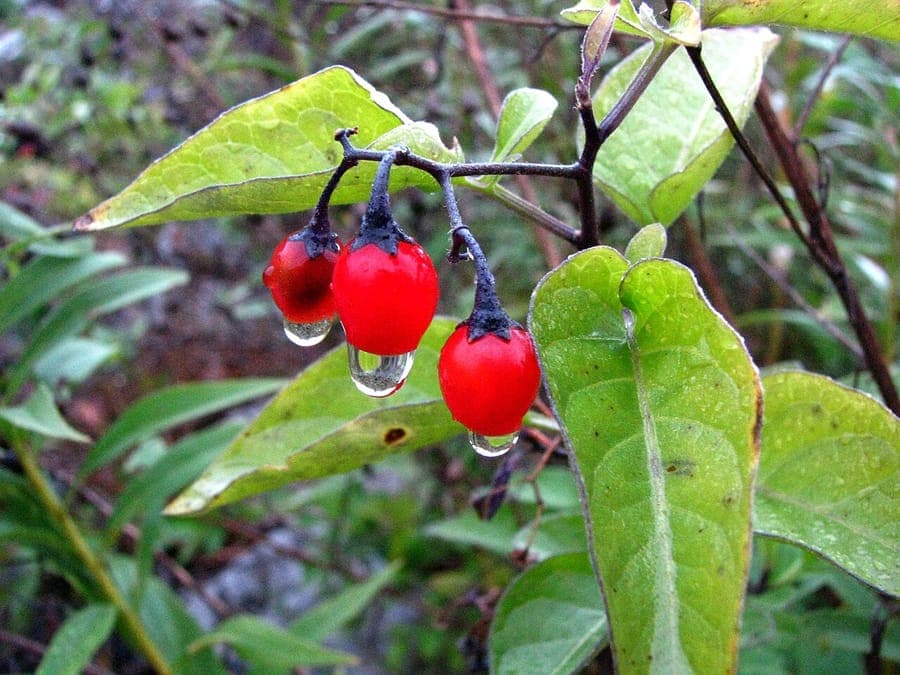
David Eickhoff from Pearl City, Hawaii, USA / CC BY 2.0, via Wikimedia Commons
Bitter nightshade: complete guide
Solanum dulcamara
Want to see Bitter nightshade: complete guide in your garden?
1 minute, no credit card
Overview
Solanum dulcamara, commonly known as Bitter nightshade, is a semi-woody vine that thrives in hedgerows, woodland edges, and damp areas across temperate zones. Native to parts of Europe and Asia, it's now naturalised in many regions, including the UK and northern US. As a member of the Solanaceae family, it shares lineage with tomatoes and potatoes-but unlike its edible cousins, every part of this plant is toxic. The bright orange berries, in particular, contain solanine and dulcamarine, which can cause severe gastrointestinal issues if ingested by humans or pets.
Despite its dangers, Bitter nightshade brings visual appeal with its twining stems, purple star-shaped flowers, and long-lasting berries. When placed thoughtfully, it can enhance a wildlife-friendly or naturalistic garden. On gardenworld.app, you can design a planting scheme that integrates Bitter nightshade safely, balancing its beauty with containment strategies.
Appearance & bloom cycle
Bitter nightshade grows as a climbing or trailing subshrub, reaching 1.5 to 2.5 metres in length. Stems are square in cross-section, often with a purple tint, and produce tendrils that help it scramble over shrubs or fences. Leaves are alternate, 4–10 cm long, and vary from oval to deeply lobed with a pointed tip.
Flowering occurs from June to September. The blooms are 1–2 cm wide, with five fused purplish-pink petals and a prominent yellow central cone formed by the stamens. These attract pollinators like bees and hoverflies. Following pollination, green berries form and ripen to glossy orange-red by late summer. They persist into early winter, offering seasonal interest-though never for consumption.
Ideal location
This plant thrives in light shade to partial sun-rate it a 6 out of 10 on the light scale. Full sun can scorch the foliage, especially in dry summers, while deep shade reduces flowering. Ideal spots include north- or east-facing walls, woodland margins, or beneath light-canopy trees like birch or hazel.
It needs support to climb: a trellis, fence, or low shrub works well. Avoid planting near play areas or dog runs due to toxicity. If you're unsure about placement, gardenworld.app offers visual garden planning tools to help you position climbing plants safely and effectively.
Soil requirements
Bitter nightshade isn't fussy but grows best in moist, well-drained soil with a pH between 6.5 and 7. It tolerates clay, loam, or sandy soils as long as they don't dry out completely or become waterlogged. Avoid overly rich compost-this encourages lush growth that's more prone to fungal issues.
For heavy clay, amend with grit or composted bark to improve drainage. On sandy soils, work in organic matter like leaf mould to retain moisture. No feeding is needed; this plant thrives in average fertility.
Free design
Want to see Bitter nightshade: complete guide in your garden? Make a free design now.
Watering
Once established, Bitter nightshade is moderately drought-tolerant but performs better with consistent moisture. Water weekly during prolonged dry spells, especially in the first year. Use rainwater when possible, as the plant dislikes high-lime tap water.
Avoid overhead watering to reduce fungal leaf spot. Instead, direct water at the base. Mulching with bark or leaf litter in spring helps retain soil moisture and suppresses weeds.
Pruning
Pruning is essential to manage growth and prevent self-seeding. In early spring (March or April), cut back all stems to 15–20 cm above ground level. This encourages bushy new growth and removes any dead or tangled wood.
Wear gloves when handling-sap can irritate skin. Remove any berries before they drop to limit spread. Use sharp, clean secateurs and sterilise tools after use to avoid disease transfer.
Maintenance calendar
- Jan: Inspect for stem damage, no pruning
- Feb: Prepare for spring pruning, check for root runners
- Mar: Cut back old growth to 15–20 cm
- Apr: Monitor new shoots, apply light mulch
- May: Control weeds, maintain even soil moisture
- Jun: Flowers begin, pollinators active
- Jul: Water during dry periods, check for pests
- Aug: Berries ripen; remove if needed
- Sep: Final flowering, prevent seed dispersal
- Oct: Foliage dies back, plant enters dormancy
- Nov: Clear fallen leaves, apply mulch
- Dec: Fully dormant, no intervention required
Winter hardiness
Bitter nightshade is hardy to USDA zones 5–8 (-20°C to -12°C). In the UK and most of the US Northeast, it survives winter without protection. Top growth dies back, but the root system remains alive and resprouts in spring.
In wet winters, root rot can occur in poorly drained soil. Ensure good drainage-plant on a slope or raised bed if needed. Avoid heavy mulching, which can trap moisture around the crown.
Companion plants
Pair Bitter nightshade with shade-tolerant perennials like foxglove (Digitalis), Solomon's seal (Polygonatum), or wild ginger (Asarum). These share similar moisture and light needs. Avoid aggressive spreaders like bindweed or mint, which can overwhelm it.
Woody companions include hawthorn, elder, or dogwood. They provide structure for climbing and create layered planting. Keep it away from edible crops or child-accessible areas due to toxicity.
Closing
Bitter nightshade isn't for every garden, but for naturalistic designs, it offers unique charm. Its climbing habit and seasonal colour cycle make it a talking point. Just remember: manage it responsibly. Prune annually, remove berries, and site it wisely.
Thinking of adding a climbing plant to your shady corner? Bitter nightshade could work-if you're prepared. For layout ideas and planting combinations, explore garden centres or browse gardenworld.app for interactive garden visualisations that match your space and climate.
Want to see Bitter nightshade: complete guide in your garden? Make a free design now.
Upload a photo, pick a style, and get a photorealistic design with plant list in under a minute.
No credit card required


Similar plants
Solanum dolichosepalum: complete guide
Solanum dolichosepalum
Discover Solanum dolichosepalum, an Andean nightshade with striking long sepals. Growing tips, hardiness, and companion planting for your patio.
Solanum ripense: complete guide
Solanum ripense
Discover Solanum ripense, a moisture-loving Andean nightshade for pond edges and conservatories. Growing tips, hardiness, and companions.
Solanum tomentosum: complete guide
Solanum tomentosum
Discover Solanum tomentosum, a thorny South African nightshade with felted leaves. Growing tips, hardiness, and companion planting ideas.