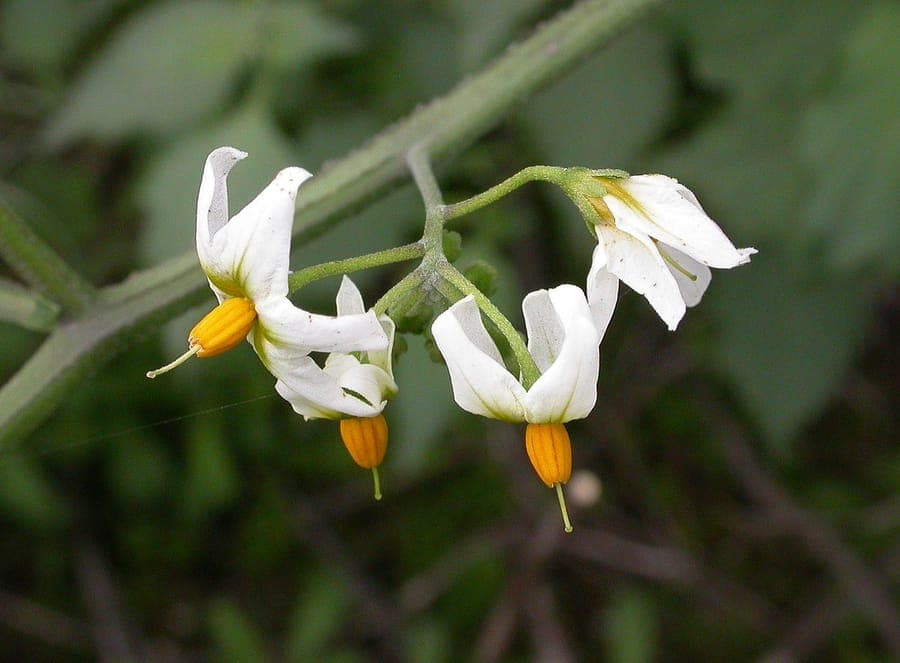
Copyright by Curtis Clark, licensed as noted / CC BY-SA 2.5, via Wikimedia Commons
Solanum douglasii: complete guide
Solanum douglasii
Want to see Solanum douglasii: complete guide in your garden?
Full design in HD: €7.99
Look after your Solanum douglasii with the GardenWorld app
Identify plants with your camera and get a care calendar with reminders for this plant.


Overview
Solanum douglasii, known as Greenspot nightshade or Green-spot nightshade, is an American subshrub native to arid and semi-arid regions of the southwest, from California to West Texas and Nicaragua. This plant from the Solanaceae family thrives perfectly in warm, dry, sunny environments and offers an extended blooming period with attractive small violet flowers.
Appearance and Bloom
Greenspot nightshade grows to approximately 60-100 cm high as a spreading subshrub. The leaves are lanceolate, grey-green, and somewhat rough-textured. The main attraction of this plant is the numerous small, star-shaped flowers in bright violet to blue-purple, with yellow stamens in the center. These flowers appear from late spring to early fall in nearly continuous display. The flowers give way to small yellow berries approximately 5-10 mm across.
Ideal Location
This plant demands full sun and dry, well-drained terrain. It thrives perfectly in dry, desert-like conditions with warm temperature profile. Minimal shade can be tolerated, but flowering period decreases. No wind protection needed; in fact, the plant tolerates wind well. Ideal for warm-loving gardens and xeriscaped designs. Plant on an elevation or slope area for optimal drainage.
Soil
Use very well-drained soil, preferably sandy or gritty soil. The plant is highly tolerant of nutrient-poor soils and grows excellently even in suboptimal soils. Drainage is the most crucial element; waterlogging will be absolutely fatal. No compost or organic material needed when planting. The plant thrives in dry, lean soils where many other plants would fail.
Watering
Once established, this plant has very low water requirements. Water deeply and infrequently after the first growing season. Actually, regular watering can damage the plant. In very extreme drought (more than 6 months without rain), minimal moisture supply can be beneficial, but generally water should be minimized. This is absolutely a plant for dryland climates. No extra water needed outside the growing season.
Free preview
Want to see Solanum douglasii: complete guide in your garden? Make a free preview of your design.
Pruning
Pruning is optional and mainly directed at shaping and removing dead wood. The plant assumes a natural, attractive form without intervention. Pruning in early spring before growth begins can promote strong formation. Remove dead or damaged branches when noticed. Overall, minimal care and shaping are needed to keep this plant healthy and attractive.
Maintenance Calendar
Spring: Prune dead wood, water supply very minimal. Summer: No watering needed, plant can thrive in full heat. Fall: No special care needed. Winter: Plant may go dormant in very cold areas, but no protection needed except in very severe winters.
Winter Hardiness
Solanum douglasii is reasonably winter-hardy in USDA zones 8-11. The plant can tolerate temperatures to about -5C but thrives better in warmer regions. In areas with light frost periods, the plant can fully recover from its root system. In very cold zones, the plant can be managed as an annual. Optimal temperature range is 15-30C with dryness.
Companion Plants
This plant combines beautifully with other dry-climate lovers such as Senecio, Helianthemum, Penstemon species, and other American native xerophytes. Create interesting texture combinations by placing this plant in the middle or background of drought-tolerant gardens. Rock garden or xeriscape-style designs are ideal.
Closing
Solanum douglasii is an exceptional plant for warm, dry climates where extended bloom and minimal care are desired. With its beautiful violet flowers and surprising resilience in extreme drought, this plant deserves more attention in xeriscaped and dry gardens. Once established, it requires very little from its caretaker. This is a bird plant where birds and insects can enjoy nectar and insects throughout the season.
Gardenworld.app helps you design drought-tolerant gardens full of interesting native American plants. Discover how to create a water-saving garden without sacrificing beauty!
Frequently asked questions about Solanum douglasii
Is Solanum douglasii winter hardy?
Solanum douglasii is reasonably winter-hardy in USDA zones 8-11. The plant can tolerate temperatures to about -5C but thrives better in warmer regions.
When and how do you prune Solanum douglasii?
Pruning is optional and mainly directed at shaping and removing dead wood. The plant assumes a natural, attractive form without intervention.
How much water does Solanum douglasii need?
Once established, this plant has very low water requirements. Water deeply and infrequently after the first growing season.
Where does Solanum douglasii grow best?
This plant demands full sun and dry, well-drained terrain. It thrives perfectly in dry, desert-like conditions with warm temperature profile.
What soil does Solanum douglasii need?
Use very well-drained soil, preferably sandy or gritty soil. The plant is highly tolerant of nutrient-poor soils and grows excellently even in suboptimal soils.

See it in your garden
See Solanum douglasii in your garden
One photo of your garden and a few questions. You see the result in about a minute.
Try it with a photoIdentify this plant in your own garden. Identify a plant
Similar plants
Petunia (Petunia × atkinsiana): complete guide
Petunia × atkinsiana
Everything about garden petunias (Petunia × atkinsiana): sowing, position, compost, watering, feeding and pruning for containers in bloom until autumn.
Chinese lantern: complete guide
Physalis alkekengi
Everything about the Chinese lantern (Physalis alkekengi): position, drying the orange lanterns, keeping its spread in check, toxicity and winter hardiness.
Solanum dolichosepalum: complete guide
Solanum dolichosepalum
Discover Solanum dolichosepalum, an Andean nightshade with striking long sepals. Growing tips, hardiness, and companion planting for your patio.
