
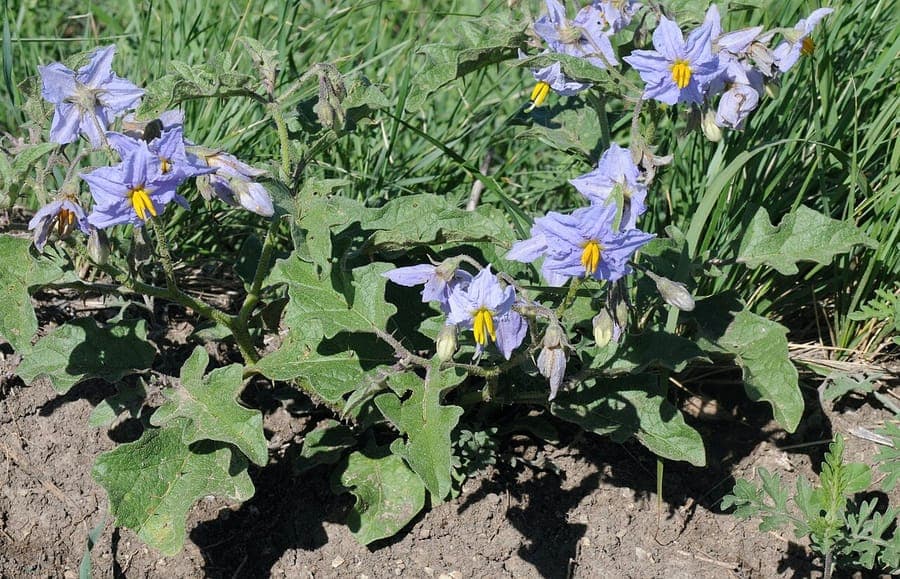
sonnia hill / CC BY 2.0, via Wikimedia Commons
Solanum dimidiatum: complete guide
Solanum dimidiatum
Want to see Solanum dimidiatum: complete guide in your garden?
1 minute, no credit card
Overview
Solanum dimidiatum, known as Carolina horse-nettle or Torrey nightshade, is a wild native American plant from the Solanaceae family. This herbaceous to semi-woody plant occurs naturally from the southeastern United States to Mexico. Although it produces beautiful purple flowers, it must be managed carefully because it bears thorns and can exhibit invasive behavior in some areas.
Appearance and Bloom
Carolina horse-nettle reaches heights of 30-80 cm and forms a sprawling shrub-like growth pattern. The stems are distinctly covered with sharp thorns, as are the leaves along their veins, making them highly irritating to touch. The leaves are green, somewhat wavy, and can vary considerably in size. In summer, small flowers appear in clusters with four- to five-parted star-shaped corollas in purple to blue-purple, with yellow stamens. These flowers attract insects and transform into yellow to orange fruits approximately 1-1.5 cm across.
Ideal Location
This plant thrives in full sun to partial shade, on dry to drought-tolerant terrain. Much of its population naturally grows in open fields, grasslands, and disturbed areas. Plant selection works best in locations with little competition from other plants. Ensure good air circulation to promote disease prevention. Due to its thorny nature, position this plant in a separate location, away from children's play areas.
Soil
Carolina horse-nettle is highly tolerant of various soils, ranging from heavy clay to sandy grounds, although it grows better in well-drained substrates. The plant can even thrive in poorly fed, erosion-prone slopes and is sometimes used as an erosion control plant. Plant in neutral to slightly acidic terrain. The plant makes no great demands on nutrition.
Watering
Once established, the plant is surprisingly drought-tolerant. Deep and infrequent watering is the rule. Regular moisture supply in the first growing year helps the plant establish, but mature plants need limited watering. Overwatering can lead to root rot. In extremely dry periods, some watering can be beneficial, but the plant also thrives without supplemental watering in many climates.
Free design
Want to see Solanum dimidiatum: complete guide in your garden? Make a free design now.
Pruning
Pruning this plant must be done carefully due to sharp thorns. Wear gloves and protective clothing. The plant responds well to pruning to maintain a more attractive form. Remove all dead branches in early spring. Excessive growth can be controlled by selective pruning. Also remove wilted flowers and fruits to ensure plant energy isn't wasted on seed production, which can help limit dispersal volume.
Maintenance Calendar
Spring: Prune dead wood, begin watering as growth starts. Summer: Minimal watering, observation for diseases, insects, seed setting. Autumn: Gradually reduce watering, remove withered vegetation. Winter: Minimal water, plant can go dormant in severe winters.
Winter Hardiness
Solanum dimidiatum is reasonably winter hardy in USDA zones 8-10, although deep-rooted specimens sometimes recover after frost kill in zone 7. In temperate climates, the plant is reseeded annually from seed or can be treated as an annual-plus. In warmer areas, it thrives as a perennial plant or even quasi-shrub. The plant is adapted to warm, dry weather and cannot tolerate very cold climate.
Companion Plants
Because this plant has invasive tendencies in certain regions and bears thorns, caution is advised in plant selections. Combinations are better in separate plant borders and can consist of similar dry-climate lovers such as Salvia greggii, Acleisanthes longipes, or other Solanum species. Use this plant primarily as an ecological educational example of native flora.
Closing
Carolina horse-nettle is a fascinating native American plant with great scientific and ecological value, but requires careful management in garden situations due to its invasive potential and thorny structures. When properly managed, it offers attractive purple flowers and support for local wildlife populations. Consult local plant expert centers before introducing this plant to your garden.
Gardenworld.app helps you choose native plant species suited to your climate zone and garden microclimate. Discover how to use local flora to promote biodiversity!
Want to see Solanum dimidiatum: complete guide in your garden? Make a free design now.
Upload a photo, pick a style, and get a photorealistic design with plant list in under a minute.
No credit card required


Similar plants
Solanum dolichosepalum: complete guide
Solanum dolichosepalum
Discover Solanum dolichosepalum, an Andean nightshade with striking long sepals. Growing tips, hardiness, and companion planting for your patio.
Solanum ripense: complete guide
Solanum ripense
Discover Solanum ripense, a moisture-loving Andean nightshade for pond edges and conservatories. Growing tips, hardiness, and companions.
Solanum tomentosum: complete guide
Solanum tomentosum
Discover Solanum tomentosum, a thorny South African nightshade with felted leaves. Growing tips, hardiness, and companion planting ideas.