
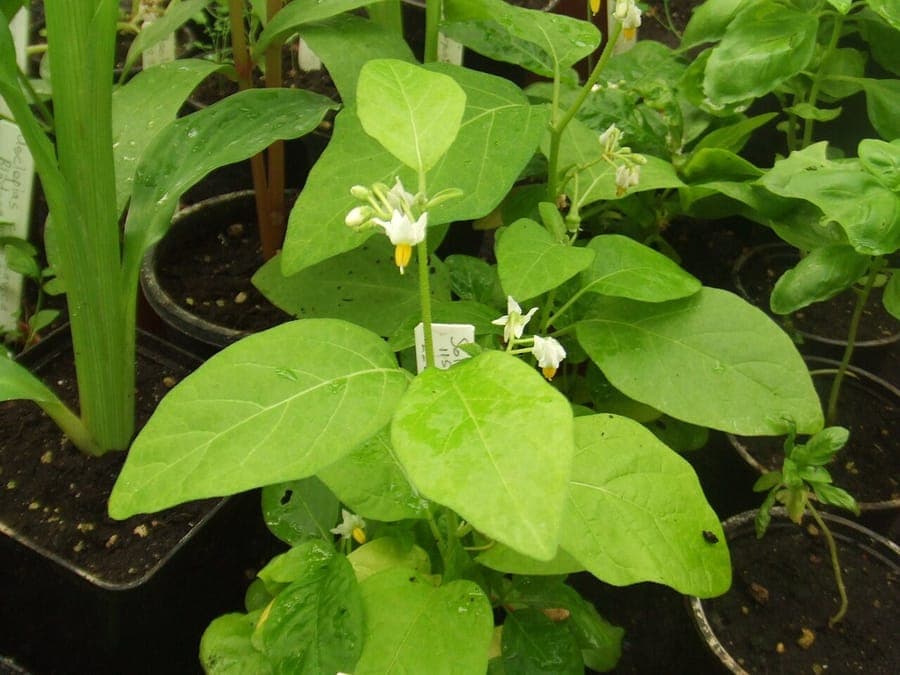
No machine-readable author provided. Hans B.~commonswiki assumed (based on copyright claims). / Public domain, via Wikimedia Commons
Gilo: complete guide
Solanum aethiopicum
Want to see Gilo: complete guide in your garden?
1 minute, no credit card
Gilo (Solanum aethiopicum) is a fascinating African vegetable from the Solanaceae family, the same family as tomato and potato. This plant grows naturally in Ethiopia and Eritrea and is now popular in many parts of Africa, South America and other warm climates.
OVERVIEW
Gilo is a compact plant known for its prolific production of small to medium-sized red fruits. The plant grows to about 60-90 centimeters tall and has a dense, bushy growth habit. The fruits appear throughout the growing season in large quantities and are red in color. The plant tolerates heat well and grows rapidly in warm seasons. The fruits can be eaten raw or cooked in a variety of dishes.
APPEARANCE AND BLOOM
Gilo has dark green, somewhat rough leaves forming a compact plant. The stems are strong and green. The flowers are small, violet-white and appear in clusters during the growing period. After pollination, small round fruits develop that ripen from green to red. The fruits are about 2-3 centimeters in diameter.
IDEAL LOCATION
Gilo thrives best in sunny locations with at least eight hours of direct sunlight daily. The plant is very sun-loving and grows poorly in shaded conditions. The plant loves warm, sheltered places. In moderately warm climates, the plant may not grow well.
SOIL
Gilo prefers well-draining, nutrient-rich soil with a pH of about 5.5 to 7.0. The plant is adaptable but grows best in rich soil. Add organic material to poor soils. The plant can tolerate reasonably dry soil once established, but grows better with regular watering.
WATERING
Gilo thrives best with regular watering, especially during flowering and fruiting. Provide sufficient water to maintain good yield. Once established, the plant can tolerate moderate drought. Avoid waterlogging.
PRUNING
Gilo requires minimal pruning, though you can prune main stems to encourage bushiness. Remove lower leaves to allow more light to penetrate. You can also remove deformed or damaged fruits.
MAINTENANCE CALENDAR
Spring: Sow seeds indoors 6-8 weeks before the last frost date. Transplant seedlings into larger pots. Summer: Plant in full sun in warm soil. Provide regular watering. Fall: Harvest ripe fruits throughout the period. Winter: Protect against frost damage in cold climates.
WINTER HARDINESS
Gilo is not hardy in cold climates and is usually grown as an annual plant. The plant can be damaged or killed if temperatures drop below 10 degrees Celsius. In very warm climates, the plant can grow year-round.
COMPANION PLANTS
Gilo looks nice with other heat-loving vegetables such as peppers and tomatoes. It combines nicely with herb plants such as basil.
CLOSING
Gilo is a fascinating, productive vegetable that provides nutritious red fruits. With minimal maintenance requirements, it is ideal for warm climates. For more garden inspiration, visit gardenworld.app/en or gardenworld.app/en.
Want to see Gilo: complete guide in your garden? Make a free design now.
Upload a photo, pick a style, and get a photorealistic design with plant list in under a minute.
No credit card required


Similar plants
Solanum dolichosepalum: complete guide
Solanum dolichosepalum
Discover Solanum dolichosepalum, an Andean nightshade with striking long sepals. Growing tips, hardiness, and companion planting for your patio.
Solanum ripense: complete guide
Solanum ripense
Discover Solanum ripense, a moisture-loving Andean nightshade for pond edges and conservatories. Growing tips, hardiness, and companions.
Solanum tomentosum: complete guide
Solanum tomentosum
Discover Solanum tomentosum, a thorny South African nightshade with felted leaves. Growing tips, hardiness, and companion planting ideas.