
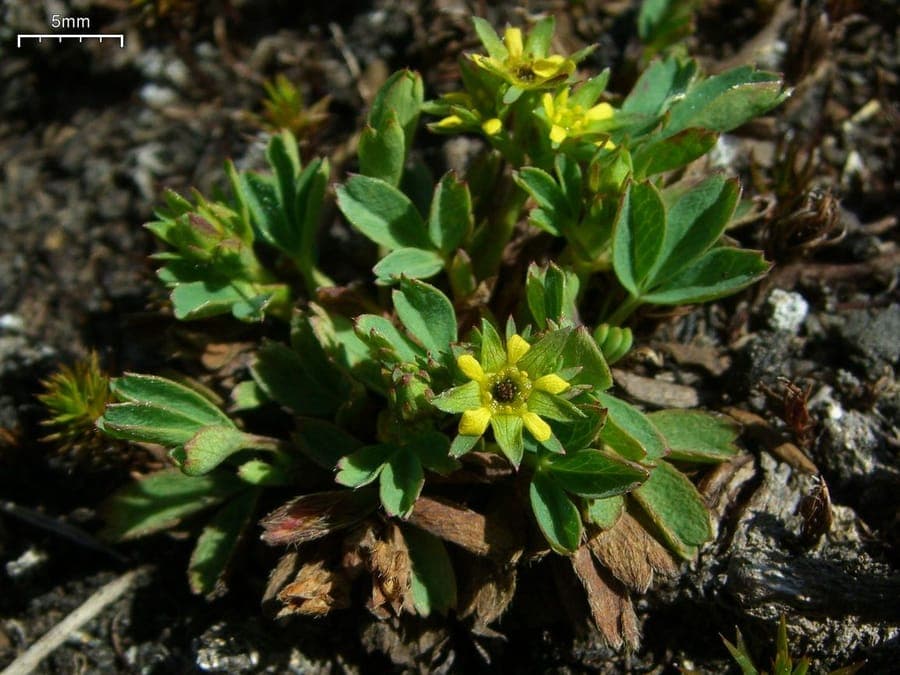
pellaea / CC BY 2.0, via Wikimedia Commons
Creeping Sibbaldia (Sibbaldia procumbens): complete guide
Sibbaldia procumbens
Want to see Creeping Sibbaldia (Sibbaldia procumbens): complete guide in your garden?
1 minute, no credit card
Overview
Creeping Sibbaldia (Sibbaldia procumbens) is a low-growing groundcover from rocky mountain regions of Europe, Asia, and North America. This compact plant from the Rose family forms tight-growing mats of delicate foliage with tiny yellow flowers. Standing only 3 to 8 centimeters tall but spreading to 30 centimeters or more, it is ideal for alpine gardens, rock gardens, and gravel borders.
Appearance & blooming
Creeping Sibbaldia forms low, tufted mats of finely textured leaves. The leaflets are small, green, and arranged in threes (characteristic of the Rose family). From July to August, numerous tiny, pale yellow flowers appear on very short stems. These flowers attract bees and are important for pollinators in alpine environments.
The plant is evergreen, providing visual interest even in winter. The seeds that follow are inconspicuous but support natural reproduction.
Ideal location
Creeping Sibbaldia thrives in sunny to half-shaded locations. At least 3 hours of direct sunlight daily is ideal, though the plant also grows in dappled shade. In fully shaded spots, flowering becomes sparse. The plant tolerates wind well and even strengthens under windy conditions.
Soil
The soil must be well-draining and relatively poor in nutrients. In stone and gravel gardens, this plant feels at home. A pH between 4 and 7 suits it well. Avoid heavy clay and waterlogging; this plant naturally grows on mountain slopes with rapid drainage. Add sand or gravel to heavy soils.
Watering
Once rooted, Creeping Sibbaldia is extremely drought-resistant. Watering during the first four weeks after planting aids establishment. Afterward, the plant grows almost without supplemental water. In extremely dry years, some water helps, but this plant naturally survives drought conditions.
Free design
Want to see Creeping Sibbaldia (Sibbaldia procumbens): complete guide in your garden? Make a free design now.
Pruning
Creeping Sibbaldia requires virtually no pruning. Dead material can be carefully removed. The plant grows outward naturally without cutting back. Avoid heavy pruning, which damages this delicate plant.
Maintenance calendar
Spring (March to May): Inspect for winter damage. No further care needed.
Summer (June to August): Enjoy the flowers. Water only in extremely dry conditions.
Fall (September to October): Plant strengthens itself. No special care required.
Winter (November to February): Hardy to severe cold; no protection needed.
Winter hardiness
Creeping Sibbaldia is extremely hardy to USDA zone 2 (temperatures to minus 40 degrees Celsius). Throughout northern Europe it grows without issue. The plant tolerates snow and severe frosts perfectly. This makes it ideal for mountain gardens in colder regions.
Companion plants
Creeping Sibbaldia combines beautifully with other alpine groundcovers: Sempervivum (Hens and chicks), Thymus alpinus (Alpine thyme), and Dianthus (Pinks) form lovely combinations. In rock gardens, it pairs well with Saxifraga (Saxifrage) and dwarf Sedum species. The yellow flowers of Sibbaldia contrast nicely against the silvery foliage of other plants.
Conclusion
Creeping Sibbaldia is indispensable for alpine and rock gardens. Its low stature, yellow flowers, and toughness make it a favorite with plant collectors and garden designers. Available from specialized plant nurseries. Plant this delightful little alpine treasure alongside similar species for an authentic mountain garden feel. The plant asks little and offers much character over many seasons.
Want to see Creeping Sibbaldia (Sibbaldia procumbens): complete guide in your garden? Make a free design now.
Upload a photo, pick a style, and get a photorealistic design with plant list in under a minute.
No credit card required


Similar plants
Siberian crab apple: complete guide
Malus x robusta
Complete guide to the Siberian crab apple (Malus x robusta): location, soil, pruning, winter hardiness and the best companion plants for your garden.
Chinese flowering crabapple (Malus x spectabilis): complete guide
Malus x spectabilis
Meet the Chinese flowering crabapple (Malus x spectabilis): a classic spring bloomer with carmine buds and pink blossom.
Potentilla crassinervia: complete guide
Potentilla crassinervia
Potentilla crassinervia, the Corsican cinquefoil, grows wild on Corsica and Sardinia's peaks. Discover how to grow this hardy alpine rock garden gem.