
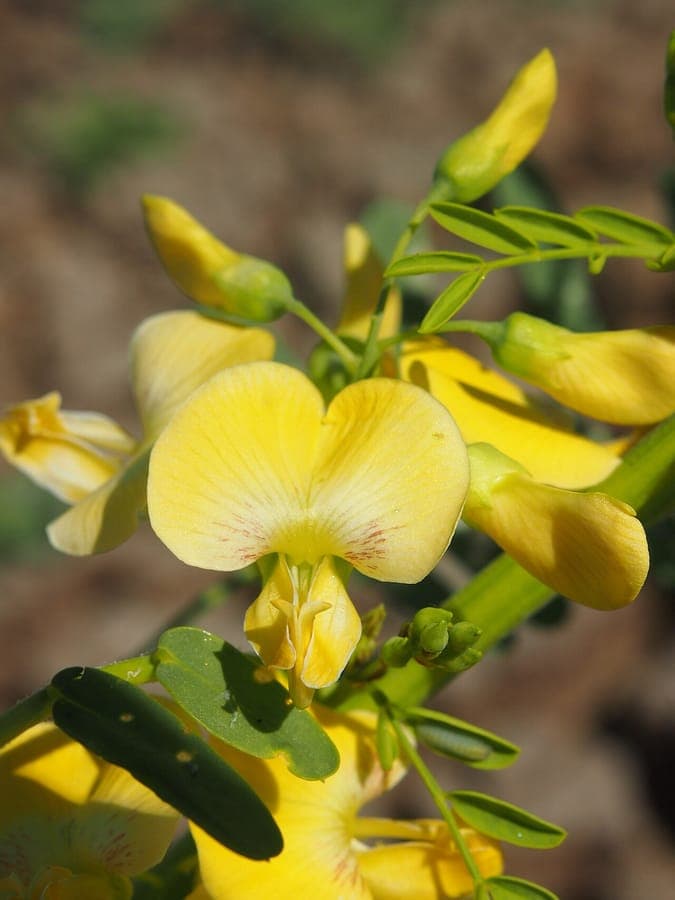
Mark Marathon / CC BY-SA 4.0, via Wikimedia Commons
Sesbania: complete guide
Sesbania cannabina
Want to see Sesbania: complete guide in your garden?
1 minute, no credit card
Overview
Sesbania cannabina, commonly known as prickly sesban, yellow peabush, sesbania pea, canicha or dhaincha, is a fast-growing annual or short-lived perennial shrub in the legume family (Fabaceae). Native to the Indian Subcontinent - primarily India, Bangladesh, Nepal and Myanmar - it has naturalised across tropical Australia, Southeast Asia, and beyond. It has also been introduced, sometimes invasively, to parts of China, the Philippines, sub-Saharan Africa and the Caribbean.
What sets Sesbania cannabina apart is its ability to fix atmospheric nitrogen through a symbiosis with Rhizobium bacteria in root nodules, making it a valuable green manure crop in tropical agriculture. In horticulture outside the tropics it is occasionally grown as an ornamental for its graceful feathery foliage and soft yellow flowers, or as a fast-growing seasonal shrub for large summer borders.
At gardenworld.app, this species is featured among leguminous ornamental shrubs suited to warm sheltered settings, where it contributes both visual structure and soil-enriching root activity during the growing season.
Appearance and bloom cycle
Sesbania cannabina grows rapidly to between 1.5 and 3 metres tall, occasionally taller in ideal tropical conditions. The stems are upright, light green and become slightly woody at the base as the plant matures. The foliage is pinnate, with each leaf bearing dozens of small oblong leaflets, giving the plant a light, airy appearance with a fine texture quite different from most common garden shrubs.
The flowers are typical of the pea family: butterfly-shaped (papilionaceous) with a bright yellow standard petal, sometimes marked with brownish-red spots. They appear in loose axillary racemes, distributed along the upper portions of the stem. Bloom time varies by climate: in tropical regions flowering continues almost year-round; in temperate zones with warm summers, flowers appear primarily between July and September.
Following flowering, long slender seed pods develop, measuring 15 to 30 cm in length and containing multiple seeds. At maturity the pods turn brown and dry. The seeds are reddish-brown and hard-coated, similar to other legume seeds, and benefit from overnight soaking before sowing to improve germination rates.
Ideal location
Sesbania cannabina thrives in full sun. In its native habitat it colonises open, warm, often moist environments: riverbanks, paddy field margins, wetland edges and disturbed ground in tropical and subtropical regions.
In northern European gardens it is best placed in the warmest, most sheltered spot available, ideally against a south-facing wall or in a south-facing corner that captures and retains heat. It is not frost-tolerant and must be resown annually from seed, or started indoors in early spring and transplanted out after the last frost. Despite being treated as an annual in cool climates, it can reach impressive dimensions within a single season.
For those designing summer container displays, Sesbania cannabina makes a striking tall backdrop plant in large pots on a sunny terrace, provided watering is consistent and the container is moved under cover before the first autumn frosts.
Soil
One of Sesbania cannabina's most notable qualities is its soil versatility. It grows on light sandy soils, heavy clay soils and periodically waterlogged ground. The pH range it tolerates spans from 5.8 to 8.5, making it suitable for mildly acidic to moderately alkaline conditions.
In garden situations, a well-structured, moderately fertile soil gives the best ornamental results. Thanks to the nitrogen-fixing Rhizobium symbiosis in its root nodules, the plant rarely needs supplemental nitrogen fertilisation. An initial phosphate dressing at planting time supports early root development and nodule formation. Avoid compacted, waterlogged soil with poor drainage in cool climates: while the plant tolerates seasonal flooding in the tropics, prolonged waterlogging in cool conditions leads to root problems.
Watering
During the growing season Sesbania cannabina benefits from regular watering, particularly in the weeks immediately after sowing or transplanting. Once established, the plant shows reasonable drought tolerance for short periods, but extended dry spells cause yellowing foliage and stunted growth.
In northern European summers, supplemental watering during warm dry spells is advisable, especially for plants in sandy soil or containers. Overwatering on poorly drained ground can lead to root rot. Aim for consistently moist but not saturated soil, similar to the moisture regime that suits a sunflower in a warm summer.
Planted at the margins of a garden pond or at the edge of a rain garden, Sesbania cannabina benefits naturally from soil moisture, making it a useful candidate for wet corners that are otherwise difficult to plant ornamentally.
Free design
Want to see Sesbania: complete guide in your garden? Make a free design now.
Pruning
As an annual shrub grown primarily for its seasonal display, Sesbania cannabina requires no regular pruning to flower well. If a bushier, more compact form is desired, the main stem can be pinched or cut back early in the season. This delays flowering slightly but promotes a denser branching structure with more lateral growth.
After flowering and seed set, the plant is allowed to die down naturally following the first autumn frosts in temperate climates. Remove the plant in autumn and compost the stems and leaves: the nitrogen-rich root nodules and plant material are valuable additions to the compost heap.
To save seed for the following season, allow a selection of pods to fully ripen and turn brown on the plant before harvesting. Store seeds dry and cool - between 10 and 15 degrees Celsius - in a paper envelope or glass jar until the following spring.
Maintenance calendar
January to March: Purchase or prepare saved seeds. Keep stored seed dry and cool. No outdoor work required for this annual.
April: Start seeds indoors on a warm windowsill at a minimum of 20 degrees Celsius. Soak seeds in lukewarm water for 24 hours before sowing to improve germination. Germination takes 5 to 10 days.
May: Transplant outdoors after the last frost date. Space plants approximately 50 cm apart. Full sun, sheltered position is essential.
June to July: Rapid growth phase. Water regularly. A single light feed with balanced fertiliser may be given if soil is very poor, though nitrogen fixing via root nodules usually suffices.
August to September: Main flowering period. Yellow flowers appear followed by developing seed pods.
October: Pods ripen and dry. Harvest seed if required. Plant begins to decline as nights cool.
November: Remove and compost spent plants. Nitrogen-enriched root material benefits next season's soil.
Winter hardiness
Sesbania cannabina is not winter-hardy in temperate northern European conditions. It is tropical in origin and sustains frost damage below zero degrees Celsius. In USDA hardiness zones 9 and warmer, established plants may survive mild winters; in zones 8 and below, including most of the UK and the Netherlands, it must be treated as a half-hardy annual.
Overwintering established plants is rarely practical given their size. The most straightforward approach is to grow them fresh from seed each year, which also ensures the strongest growth, as young vigorous plants perform better than any overwintered specimens. The seeds, however, store reliably for two or more years if kept dry and cool.
Gardeners in USDA zone 9 or in mild coastal locations may find that self-sown seedlings appear in sheltered spots in late spring, indicating the plant's ability to spread when conditions favour it.
Companion plants
Sesbania cannabina works well alongside other tall, warm-season plants in large sunny borders. Suitable companions include:
- Ricinus communis (castor oil plant): similarly dramatic tropical foliage with a bold leaf texture that contrasts beautifully with Sesbania's fine pinnate leaves.
- Tithonia rotundifolia (Mexican sunflower): vivid orange flowers that complement the soft yellow of Sesbania blooms.
- Hibiscus cannabinus (kenaf): a related species with large showy flowers and similarly rapid growth.
- Cosmos sulphureus: lower-growing border filler in yellow and orange tones that echo the sesbania flower colour.
- Sorghum bicolor (ornamental sorghum): tall, structural grass companion that benefits from the nitrogen-enriching root activity of the sesbania.
In the kitchen garden, Sesbania cannabina serves as a nitrogen-fixing intercrop alongside maize, sorghum or other heavy feeders, improving soil fertility for subsequent crops. Look for seeds at specialist garden centres or online suppliers - mainstream retailers rarely carry this species.
Closing
Sesbania cannabina is an underappreciated plant for gardeners willing to look beyond the conventional shrub selection. Its rapid growth, graceful feathery foliage, cheerful yellow flowers and real ecological benefit as a nitrogen-fixer make it a rewarding addition to large, sunny summer gardens.
For more ideas on incorporating tropical and semi-tropical ornamentals into your planting schemes, visit gardenworld.app, where personalised garden design concepts are developed around your own outdoor space, including plant combinations that work for your specific climate and soil conditions.
Want to see Sesbania: complete guide in your garden? Make a free design now.
Upload a photo, pick a style, and get a photorealistic design with plant list in under a minute.
10,000+ gardens designed already
No credit card required


Similar plants
Tall Silky Lupine: complete guide
Lupinus elatus
Tall silky lupine is a fast-growing Californian perennial with silvery foliage and blue-purple flower spikes, ideal for a prairie-style garden.
Garfield Lupine: complete guide
Lupinus garfieldensis
The Garfield lupine is a rare, fast-growing American perennial for alkaline, dry grassland gardens, with striking blue flower spikes.
Lupinus elegans: complete guide
Lupinus elegans
Lupinus elegans, the elegant lupine, is a spectacular blooming plant from Mexico with blue flower spikes. Care, cultivation and garden use.