
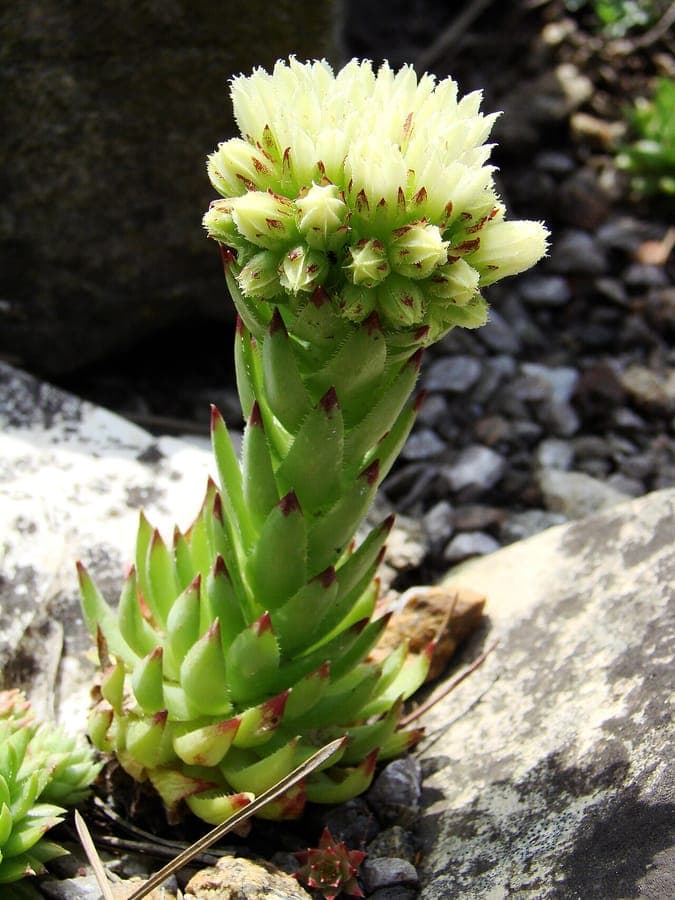
Guérin Nicolas (messages) / CC BY-SA 3.0, via Wikimedia Commons
Rolling hen-and-chicks: complete guide
Sempervivum globiferum
Want to see Rolling hen-and-chicks: complete guide in your garden?
1 minute, no credit card
Overview
Sempervivum globiferum, commonly called Rolling hen-and-chicks, stands out in any garden for its unusual propagation method. Unlike most houseleeks that produce offspring close to the base, this species sends out long, thread-like stolons that carry miniature rosettes - often literally rolling them across gravel or soil. This gives the plant its evocative common name and adds a dynamic, living texture to dry landscapes.
Native to central and eastern Europe - including Austria, Germany, Hungary, and parts of Russia - it thrives in rocky, nutrient-poor environments with excellent drainage. It's fully hardy and exceptionally drought-tolerant, making it a reliable choice for xeriscaping, green roofs, or crevices in stone walls. On gardenworld.app, you can design a layout that mimics its natural habitat, pairing it with other alpine plants for a cohesive, low-effort display.
Appearance & bloom cycle
The plant forms tight, silvery-green rosettes around 4–6 cm in diameter. Leaves are fleshy, covered with a waxy cuticle that minimizes water loss. In midsummer - typically July and August - it sends up slender flower stalks reaching 15–25 cm tall. The blooms are bright yellow, star-shaped, and open fully in direct sunlight, attracting bees and hoverflies.
Like most Sempervivums, the flowering rosette dies after setting seed, but by then, it has already produced numerous offsets via stolons. These pups root easily and spread rapidly in ideal conditions. The rolling motion adds a sense of natural movement to static garden features, almost like a plant in slow motion.
Ideal location
This succulent demands full sun - a 9 on the light scale. Choose south- or west-facing spots where it can bask for most of the day. It performs poorly in shade, becoming leggy and losing its compact form. The more sun it gets, the more intense the leaf coloration, often developing reddish or coppery tints under stress.
Perfect for rock gardens, gravel beds, green roofs, and wall crevices. It also works well in containers or shallow troughs, as long as drainage is guaranteed. If you're unsure whether your garden gets enough light, gardenworld.app offers sun-mapping tools to help you place Sempervivum globiferum exactly where it will thrive.
Soil requirements
Grow it in sharply drained soil. A mix of gritty sand, perlite, and a small amount of loam works best. Avoid rich, moisture-retentive composts - they lead to root rot. The ideal pH is slightly acidic, between 4.0 and 4.5, though it tolerates minor deviations.
In garden beds, amend the soil with gravel or pumice. In pots, use a commercial succulent mix, available at most garden centres. Always ensure containers have drainage holes. A layer of crushed rock at the base improves airflow and prevents waterlogging.
Free design
Want to see Rolling hen-and-chicks: complete guide in your garden? Make a free design now.
Watering
Water deeply but infrequently. During the growing season (April to September), soak the soil only when completely dry - roughly every 10 to 14 days, depending on weather. Let the soil dry out fully between waterings.
In winter, stop watering entirely if the plant is outdoors and exposed to rain. If grown under cover, give a light drink only if the rosettes start to shrivel. Overwatering, especially in cold months, is the number one killer of Sempervivum globiferum.
Pruning
No pruning is needed. Simply remove dead or damaged leaves with clean, sharp scissors. You can gently detach healthy pups and replant them elsewhere to control spread. Avoid touching the leaves with wet hands - the waxy coating protects against sun and dehydration.
If a pup rolls into an unwanted area, just pick it up and tuck it into a better spot. It will root within weeks with minimal care.
Maintenance calendar
- Jan: Check for rot or fungal issues. No water.
- Feb: Keep dry. Remove snow buildup from rosettes.
- Mar: Monitor for early growth. Still no watering needed.
- Apr: Begin occasional watering. Watch for new pups.
- May: Ensure full sun exposure. Stolons become visible.
- Jun: No action unless extreme drought.
- Jul: Flowering begins. Support tall stems if needed.
- Aug: Peak bloom. Remove spent flowers.
- Sep: Gradually reduce watering.
- Oct: Stop watering. Clear away dead foliage.
- Nov: Protect from wet conditions. No pruning.
- Dec: Dormant period. Keep cold and dry.
Winter hardiness
Hardy to USDA zone 4 (-34°C). In the UK and most of Europe, it survives winter without protection. The key is dry soil - wet roots in freezing temperatures cause fatal rot. Avoid mulching heavily, as it traps moisture.
If grown in containers, leave them outside - but elevate pots to prevent waterlogging. A cold frame works well in extremely wet climates, as long as ventilation is maintained.
Companion plants
Pair with other drought-tolerant species: Sedum spurium, Thymus polytrichus, Draba aizoon, or Arabis caucasica. These share similar needs for sun and drainage. Avoid moisture-loving plants like hostas or ferns, which create humid microclimates.
In a rock garden, contrast the silvery foliage with dark-leaved heucheras or golden oregano. Gravel paths enhance the alpine feel and improve drainage around the base.
Closing
Sempervivum globiferum brings movement, texture, and resilience to any garden. Its rolling pups create living patterns that evolve over time, making it more than just a plant - it's a slow-growing landscape feature. With minimal demands and maximum visual impact, it's a must for modern, low-maintenance gardens.
For inspiration on where to place it, try sketching your ideal layout on gardenworld.app. You can simulate seasonal changes and see how this succulent interacts with light and companion plants over time.
Want to see Rolling hen-and-chicks: complete guide in your garden? Make a free design now.
Upload a photo, pick a style, and get a photorealistic design with plant list in under a minute.
No credit card required


Similar plants
Sedum nevadense: complete guide
Sedum nevadense
Discover Sedum nevadense, the stunning alpine stonecrop from the Pyrenees. Expert care tips, growing requirements, and design ideas for rock gardens.
Aizoon stonecrop: complete guide
Phedimus aizoon
Everything about Phedimus aizoon - the frost-tolerant aizoon stonecrop from Siberia with bright yellow flowers. Planting, care and garden use.
Roseroot: complete guide
Rhodiola rosea
Everything about roseroot (Rhodiola rosea): a tough hardy succulent ideal for rock gardens, green roofs, and dry sunny positions.