
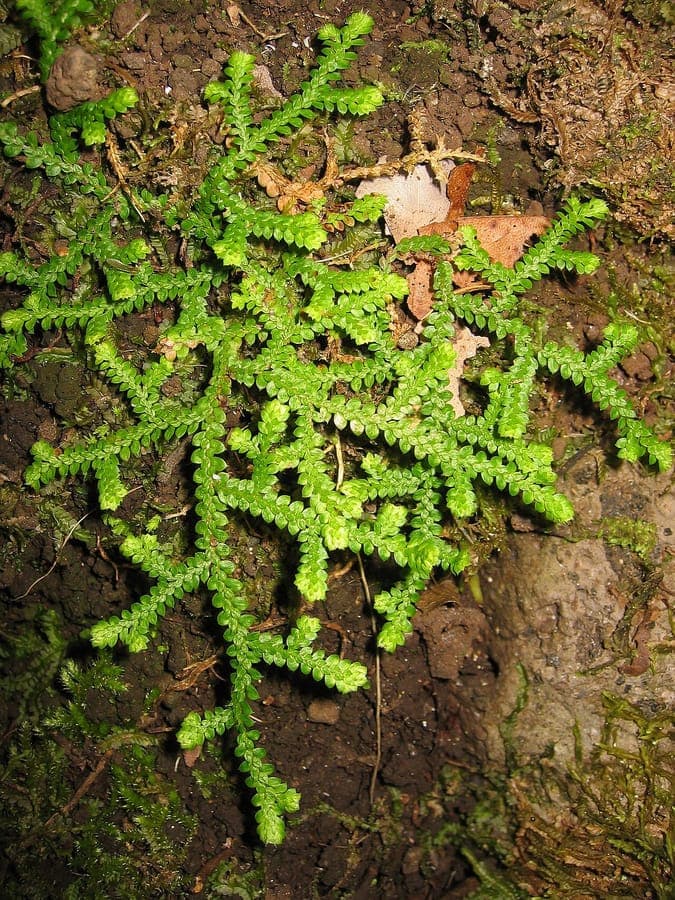
Tigerente / CC BY-SA 3.0, via Wikimedia Commons
Toothed-leaved clubmoss: complete guide to Selaginella denticulata
Selaginella denticulata
Want to see Toothed-leaved clubmoss: complete guide to Selaginella denticulata in your garden?
1 minute, no credit card
Overview
Selaginella denticulata, commonly called the toothed-leaved clubmoss, belongs to one of the oldest plant lineages still thriving on Earth. The Selaginellaceae predate flowering plants by hundreds of millions of years, and this Mediterranean species carries that ancient heritage into modern gardens. Described scientifically in 1838 by the botanist Spring, it grows natively across a broad arc from Portugal, Spain and the Balearic Islands eastward through France, Italy, Greece, Turkey and into North Africa, as well as on Atlantic islands including Madeira and the Canary Islands.
In its native range it colonises shaded, damp rock faces, sheltered crevices, and moist forest floors where limestone or calcareous substrate keeps the pH slightly alkaline. For gardeners in Northern Europe or North America, it is primarily a container and terrarium subject, though in mild maritime climates it can survive outdoors with protection. Its appeal lies in the extraordinarily fine-textured, emerald-green carpet it forms, making it a standout choice wherever low-maintenance ground-covering foliage is wanted.
If you are planning a shade garden or a sheltered courtyard planting, gardenworld.app offers design tools to help you place textural plants like this clubmoss effectively alongside ferns and other low-light companions.
Appearance and growth cycle
Selaginella denticulata builds dense, creeping mats from repeatedly branched, thread-fine stems covered with small, scale-like leaves arranged in a flattened, overlapping pattern. The texture is distinctly mossy at a glance, but on closer inspection each stem has a clear, regular structure that moss lacks. Colour ranges from vivid emerald in deep shade to a slightly yellowish green in brighter conditions.
As a spore-bearing plant it produces no flowers. Instead, specialised cone-like structures called strobili develop in the leaf axils. According to Trefle data, spore-bearing occurs from January through June and again in December, meaning the plant is almost continuously reproductively active during its growing season. Spores are tiny and wind-dispersed, so the plant can self-seed quietly in a suitable terrarium or shaded garden corner.
Growth height is modest: typically 5 to 8 cm tall, spreading horizontally to fill gaps between stones and roots. Growth rate is slow, which is part of its charm: once established in a good spot, the mat thickens gradually over years with minimal intervention.
Ideal location
Shade or dappled shade is essential. Direct sun, especially afternoon summer sun, causes rapid desiccation of the delicate leaves. A north-facing wall base, the understory of a tree with an open canopy, or the shaded side of a rockery are all good choices. In Trefle data, light requirement is scored at 7 out of 10, indicating bright indirect light rather than full shade, so a little morning sun does no harm.
Outdoor use in northern climates demands a sheltered, frost-protected microclimate. An enclosed courtyard, a south-facing wall that holds warmth overnight, or a raised bed against the house are the best options. Indoors, terrariums with maintained humidity are where this plant genuinely excels. In a closed or semi-closed glass container it can be a centrepiece of a living miniature landscape.
Soil requirements
Unlike most fern allies, Selaginella denticulata prefers a slightly alkaline substrate, with pH 7.5 to 8 listed in the Trefle data. In practical terms this means a mix that includes limestone grit, crushed shell, or a small amount of garden lime. Ordinary peat-based compost is too acidic and should be amended or avoided.
Drainage is critical. The roots dislike sitting in waterlogged conditions even though the shoots prefer humid air. A recommended mix for pots or terrarium use: one part horticultural grit, one part coarse river sand, and one part loam-based compost, with a thin layer of fine limestone grit as a top dressing. Nutrient requirements are low (Trefle score: 2/10), so avoid heavy feeding. A single light application of balanced liquid fertiliser in spring is sufficient for the whole growing season.
Free design
Want to see Toothed-leaved clubmoss: complete guide to Selaginella denticulata in your garden? Make a free design now.
Watering
Consistent moisture without waterlogging is the goal. Allow the top centimetre of soil to approach dryness before watering, then water gently and thoroughly. In summer, this may mean watering every two to three days outdoors; in a terrarium, the frequency depends on how open or closed the container is and the ambient temperature.
Use rain water or tap water that has been left to stand overnight, especially in hard-water areas, as calcium deposits on the fine leaves can block gas exchange. In winter, reduce frequency significantly: outdoor plants in light frost protection need very little water. Terrarium plants need only enough to maintain a light background moisture in the substrate.
A 3 to 5 cm mulch of leaf mould around outdoor plants greatly reduces moisture loss and keeps soil temperature stable, mimicking the forest floor conditions the plant knows from its Mediterranean home.
Pruning
This plant requires no conventional pruning. The creeping stems do not need cutting back under normal conditions. In spring, gently remove any winter-browned or frost-damaged stems by pulling them free with your fingers or snipping with clean scissors at the base.
In terrariums, when the plant starts to overgrow its intended space, trim the leading stems with clean scissors. The cuttings can be rooted by pressing them horizontally into moist substrate - they take root readily in warm, humid conditions, which makes propagation by division or stem cutting very practical. This is the easiest way to increase your stock without sourcing new plants from specialist nurseries.
Maintenance calendar
January to March: Minimal activity for outdoor plants. Monitor for frost damage. Terrarium plants continue to grow; check humidity and substrate moisture weekly. Strobili may already be present.
April to May: Resumption of outdoor growth. Remove dead material from winter. Apply a half-strength liquid feed once. Watch for slugs on young growth.
June to August: Peak growing season. Water consistently; check moisture two to three times a week outdoors. Ensure any fallen leaves from overhanging trees are removed promptly to avoid smothering.
September to October: Growth slows. Reduce feeding to zero. Prepare frost protection materials.
November to December: Protect outdoor plants from frost. Terrarium maintenance unchanged. December strobili formation is botanically interesting to observe. Visit gardenworld.app to plan your winter and spring planting combinations in advance.
Winter hardiness
Selaginella denticulata is rated as half-hardy to tender. It survives light frosts down to approximately -3 to -5 degrees Celsius if the rootzone is well-drained and the plant is sheltered from wind and wet. USDA hardiness zone 8 and above allows outdoor cultivation year-round in mild maritime areas. In zone 7 and below, bring plants indoors or into a cool greenhouse for winter.
In practice: in much of the UK, Ireland, Belgium and the Netherlands, careful placement against a warm wall with a good mulch layer can see the plant through an average winter. But a severe frost event will kill unprotected outdoor plants. A cold but frost-free greenhouse or cool windowsill (5 to 10 degrees Celsius) is the reliable winter option.
Companion plants
The fine texture and persistent green of this clubmoss make it an excellent companion for a range of shade-tolerant plants:
- Asplenium scolopendrium (hart's tongue fern): bold, glossy strap leaves provide strong textural contrast.
- Polypodium vulgare (common polypody): another calcicolous fern that thrives in similar rocky, shaded conditions.
- Helleborus orientalis (Lenten rose): dark, leathery foliage and winter flowers above the green carpet.
- Epimedium species: tough, semi-evergreen ground cover that tolerates dry shade, complementing the texture beautifully.
- Viola odorata (sweet violet): spreading, spring-flowering; fills gaps the selaginella has not yet reached.
Avoid pairing with acid-loving plants such as heathers or rhododendrons, as their pH requirements are incompatible.
Closing thoughts
Selaginella denticulata rewards patience and attention to detail. It will not dazzle you with flowers, and it will not establish itself in a single season. But given the right conditions - shade, consistent moisture, slightly alkaline, well-drained soil and protection from harsh frost - it builds, year by year, into one of the most refined and calming ground-covering plants a garden or terrarium can hold.
Look for it at specialist fern nurseries, terrarium plant suppliers, or at well-stocked garden centres with a good shade-plant section. It is rarely found in general plant aisles, but it is well worth seeking out. Use gardenworld.app to design the shaded corner of your garden where this ancient plant can finally take its rightful place.
Want to see Toothed-leaved clubmoss: complete guide to Selaginella denticulata in your garden? Make a free design now.
Upload a photo, pick a style, and get a photorealistic design with plant list in under a minute.
10,000+ gardens designed already
No credit card required


Similar plants
Meadow Spikemoss: complete guide
Selaginella apoda
Everything about Selaginella apoda, meadow spikemoss: growing as ground cover, site requirements, moisture, pruning and winter hardiness.
Alpine Selaginella: complete guide
Selaginella helvetica
Discover how to cultivate this delicate shade-loving moss-like plant. Perfect for moist terrariums and woodland garden corners beneath dense canopy.
Clubmoss: complete guide
Selaginella selaginoides
Discover the Clubmoss (Selaginella selaginoides), a moisture-loving alpine fern thriving on rocky hillsides. Perfect for shaded gardens in temperate climates with consistent moisture.