
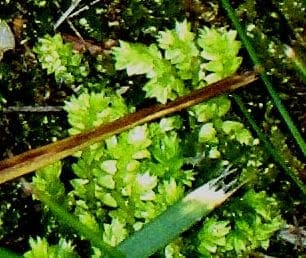
Jaknouse / CC BY-SA 3.0, via Wikimedia Commons
Meadow Spikemoss: complete guide
Selaginella apoda
Want to see Meadow Spikemoss: complete guide in your garden?
1 minute, no credit card
Overview
Selaginella apoda, commonly known as meadow spikemoss or creeping spikemoss, is a small but fascinating vascular plant in the family Selaginellaceae. It is neither a true fern nor a moss, but rather a representative of an ancient lineage - the lycophytes - that flourished in the Carboniferous period long before flowering plants existed. Native to the eastern United States and ranging south through Mexico to Guatemala, it grows naturally on moist meadows, stream banks and in open, humid woodlands.
In European gardens, Selaginella apoda is increasingly valued as a delicate green ground cover that forms a tight, moss-like carpet in cool, moist shaded spots. For those seeking a graceful alternative to conventional lawn or a low living carpet for shaded beds, this plant offers an intriguing option. Visit gardenworld.app for ideas on combining small ground-covering plants in a shade border or Japanese-inspired garden.
Appearance and bloom cycle
Selaginella apoda does not flower in the botanical sense. It is a spore-bearing plant that produces tiny spores in small candle-shaped structures called strobili, borne at the tips of the shoots. These strobili are just a few millimetres long and inconspicuously green; all the ornamental value lies in the fine, branched foliage.
The shoots are creeping and rarely exceed 5 to 10 cm in height. They branch in a flat, finely textured pattern strongly reminiscent of a moss mat. Individual leaves (technically microphylls) are small, scale-like and soft green to blue-green, overlapping along the stems like tiles. They are translucent and respond quickly to water stress: when moisture is lacking, the shoots contract and turn brown, but they recover with remarkable speed once water is available. This desiccation-tolerance mechanism makes the Selaginella genus scientifically interesting and has enabled relatives in arid regions to become remarkable drought survivors.
Ideal location
Selaginella apoda prefers a semi-shaded to fully shaded position. In its natural habitat - moist meadows and woodland edges in eastern North America - it receives filtered light through an overhead canopy. Full sun is poorly tolerated: leaves scorch quickly and the plant desiccates. A sheltered spot under shrubs or low-canopy trees, or on the north-facing side of buildings and walls, is ideal.
In the garden it works beautifully as a ground cover in a shade border or under rhododendrons, azaleas or larger ferns. In a moss garden or Japanese-style garden it is a natural companion to mosses and other shade lovers. In a terrarium or closed plant case it thrives particularly well, as the humidity there remains consistently high.
Soil
A humus-rich, moisture-retentive but well-drained soil is ideal. Selaginella apoda does not tolerate dry sandy soil, nor does it cope with prolonged waterlogging. A general garden loam amended with extra compost and a little sharp sand or perlite gives the best results. pH should be in the range of 5.5 to 7.0 - slightly acid to neutral.
Avoid strongly organic soils that have become very acidic, such as pure sphagnum moss. If the existing soil lacks sufficient humus, incorporate composted leaf mould; this retains moisture without the soil becoming waterlogged.
Watering
Consistent moisture is the essential requirement for Selaginella apoda. The soil must be kept evenly moist without free-standing water on the surface. Water regularly, particularly in summer, and never allow the soil to dry out completely. Rainwater or softened tap water is preferred over hard mains water, which can deposit limescale on the delicate shoots over time.
When grown as a houseplant or in a terrarium, you can supplement soil moisture by lightly misting the foliage to raise humidity. In a sealed terrarium, almost no supplementary watering is needed - condensation cycling inside the enclosure keeps the substrate naturally moist.
Free design
Want to see Meadow Spikemoss: complete guide in your garden? Make a free design now.
Pruning
Selaginella apoda requires very little pruning. It grows slowly and stays naturally compact. Any dry or brown shoots following a dry spell can be pinched off or gently raked away once the plant has recovered. If you want to limit spread, simply trim the edges periodically with scissors. Heavy pruning is neither necessary nor advisable - the fine texture of the plant makes any coarse cut immediately conspicuous.
Maintenance calendar
- January-February: The plant slows but rarely dies back entirely in mild winters. Protect with a layer of dry leaf mulch if temperatures drop below -5 degrees Celsius.
- March-April: Fresh green shoots appear. Remove mulch cover and give the first gentle watering.
- May-June: Main growing season. Keep soil consistently moist; remove weeds that could smother the delicate shoots.
- July-August: In heat and drought, water or mist frequently. Keep the plant shaded from harsh afternoon sun.
- September: Growth slows. Reduce watering to match the cooling temperatures.
- October-November: Apply a protective mulch layer before the first frosts. Surviving shoots may freeze and brown but can recover in spring.
- December: Dormant period. Do not overwater if the soil is already sufficiently moist.
Winter hardiness
Selaginella apoda is moderately hardy, rated for USDA zones 5 to 9. In its native eastern North America it regularly overwinters under snow cover. In mild maritime regions of northwest Europe - equivalent to USDA zones 8 to 9 - it normally survives outside with minimal protection. A light mulch of dry leaves or straw provides extra insurance during prolonged cold snaps. In colder, more continental climates of zone 6 or lower, above-ground shoots may die back entirely, but recovery from the rootstock is possible in spring.
Gardenworld.app offers practical advice for selecting winter-hardy ground covers and designing shade borders that look good through the full four seasons.
Companion plants
Selaginella apoda pairs beautifully with other moisture-loving shade dwellers:
- Male fern (Dryopteris filix-mas) or shield fern (Polystichum): larger ferns as backdrop
- Hosta (Hosta spp.): broad leaves create striking textural contrast with the fine Selaginella mat
- Lungwort (Pulmonaria officinalis): spotted leaves, early spring flowers
- Sweet violet (Viola odorata): low-growing, thrives in the same moist shaded conditions
- Wood anemone (Anemone nemorosa): spring-blooming, dies back by summer
- Yellow archangel (Lamiastrum galeobdolon): robust ground cover as a counterweight
Avoid combining with drought-tolerant plants that need little water; the moisture requirements of Selaginella apoda will conflict with the needs of those companion plants.
Closing
Selaginella apoda is a rewarding choice for gardeners who want something beyond the conventional ground cover. Its fine, moss-like texture, fresh green carpet and extraordinary botanical lineage make it a genuine conversation piece in any shaded corner of the garden. Look for it in the terrarium or shade perennial section of specialist garden centres. Anyone wanting to plan a professionally designed planting scheme with the right ground covers for each microclimate will find inspiration and practical design tools at gardenworld.app.
Want to see Meadow Spikemoss: complete guide in your garden? Make a free design now.
Upload a photo, pick a style, and get a photorealistic design with plant list in under a minute.
10,000+ gardens designed already
No credit card required


Similar plants
Toothed-leaved clubmoss: complete guide to Selaginella denticulata
Selaginella denticulata
A full guide to growing Selaginella denticulata: location, soil, watering, care and use in shade gardens and terrariums.
Alpine Selaginella: complete guide
Selaginella helvetica
Discover how to cultivate this delicate shade-loving moss-like plant. Perfect for moist terrariums and woodland garden corners beneath dense canopy.
Clubmoss: complete guide
Selaginella selaginoides
Discover the Clubmoss (Selaginella selaginoides), a moisture-loving alpine fern thriving on rocky hillsides. Perfect for shaded gardens in temperate climates with consistent moisture.