
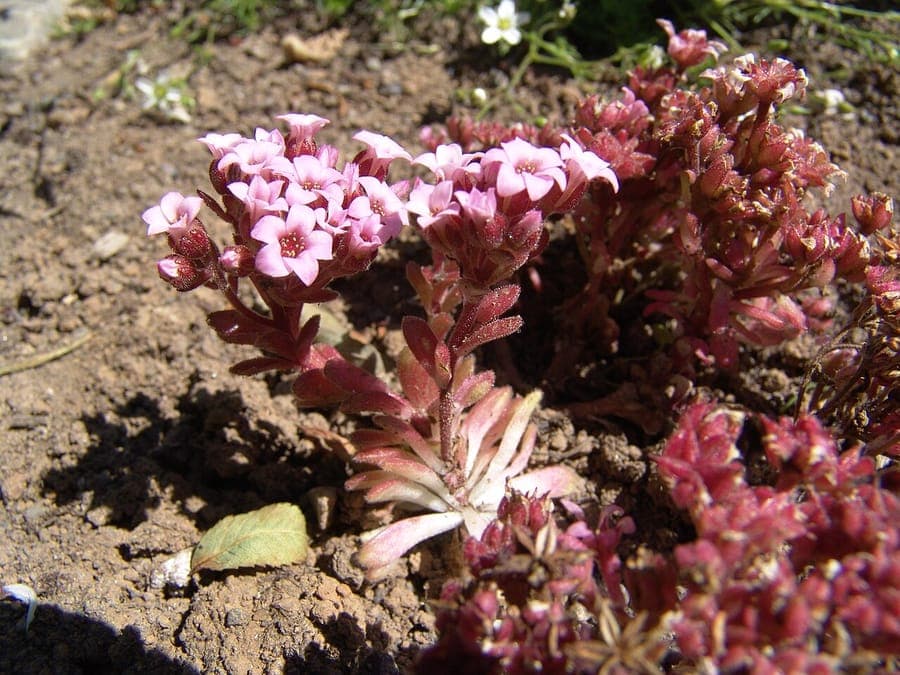
Manfred Morgner (ka-em-zwei-ein) / CC BY-SA 3.0, via Wikimedia Commons
Hairy stonecrop: complete guide
Sedum villosum
Want to see Hairy stonecrop: complete guide in your garden?
1 minute, no credit card
Overview
Hairy stonecrop, or Sedum villosum, is a creeping perennial succulent in the Crassulaceae family, native to damp regions across central and northern Europe. It's found naturally in wet woodlands, fens, and along stream banks in countries like Finland, Germany, Great Britain, and Iceland. In the garden, it's a quietly resilient plant that excels where other sun-loving sedums fail - in moist, partially shaded conditions.
Growing 10–20 cm tall, it forms a dense, spreading mat through stolons, making it ideal as ground cover in damp areas. The plant is fully winter hardy (USDA zones 5–8) and keeps much of its foliage through winter, turning bronze in colder months. Its most distinctive feature is the dense, velvety hair covering stems and leaves - a natural adaptation to retain moisture and protect against drying winds.
On gardenworld.app, you can design a planting scheme that highlights the natural spread and texture of hairy stonecrop, especially in shaded wetland corners.
Appearance & bloom cycle
The foliage is soft to the touch, with narrow, lance-shaped leaves 1–2 cm long, arranged densely along fuzzy green stems. In midsummer (June to August), clusters of tiny star-shaped flowers appear at the tips. Each bloom is about 5 mm wide, pale pink to whitish, and attracts hoverflies, small bees, and butterflies. While not showy, the flowers add subtle charm and support pollinators in a low-light garden.
After flowering, seed capsules form and split open in autumn, releasing fine seed. Vegetative spread via stolons is the main method of expansion, creating a weed-suppressing carpet over time. The plant dies back slightly in winter but remains semi-evergreen in milder climates.
Ideal location
Choose a spot with light to partial shade. Full sun is acceptable only if the soil stays consistently moist. Hairy stonecrop thrives in damp woodland edges, bog gardens, or near water features. It's excellent between pavers in shaded paths or under shrubs where moisture collects.
Avoid dry, sandy, or alkaline soils. This isn't a rock garden sedum - it needs dampness. It performs best in microclimates with high humidity and low evaporation, such as north-facing slopes or under deciduous trees.
Soil requirements
Sedum villosum prefers moist, humus-rich soil with a pH between 4.5 and 5.0 - acidic to slightly acidic. A mix of peat-free compost, leaf mould, and a bit of sand works well. Avoid chalky or lime-rich soils, which will stunt growth. Heavy clay can be improved with organic matter to enhance drainage while retaining moisture.
If your garden has neutral soil, consider planting in a raised bed with an ericaceous mix, commonly used for rhododendrons and heathers. This creates the ideal acidic environment without altering the entire garden.
Free design
Want to see Hairy stonecrop: complete guide in your garden? Make a free design now.
Watering
Keep the soil consistently moist, especially from March through July. During hot, dry spells, water at least twice a week. Use rainwater if possible, as tap water can be too alkaline. Young plants are particularly vulnerable to drying out.
Once established, hairy stonecrop is more resilient but still dislikes drought. Mulch with pine needles or fine bark to retain moisture and slowly acidify the soil. Avoid standing water - while the plant likes damp soil, it won't tolerate waterlogged roots.
Pruning
Pruning is minimal. In early spring, remove any dead or damaged stems to encourage fresh growth. Lightly trim back overgrown areas if needed, but avoid heavy cutting. The plant self-manages well and doesn't require shaping.
Leave flower heads intact over winter for structure and to support overwintering insects. Cut back only if the appearance becomes too messy by late winter.
Maintenance calendar
- Jan: Check for winter damage; remove any mushy stems
- Feb: No action needed
- Mar: Clear old growth; add acidic mulch
- Apr: New shoots emerge; monitor moisture
- May: Active growth; protect from drying winds
- Jun: Flowering begins; watch for slugs
- Jul: Peak bloom; ensure consistent moisture
- Aug: Flowers fade; seed formation starts
- Sep: Growth slows; reduce watering slightly
- Oct: Prepare for dormancy; leave seed heads
- Nov: No pruning; let plant rest
- Dec: Fully dormant; no care required
Winter hardiness
Hairy stonecrop is hardy down to -25°C (USDA zone 5). In zones 6–8, it remains semi-evergreen with bronze-tinted foliage. No winter protection is needed, even in wet soils. Avoid covering with plastic, which can trap moisture and cause rot. The plant naturally survives freezing and thawing cycles.
Companion plants
Pair with other moisture-loving, shade-tolerant perennials:
- Hosta (especially dwarf varieties)
- Alchemilla mollis
- Carex elata 'Aurea'
- Tellima grandiflora
- Lysimachia clethroides
These combinations create layered textures in a damp, shaded garden. Avoid aggressive spreaders unless contained. Hairy stonecrop fills gaps gracefully without choking out neighbours.
On gardenworld.app, you can generate a planting plan that integrates these companions based on your garden's light and soil conditions.
Closing
Hairy stonecrop is an underrated gem for moist, shady gardens. It brings soft texture, subtle flowers, and year-round interest without high maintenance. With the right acidic, damp soil and light shade, it forms a lush carpet that few other succulents can match. Look for it at garden centres like B&Q, Wyevale, or local nurseries, or order online from specialists in native perennials.
Want to see Hairy stonecrop: complete guide in your garden? Make a free design now.
Upload a photo, pick a style, and get a photorealistic design with plant list in under a minute.
No credit card required


Similar plants
Sedum nevadense: complete guide
Sedum nevadense
Discover Sedum nevadense, the stunning alpine stonecrop from the Pyrenees. Expert care tips, growing requirements, and design ideas for rock gardens.
Aizoon stonecrop: complete guide
Phedimus aizoon
Everything about Phedimus aizoon - the frost-tolerant aizoon stonecrop from Siberia with bright yellow flowers. Planting, care and garden use.
Roseroot: complete guide
Rhodiola rosea
Everything about roseroot (Rhodiola rosea): a tough hardy succulent ideal for rock gardens, green roofs, and dry sunny positions.