
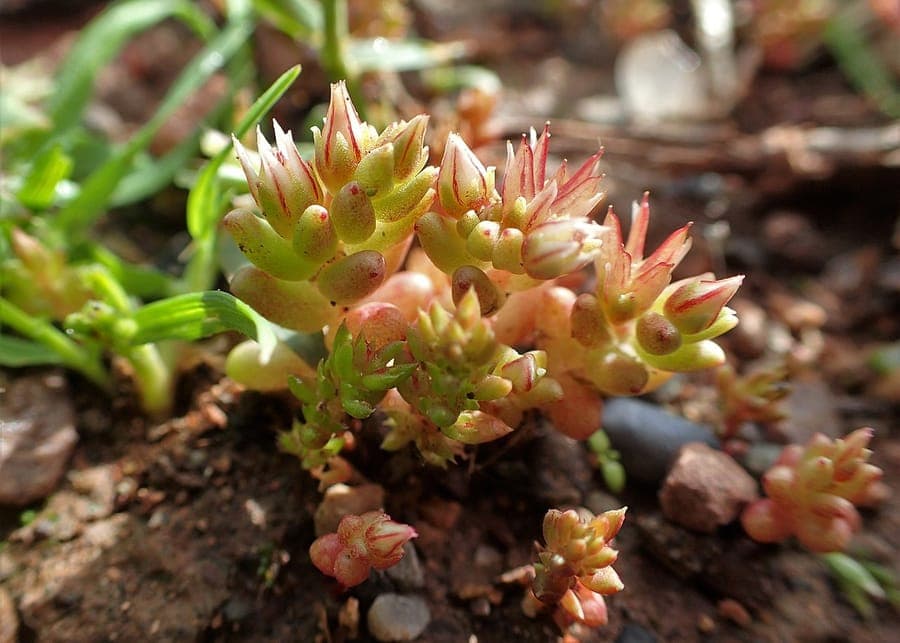
Krzysztof Ziarnek, Kenraiz / CC BY-SA 4.0, via Wikimedia Commons
Red stonecrop: complete guide
Sedum rubens
Want to see Red stonecrop: complete guide in your garden?
1 minute, no credit card
Overview
Sedum rubens, commonly known as Red stonecrop, is a low-growing succulent that thrives in dry, sunny conditions. Native to regions like the Balearic Islands, Corsica, and Cyprus, this hardy plant has adapted to hot summers and mild winters. In garden settings across temperate climates, it excels as a ground cover, spilling over rock walls or filling gaps between paving stones. It's tough, drought-resistant, and adds a splash of summer colour - making it a staple for xeriscaping and sustainable gardens.
If you're designing a dry garden, use gardenworld.app to visualise how Red stonecrop can weave through your rockeries or soften the edges of a gravel path. Its compact growth and vibrant blooms make it ideal for creating low-effort, high-impact designs.
Appearance & bloom cycle
Red stonecrop forms a dense, creeping mat, typically 5–8 cm tall and spreading up to 30 cm wide. The foliage is fleshy, dark green, and arranged in tight rosettes along trailing stems. From June to August, it bursts into bloom with clusters of rich crimson flowers. These star-shaped blooms last for several weeks and attract pollinators like bees and hoverflies.
As the season progresses, spent flowers fade to a soft tan, maintaining visual interest into autumn. Even in dormancy, the plant retains a tidy appearance, which is rare among seasonal ground covers. This makes it a valuable addition to year-round garden schemes.
Ideal location
Choose a spot with plenty of sun - aim for a light level of 7 out of 10, which translates to at least 5–6 hours of direct sunlight daily. Red stonecrop performs best in full sun but tolerates light shade. South- or southwest-facing slopes, rock gardens, and raised beds are ideal. It also works well in crevices of dry stone walls or in containers on sunny patios.
Avoid heavily shaded areas, as this leads to leggy growth and poor flowering. In consistently wet, shady spots, the plant may rot. Before planting, assess sun exposure using tools like gardenworld.app, which helps map sunlight patterns in your garden.
Soil requirements
This succulent isn't fussy about soil fertility, but drainage is critical. It prefers a slightly acidic to neutral pH (5.5–6.5). Heavy clay soils should be amended with coarse sand, gravel, or perlite to improve drainage. A mix of equal parts garden soil, sand, and compost works well in raised beds or pots.
Never plant in water-retentive soils. Poor drainage leads to root rot, especially in winter. When planting in containers, use a cactus or succulent mix and ensure pots have drainage holes. A layer of gravel at the bottom helps prevent waterlogging.
Free design
Want to see Red stonecrop: complete guide in your garden? Make a free design now.
Watering
Once established, Red stonecrop needs minimal watering. During active growth (April–September), water every 10–14 days in dry spells. In rainy summers, no supplemental irrigation is needed. Use rainwater when possible - it's free of chlorine and lime, which can build up in the soil.
In winter, reduce watering to almost zero. The plant is dormant and susceptible to rot if overwatered. Always check the soil moisture before watering - if the top 2–3 cm is dry, it's safe to water lightly.
Pruning
Pruning isn't essential, but a light trim in early spring (March–April) keeps the plant looking fresh. Remove dead foliage and spent flower stems to encourage new growth and reduce disease risk. Use clean, sharp secateurs and disinfect between cuts to prevent spreading pathogens.
Don't cut into old wood - this species regenerates from green stems. Save the trimmings; they root easily in well-drained soil and can be used to propagate new plants.
Maintenance calendar
- Jan: Dormant. Check for rot or pests.
- Feb: Inspect for winter damage. Remove any debris.
- Mar: Trim old growth. Apply light cactus fertiliser.
- Apr: New growth appears. Water sparingly in dry weather.
- May: Prepare for bloom. Avoid fertilising.
- Jun-Aug: Flowering period. Keep soil on the dry side.
- Sep: Growth slows. Leave seed heads for winter interest.
- Oct: Stop watering. Let soil dry completely.
- Nov: Clear fallen leaves to prevent mould.
- Dec: Full dormancy. Protect containers from freezing.
Winter hardiness
Red stonecrop is hardy in USDA zones 7b to 9 (down to -12°C). In colder zones, it may die back but often re-sprouts in spring if roots remain dry. In wet winters, even in zone 7, poor drainage can be fatal. For extra protection, add a light mulch of gravel or pine needles.
Potted plants are more vulnerable - move them to a sheltered spot or against a warm wall. Avoid organic mulches like bark, which retain moisture and promote rot.
Companion plants
Pair Red stonecrop with other drought-tolerant species. Good companions include creeping thyme (Thymus serpyllum), Sedum spurium, dwarf lavender (Lavandula angustifolia 'Hidcote'), and Artemisia schmidtiana. These create textural contrast and extend seasonal interest.
For a naturalistic look, plant between flagstones or in wall crevices. Avoid aggressive spreaders like ivy or mint, which can overwhelm Sedum rubens. The plant also complements ornamental grasses like Festuca glauca.
Closing
Red stonecrop is a reliable, low-maintenance perennial that brings bold colour to dry areas. It's perfect for rock gardens, green roofs, or as a living mulch. You can find it at local garden centres or reputable suppliers like those listed on gardenworld.app. Once planted in the right spot, it asks for little and gives back a lot. When planning your next garden update, check gardenworld.app to see how this vibrant succulent can fit into your design.
Want to see Red stonecrop: complete guide in your garden? Make a free design now.
Upload a photo, pick a style, and get a photorealistic design with plant list in under a minute.
No credit card required


Similar plants
Sedum nevadense: complete guide
Sedum nevadense
Discover Sedum nevadense, the stunning alpine stonecrop from the Pyrenees. Expert care tips, growing requirements, and design ideas for rock gardens.
Aizoon stonecrop: complete guide
Phedimus aizoon
Everything about Phedimus aizoon - the frost-tolerant aizoon stonecrop from Siberia with bright yellow flowers. Planting, care and garden use.
Roseroot: complete guide
Rhodiola rosea
Everything about roseroot (Rhodiola rosea): a tough hardy succulent ideal for rock gardens, green roofs, and dry sunny positions.