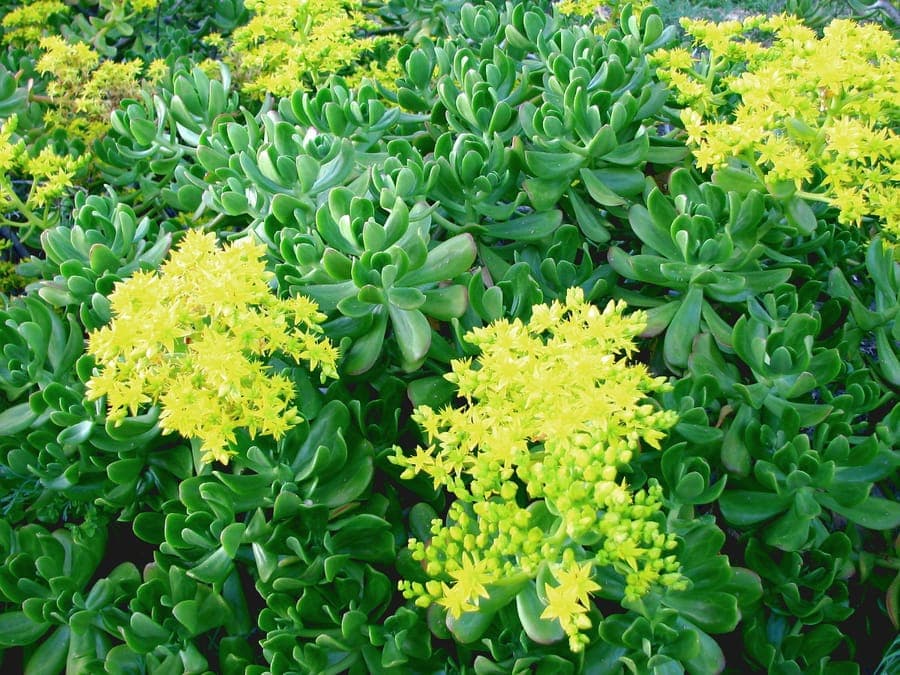
Seán A. O'Hara from Berkeley, CA, USA / CC BY 2.0, via Wikimedia Commons
Sedum praealtum (Green cockscomb): complete guide
Sedum praealtum
Want to see Sedum praealtum (Green cockscomb): complete guide in your garden?
Full design in HD: €7.99
Look after your Sedum praealtum with the GardenWorld app
Identify plants with your camera and get a care calendar with reminders for this plant.


Overview
Sedum praealtum, better known as green cockscomb, is a robust succulent native to Mexico through El Salvador. This plant from the stonecrop family is renowned for its thick, green leaves that store energy. With minimal support, this plant creates an interesting structural element in garden or container.
Appearance and Bloom
Green cockscomb grows as a compact, upright shrub with thick, green leaves arranged in rosettes. The leaves are approximately 5-10 centimeters long and have a waxy surface. In late spring, yellow flowers appear in dense clusters at the top of the plant. The plant reaches about 0.5-1 meter in height.
Ideal Location
Choose a sunny location with at least four to six hours of direct sunlight. This plant also tolerates partial shade but blooms better in full sun. Ensure good air circulation. In warmer climate, some afternoon shade helps against intense heat.
Soil
Succulents require very well-draining soil. A mixture of cactus soil or sand with some leaf mold is ideal. Acidic to neutral soil (pH 5.5-7.0) is suitable. Ensure water does not stagnate. Poor-draining soil leads to root rot.
Watering
Let soil dry completely between waterings. Water sparingly, especially in winter. Excessive water is the biggest threat to succulents. During growing season (spring-summer), water somewhat more regularly. Winter minimal water.
Free preview
Want to see Sedum praealtum (Green cockscomb): complete guide in your garden? Make a free preview of your design.
Pruning
Pruning is usually unnecessary. Remove dead or damaged leaves and leaf rosettes. Old plant can be gently cut back for more compact form. Removed parts can be re-planted.
Maintenance Calendar
Spring: Begin feeding with cactus fertilizer. Summer: Water regularly, ensure good light. Autumn: Reduce feeding. Winter: Minimal water, no feeding, frost protection.
Winter Hardiness
Sedum praealtum is moderately hardy to about -5 to -8 degrees Celsius. In colder regions, better to grow in pots and overwinter indoors. In warmer climate can stay outdoors. Protection from wet frost is crucial.
Companion Plants
Combine with other succulents like echeveria, aloe and jade plants. Perfect for dry borders, rock gardens and alpine troughs. Functions well in large containers and mixed succulent arrangements.
Closing
Sedum praealtum is an ideal choice for dry, sunny garden locations. With practically no maintenance, this plant delivers year after year interesting structure and yellow blooming. Find plant material at garden centers and online suppliers.
Discover more on gardenworld.app/en about succulents and dry garden design!
Frequently asked questions about Sedum praealtum
Is Sedum praealtum winter hardy?
Sedum praealtum is moderately hardy to about -5 to -8 degrees Celsius. In colder regions, better to grow in pots and overwinter indoors.
When and how do you prune Sedum praealtum?
Pruning is usually unnecessary. Remove dead or damaged leaves and leaf rosettes.
How much water does Sedum praealtum need?
Let soil dry completely between waterings. Water sparingly, especially in winter.
Where does Sedum praealtum grow best?
Choose a sunny location with at least four to six hours of direct sunlight. This plant also tolerates partial shade but blooms better in full sun.
What soil does Sedum praealtum need?
Succulents require very well-draining soil. A mixture of cactus soil or sand with some leaf mold is ideal.

See it in your garden
See Sedum praealtum in your garden
One photo of your garden and a few questions. You see the result in about a minute.
Try it with a photoIdentify this plant in your own garden. Identify a plant
Similar plants
Aeonium tabuliforme: growing the saucer plant
Aeonium tabuliforme
Aeonium tabuliforme, the saucer plant, forms a flat, hairy rosette like a green plate. How to grow this Tenerife succulent, tilt it, water it and overwinter it.
String of buttons (Crassula perforata): care guide
Crassula perforata
How to grow string of buttons, Crassula perforata: light, watering, compost, cuttings and overwintering for this succulent with leaf pairs stacked like beads on a stem.
Glaucous echeveria (Echeveria secunda): complete guide
Echeveria secunda
Echeveria secunda forms mats of blue-grey rosettes with red leaf tips and is one of the toughest echeverias. Light, watering, potting mix, propagation and pet safety.
