
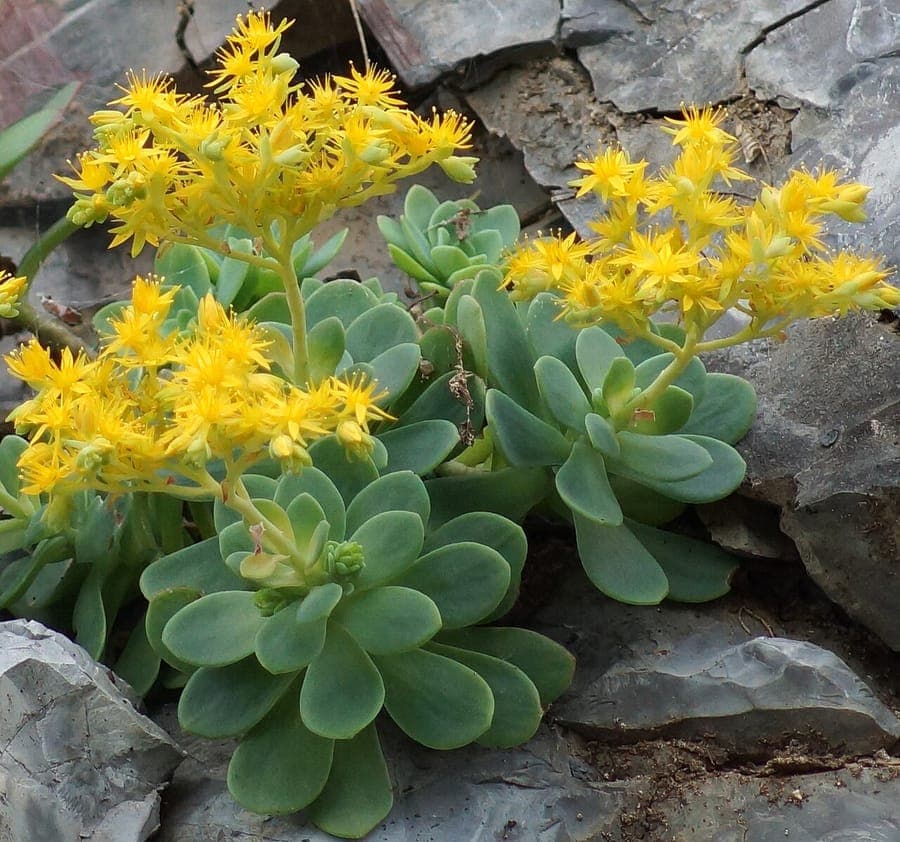
sergio niebla from Cd. Victoria, Tamaulipas, México / CC BY-SA 2.0, via Wikimedia Commons
Sedum palmeri: complete guide
Sedum palmeri
Want to see Sedum palmeri: complete guide in your garden?
1 minute, no credit card
Overview
Sedum palmeri is an impressive succulent originating from Mexico, specifically from the still-wild mountain regions of Veracruz and Jalisco. This is a true gem from the tropics that grows perfectly in temperate climates. It's highly interesting for succulent enthusiasts who want something different from common varieties.
What makes Sedum palmeri special is the combination of imposing foliage and compact growth habit. This plant forms attractive clusters and can develop beautifully colored leaves throughout the season, especially under stress conditions.
Appearance & Bloom
Sedum palmeri grows as a compact, slightly upright succulent with thick, fleshy leaves arranged in strong rosettes. The foliage ranges from brownish-gray to greenish-gray and can blush pink to red under bright light - giving it special ornamental value, particularly in sunny winters.
Flowers appear during warm growing seasons (late spring to early summer) and are small, white to creamy yellow. They form in compact inflorescences rising above the foliage. These flowers attract pollinators and give the plant an elegant appearance.
Ideal Location
Sedum palmeri thrives best on a very sunny spot. Minimum 6-8 hours of direct sunlight daily are essential for good growth and color development. The more sun the plant receives, the more beautiful red and purple tones will emerge.
Give it a protected location away from excessive rain and cold wind. During warm seasons, you can place it on a terrace or balcony. The plant adapts easily to various light conditions, though full sun really brings out the best display.
Soil
For soil composition, the same rules apply as other succulents: excellent drainage is key. Sedum palmeri needs very light, porous soil. Create a mix of 50% coarse sand or perlite, 40% succulent potting mix, and 10% coconut fiber.
The plant isn't fussy about pH, but the absence of standing water is critical. In containers, add 2-3 centimeters of gravel to the pot bottom for extra drainage.
Free design
Want to see Sedum palmeri: complete guide in your garden? Make a free design now.
Watering
Sedum palmeri is a true drought-lover like its relatives. Water only when soil feels completely dry, usually once every two weeks during growing season. In winter, watering is greatly reduced - essentially just checking that roots don't completely dry out.
Watch for moisture accumulation and stagnation; this kills many succulents. When in doubt, skip watering. The plant can survive weeks without water as it stores moisture in its leaves.
Pruning
Sedum palmeri barely needs pruning. Simply remove dead or damaged leaves and flowers after blooming. If the plant becomes too large or grows out of shape, gently prune back some stems in early spring.
These cut pieces are excellent for propagation - let them dry for a few days, then place in dry soil where they'll root themselves.
Maintenance Calendar
January to March: Winter period. Minimal water. Check root health.
April to May: Growing season begins. Gradually increase water. No fertilizer needed.
June to August: Active growth and flowering. Water regularly. Plant thrives in warmth.
September to October: Cooling begins. Gradually reduce water. Plant prepares for rest.
November to December: Deep winter dormancy. Almost no water. Keep dry and cool.
Winter Hardiness
Sedum palmeri is less cold-hardy than many other Sedum species. The plant can tolerate frost days down to minus 10 degrees Celsius, but prolonged frost below -5 degrees can cause problems. In cold-winter climates, it's wise to keep the plant indoors.
In southern Netherlands, it can overwinter outside under a protective mulch layer. Use pots so you can quickly bring it inside if needed.
Companion Plants
Sedum palmeri works beautifully in Mediterranean gardens and xeriscapes. Pair it with other Mexican succulents like Echeveria, Aeonium, and other Sedum varieties. Also lovely combined with gray-green herbaceous plants like Santolina or Artemisia.
In green roofs, it's part of lively mixed plantings. It contrasts wonderfully with red and orange flowers from nearby plants.
Closing Thoughts
Sedum palmeri is a recognized favorite for many gardeners due to its unique appearance and trouble-free cultivation. With minimal care, you achieve maximum beauty. Place it in your sunniest spot and practically forget about it - the plant does the work and rewards you every year. Gardenworld.app helps you design a garden where succulents take center stage. Gardenworld.app makes garden design simple!
Want to see Sedum palmeri: complete guide in your garden? Make a free design now.
Upload a photo, pick a style, and get a photorealistic design with plant list in under a minute.
No credit card required


Similar plants
Sedum nevadense: complete guide
Sedum nevadense
Discover Sedum nevadense, the stunning alpine stonecrop from the Pyrenees. Expert care tips, growing requirements, and design ideas for rock gardens.
Aizoon stonecrop: complete guide
Phedimus aizoon
Everything about Phedimus aizoon - the frost-tolerant aizoon stonecrop from Siberia with bright yellow flowers. Planting, care and garden use.
Roseroot: complete guide
Rhodiola rosea
Everything about roseroot (Rhodiola rosea): a tough hardy succulent ideal for rock gardens, green roofs, and dry sunny positions.