Walter Siegmund (talk) / CC BY-SA 3.0, via Wikimedia Commons
Oregon Stonecrop: complete guide
Sedum oreganum
Want to see Oregon Stonecrop: complete guide in your garden?
Full design in HD: €7.99
Look after your Oregon Stonecrop with the GardenWorld app
Identify plants with your camera and get a care calendar with reminders for this plant.


Overview
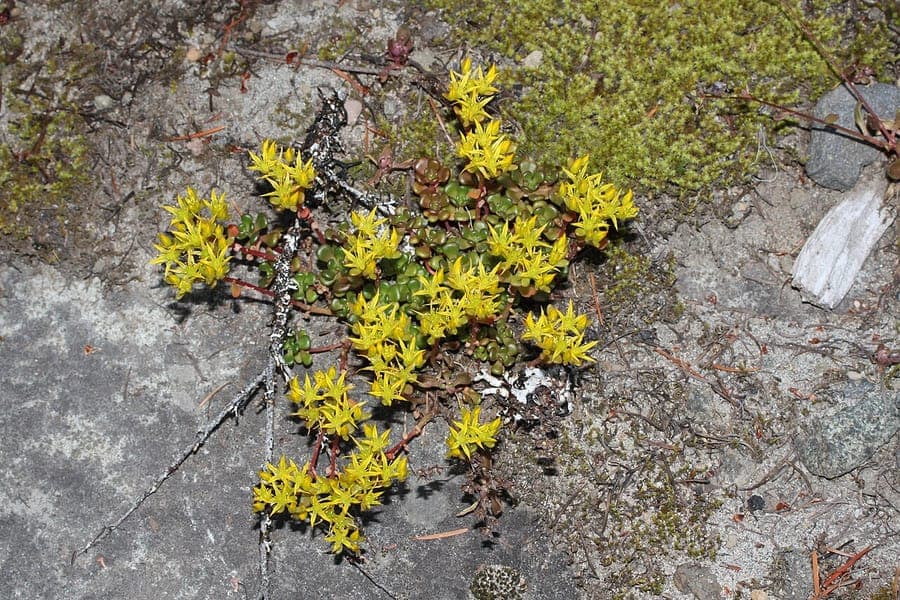
Sedum oreganum, commonly called Oregon stonecrop, is a compact succulent from the Crassulaceae (stonecrop) family. Native from Alaska to California, this tiny jewel grows on rocky slopes and steep terrain in alpine and subalpine zones. With its diminutive form, attractive foliage, and rosy-red flowers, it is perfect for rock gardens, green roofs, and crevice planting in cool to cold climates.
Appearance and Bloom
Sedum oreganum forms dense, clump-forming rosettes with tiny, fleshy green leaves that often turn reddish in winter. The plant is typically just 5-10 cm tall but spreads much wider (to 30 cm), making it superb for groundcover and roof applications. In June-July, small star-shaped flowers appear in pink to red, arranged in loose clusters. Blooms attract bees, though they are diminutive.
Ideal Location
Full sun to light half-shade. Minimum 4-5 hours direct sunlight, ideally 6+. This is not a plant for deep shade. More sun helps red tones develop richly.
Soil
Extremely well-draining, lean, sandy soil. This succulent rejects heavy, moist soil absolutely. Ideal: proprietary green-roof mix, alpine grit, rocky aggregate mix, or specialised drainage blend. pH 6-7.5. No feeding required; actually, very poor soil is preferred.
Free preview
Want to see Oregon Stonecrop: complete guide in your garden? Make a free preview of your design.
Watering
Minimal water. Once planted, almost no supplemental water needed. In extreme drought, a light spray may help. Overwatering is the primary killer. In crevices or green roofs: virtually no water required.
Pruning
No pruning required. Remove spent flower heads after bloom if desired for tidiness (optional). The plant regenerates via self-seeding or vegetative spread.
Maintenance Calendar
May: No maintenance required. Plant begins growth. June-July: Blooms. Enjoy red tones. No watering needed. August-October: Plant winds down for winter. Leaf reddening occurs. No maintenance. November-April: Dormancy period. Parts may freeze back wholly.
Winter Hardiness
USDA Zone 3-9. Extremely cold-hardy, endures temperatures to -34 C (-30 F). This is a plant for severest winters. No winter protection needed in the UK, northern France, Germany, or similar climates. Perfect for alpine gardens.
Companion Plants
Other succulents: Sempervivum (houseleeks), other sedums (S. spurium, S. acre). Alpine groundcovers: Thymus, Arabis, Phlox subulata. Rocky shrubs: Genista, Helianthemum. Grey foliage: Senecio, dwarf Artemisia.
Find stock at garden centres and alpine plant specialists across the UK and Europe.
Closing
Sedum oreganum is an ideal succulent for lean, dry sites and green roofs. Winter-hardy, maintenance-free, and visually interesting thanks to red foliage and blooms. Plant in well-draining soil, set it, and forget it.
Frequently asked questions about Oregon Stonecrop
Is Oregon Stonecrop winter hardy?
USDA Zone 3-9. Extremely cold-hardy, endures temperatures to -34 C (-30 F).
When and how do you prune Oregon Stonecrop?
No pruning required. Remove spent flower heads after bloom if desired for tidiness (optional).
How much water does Oregon Stonecrop need?
Minimal water. Once planted, almost no supplemental water needed.
Where does Oregon Stonecrop grow best?
Full sun to light half-shade. Minimum 4-5 hours direct sunlight, ideally 6+.
What soil does Oregon Stonecrop need?
Extremely well-draining, lean, sandy soil. This succulent rejects heavy, moist soil absolutely.

See it in your garden
See Oregon Stonecrop in your garden
One photo of your garden and a few questions. You see the result in about a minute.
Try it with a photoIdentify this plant in your own garden. Identify a plant
Similar plants
Aeonium tabuliforme: growing the saucer plant
Aeonium tabuliforme
Aeonium tabuliforme, the saucer plant, forms a flat, hairy rosette like a green plate. How to grow this Tenerife succulent, tilt it, water it and overwinter it.
String of buttons (Crassula perforata): care guide
Crassula perforata
How to grow string of buttons, Crassula perforata: light, watering, compost, cuttings and overwintering for this succulent with leaf pairs stacked like beads on a stem.
Glaucous echeveria (Echeveria secunda): complete guide
Echeveria secunda
Echeveria secunda forms mats of blue-grey rosettes with red leaf tips and is one of the toughest echeverias. Light, watering, potting mix, propagation and pet safety.
