
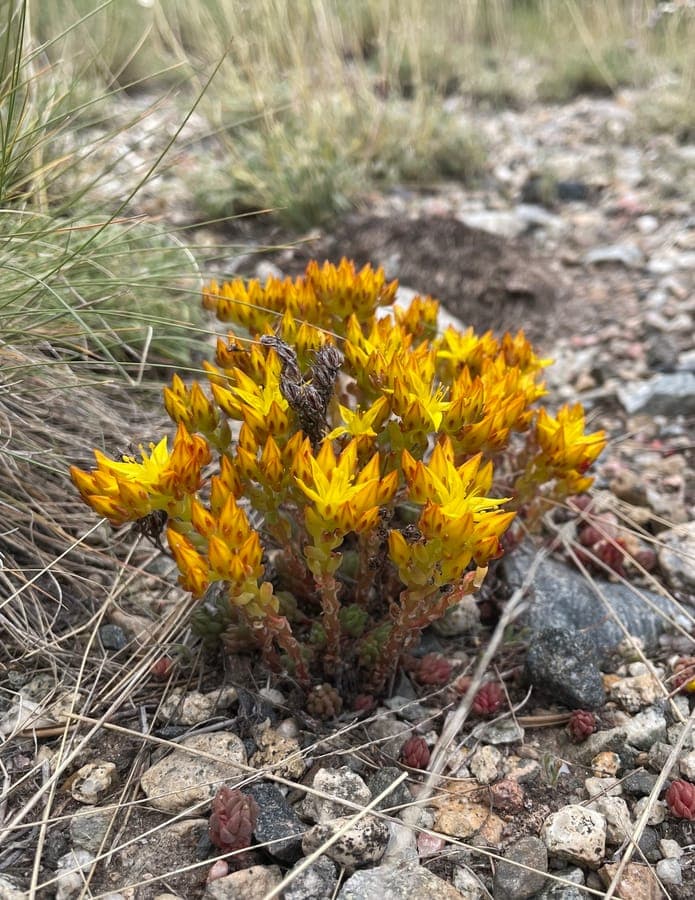
Stephen Hornbeck https://www.inaturalist.org/people/stephen_hornbeck / CC BY 4.0, via Wikimedia Commons
Sedum lanceolatum: complete guide
Sedum lanceolatum
Want to see Sedum lanceolatum: complete guide in your garden?
1 minute, no credit card
Overview
Sedum lanceolatum, commonly known as Spearleaf stonecrop or Lanceleaf stonecrop, is a compact succulent native to Alaska through western North America. This tiny, shallow-rooted plant is an absolute favorite for alpine gardens, dry rock gardens, and container planting. With its slim, pointed leaves and bright yellow summer flowers, this plant is an elegant yet hardy addition to any low-maintenance garden arrangement preference.
Appearance and bloom
Sedum lanceolatum forms compact rosettes of slim, sharply-oval leaves that are dark green to reddish-tinged depending on sunlight and season. The plant grows only a few centimeters tall and spreads laterally via runners. From June through August, bright yellow, starry flowers appear in loose spikes above the foliage. The flowers attract insects with their nectar. After blooming, flower-bearing rosettes die and are replaced by lateral shoots.
Ideal location
Choose full sun for this plant - at least 6-8 hours of direct sunlight daily. Sedum lanceolatum thrives optimally in very sunny, exposed locations. Good water drainage and available airflow are essential. The plant tolerates wind and exposure well. In hotter climates, some afternoon shade may be welcome to avoid leaf-scorch, but growth and flowering will be reduced. This plant is easily satisfied in marginal soils other plants shun.
Soil
Sedum lanceolatum requires extremely well-draining soil - nearly pure sand. Heavy soils MUST be amended with mineral sand, gravel, and fine rocks. Add very little organic matter; too much will cause water pooling and root rot. A pH of 6.0-7.5 is suitable. For container growth, use specialized succulent potting mix. In garden planting, sow onto exposed sand or gravel patches without any organic material.
Free design
Want to see Sedum lanceolatum: complete guide in your garden? Make a free design now.
Watering
Once established, Sedum lanceolatum is very drought-tolerant. During the growing season, water only when the soil feels very dry - perhaps once every 2 weeks or less. Too much water is deadly. In container growth, water carefully in dry weather, but much prefer allowing it to dry between waterings. In autumn and winter, provide virtually no water; the plant rests.
Pruning
Minimal pruning needed. Remove dead or damaged leaves. After blooming, spent flower stems can be clipped off. Allow side shoots to grow to form new rosettes. In containers, gentle thinning can help keep the plant compact. Overall, this is a self-managing plant that requires no aggressive pruning.
Maintenance calendar
Spring: minimal maintenance, wait for growth to begin. Summer: watch for blooming, no fertilizer needed. Autumn: reduce watering, no interventions. Winter: keep dry, do not water.
Winter hardiness
Sedum lanceolatum is very winter-hardy, to -35 degrees Celsius in well-drained conditions. This plant grows in alpine zones of North America and tolerates severe frost without issue. In temperate climates, plants can overwinter outdoors as long as drainage is perfect. In very wet winters, moisture can be more problematic than cold. Mulch is not recommended as it promotes moisture retention.
Companion plants
Sedum lanceolatum combines beautifully with other alpine succulents: Sedum acre, Sempervivum species, Aeonium, and Jovibarba. Plant in rock gardens with other dwarf alpines such as Silene and Armeria. In troughs and containers, pair with fine sedums and silvery gray-foliage plants for texture contrast. Avoid moisture-loving plants.
Closing
Sedum lanceolatum is an excellent choice for those seeking a reliable, barely-maintained succulent that is also appealing with its yellow summer flowers. Suitable for rock gardens, containers, troughs, and alpine arrangements. Available through specialized sources. Discover more on gardenworld.app or gardenworld.app.
Want to see Sedum lanceolatum: complete guide in your garden? Make a free design now.
Upload a photo, pick a style, and get a photorealistic design with plant list in under a minute.
No credit card required


Similar plants
Sedum nevadense: complete guide
Sedum nevadense
Discover Sedum nevadense, the stunning alpine stonecrop from the Pyrenees. Expert care tips, growing requirements, and design ideas for rock gardens.
Aizoon stonecrop: complete guide
Phedimus aizoon
Everything about Phedimus aizoon - the frost-tolerant aizoon stonecrop from Siberia with bright yellow flowers. Planting, care and garden use.
Roseroot: complete guide
Rhodiola rosea
Everything about roseroot (Rhodiola rosea): a tough hardy succulent ideal for rock gardens, green roofs, and dry sunny positions.