
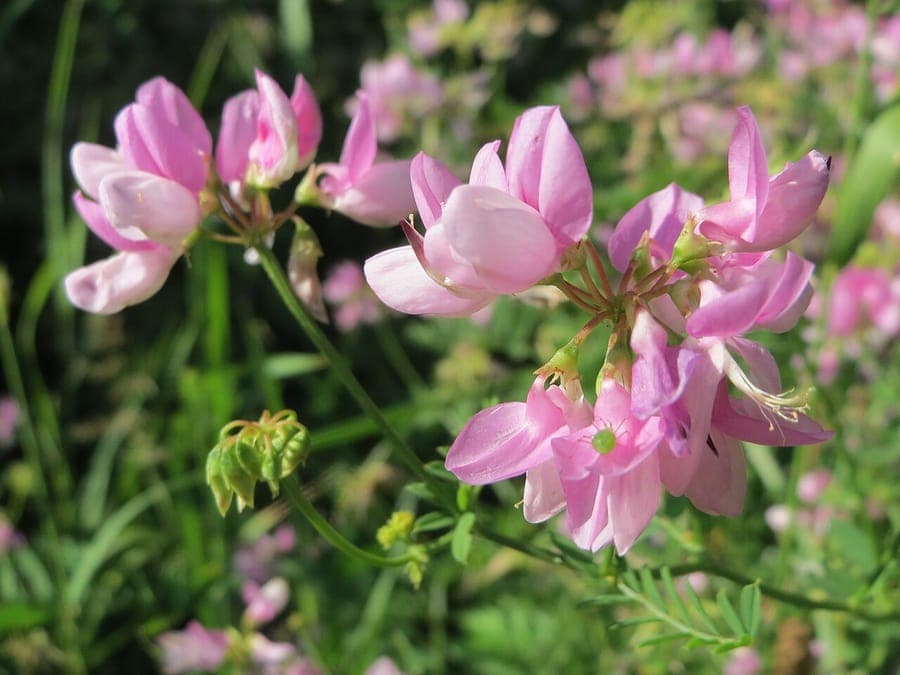
AnRo0002 / CC0, via Wikimedia Commons
Trailing crown-vetch: complete guide
Securigera varia
Want to see Trailing crown-vetch: complete guide in your garden?
1 minute, no credit card
Overview
Trailing crown-vetch (Securigera varia) is a fascinating climbing plant from the legume family, native to Europe through Central Asia. This versatile plant produces attractive red-white flower clusters and grows readily as a climbing or creeping plant. With its lasting interest, wildlife-friendly properties, and low maintenance requirements, this crown-vetch offers a unique garden addition.
Appearance and Bloom
Trailing crown-vetch grows as a climbing or scrambling plant, typically 50-100 centimeters long depending on support. The plant produces characteristic pinnate leaves typical of the legume family. From June through September, numerous small flowers appear in dense clusters combining red-white colors. These flowers are highly attractive to pollinators, especially bees. Following bloom, seed pods develop that remain visually interesting until ripening and opening.
Ideal Location
Plant trailing crown-vetch in full sun to partial shade where it can climb along trellis, lattice, or netting. It can also serve as a groundcover on sloping terrain. This plant thrives along property edges, against fences, or along pergolas. Provide space for spreading. In full sun, the plant blooms more abundantly with more intense flower colors.
Soil
Trailing crown-vetch is extremely soil-tolerant and grows in nearly all soil types except heavy wet clay. Well-draining, moderately fertile soil is ideal. This plant benefits from nitrogen fixation via root nodules, so fertilizing is nearly unnecessary. Even nutrient-poor soil suffices. In heavy terrain, some sand or compost can be worked in for improved drainage.
Watering
Once established, trailing crown-vetch is drought-tolerant. Water regularly during the first growing season to establish roots well. After that, this plant requires minimal water. Water only during prolonged drought. This legume family member can endure even dry summer periods. Overwatering can harm roots.
Free design
Want to see Trailing crown-vetch: complete guide in your garden? Make a free design now.
Pruning
Pruning of trailing crown-vetch is minimal. Remove spent flowers regularly to encourage continued bloom. After first flowering in August, gentle cutback to one-third may encourage second blooming. Dead or damaged plant parts can be removed. Allow seed to ripen and dry on the plant if you want natural seeding or bird food.
Maintenance Calendar
May: Install support if plant must climb. June-September: Bloom period, regular deadheading. August: First bloom completes, gentle pruning for second bloom. October: Late flowering, seed begins ripening. November-March: Plant dies back to ground level in cold regions, remains semi-evergreen in milder climates.
Winter Hardiness
Trailing crown-vetch is moderately winter-hardy, tolerating temperatures down to minus 10 to minus 15 degrees Celsius. In severe winters, the plant dies back to roots and will recover the following spring. In milder climates, the plant can overwinter above ground. Mulching around the base in cold regions helps protect roots.
Companion Plants
Combine trailing crown-vetch with other climbers like clematis, hops, or jasmine. Low-growing companions can be lavender, sage, and perennials. The flowers attract butterflies and bees, so position this alongside other pollinator-friendly plants. For visual contrast, combine with silver or blue-foliaged plants.
Closing
Trailing crown-vetch is a charming, versatile plant for gardeners seeking interesting climbing specimens. With its extended bloom period, insect-friendly flowers, and low maintenance needs, this plant delivers months of pleasure. Find this plant at specialized nurseries. Plant this once and enjoy years of climbing charm.
Want to see Trailing crown-vetch: complete guide in your garden? Make a free design now.
Upload a photo, pick a style, and get a photorealistic design with plant list in under a minute.
No credit card required


Similar plants
Tall Silky Lupine: complete guide
Lupinus elatus
Tall silky lupine is a fast-growing Californian perennial with silvery foliage and blue-purple flower spikes, ideal for a prairie-style garden.
Garfield Lupine: complete guide
Lupinus garfieldensis
The Garfield lupine is a rare, fast-growing American perennial for alkaline, dry grassland gardens, with striking blue flower spikes.
Lupinus elegans: complete guide
Lupinus elegans
Lupinus elegans, the elegant lupine, is a spectacular blooming plant from Mexico with blue flower spikes. Care, cultivation and garden use.