
en:User:Iorsh / Public domain, via Wikimedia Commons
Scolymus hispanicus: complete guide
Scolymus hispanicus
Want to see Scolymus hispanicus: complete guide in your garden?
1 minute, no credit card
Overview
Scolymus hispanicus, better known as goldroot or Spanish golden thistle, is a versatile plant from the Mediterranean region and Iran. This unique plant is special not only for its bright yellow flowers but also for its edible roots, which are harvested as a vegetable in many Mediterranean regions.
This is a plant for gardeners who want to try something different. With its robust growth, drought tolerance, and edible parts, it is an excellent choice for food gardens and experimental plots.
Appearance and Bloom
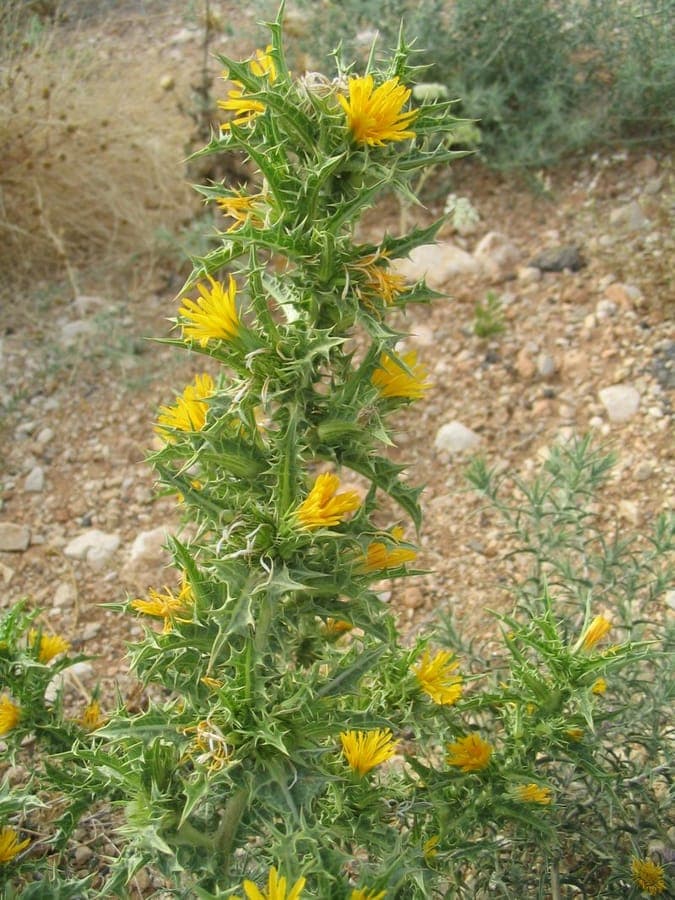
Scolymus hispanicus forms an interesting plant with sharply pointed leaves that are gray-green and often have purple tones. The leaves are linear to spatulate and can reach 20-30 centimeters long. Be careful when approaching the plant closely - the spines on the leaves are sharp and can prick.
The flowers are undoubtedly the highlight. They appear in July through September in bright yellow clusters along stems. These small, daisy-like flowers are very attractive to pollinators and other insects.
After blooming, brown seeds form that spread themselves if you let them.
Ideal Location
Scolymus hispanicus demands a warm, sunny location. At least 6-8 hours of direct sun per day is essential for good growth and blooming. This is not a plant for shade.
The plant grows well against south-facing walls, on stony slopes, and on other hot, dry locations. In very warm climates it can also tolerate some afternoon shade.
Soil
This plant is adaptable regarding soil type, as long as drainage is excellent. It grows well on:
- Sandy soil
- Gritty soil
- Lean soil
- Alkaline to neutral pH, 6.5 to 8.0
The fact is: good drainage is more important than soil nutrients. The plant tolerates lean soil much better than rich soil.
When you cultivate the plant for the roots (goldroots), you can add some compost to get larger, easier harvests.
Watering
Once established, Scolymus hispanicus requires very little water. This is a very drought-tolerant plant, especially after the first growing season.
During the first growing season water regularly, especially if it is very dry. After that, minimal water, only in serious droughts.
Excessive moisture can be problematic, especially in winter if drainage is poor. The plant prefers dry to wet conditions.
Free design
Want to see Scolymus hispanicus: complete guide in your garden? Make a free design now.
Pruning
Minimal pruning is needed. The main thing is to remove or cut back dead flower stems after blooming to keep the plant neat.
If you want bigger blooms next year, you can carefully remove some older rosettes.
Maintenance Calendar
March-April: Growing season begins. Check drainage. Water as needed.
May-June: Vegetative growth. Regular watering.
July-August: Peak blooming. Minimal watering.
September-October: Bloom declines. Seeds ripen. Remove dead flower stems.
November-February: Winter dormancy. Virtually no water. Protect from wet winters.
Winter Hardiness
Scolymus hispanicus is hardy to about -10 to -15 degrees Celsius, depending on local conditions and drainage. It may suffer from wet, cold winters.
In many European regions this plant is treated as an annual or short-lived perennial. In warmer regions it can last for years.
Companion Plants
This plant works well with other Mediterranean dry-site plants:
Euphorbia species: The red and yellow contrasts between Euphorbia and Scolymus are striking.
Foeniculum vulgare: Wild fennel grows well in the same dry conditions.
Centaurea species: Blue and purple Centaurs add color.
Salvia species: These group beautifully with Scolymus.
Onosma species: Yellow flowers of Onosma add variety.
Edible Parts
The roots of Scolymus hispanicus are edible and taste somewhat like artichoke. In traditional Mediterranean cooking they are grilled, roasted, or used in soups.
To harvest roots, carefully dig around the plant in the second year. The roots can reach 30 centimeters long.
Young leaves can also be cooked, though they are very prickly.
Propagation
Seeding is easiest. Plant seed in spring in warm conditions. Seeds germinate quickly.
You can also carefully divide roots in early spring, though this is not ideal.
Closing Thoughts
Scolymus hispanicus is a unique, robust plant that tolerates heat and drought and also produces edible roots. With minimal care you will enjoy years of yellow flowers and possibly even harvest your own goldroots. This is a plant for adventurous gardeners who want to try something different.
Want to learn more? Visit gardenworld.app. For seedlings and mature Scolymus hispanicus, check local vegetable suppliers or Mediterranean-specialized garden material vendors.
Want to see Scolymus hispanicus: complete guide in your garden? Make a free design now.
Upload a photo, pick a style, and get a photorealistic design with plant list in under a minute.
No credit card required


Similar plants
Calendula stellata: complete guide
Calendula stellata
Complete guide to Calendula stellata, the star-flowered marigold from Sicily: location, soil, watering and companion planting tips.
Korean chrysanthemum: complete guide
Chrysanthemum x rubellum
Chrysanthemum x rubellum is a hardy autumn perennial with single pink to copper flowers from August to November. Care and combinations.
Helianthus divaricatus: complete guide
Helianthus divaricatus
Helianthus divaricatus is a North American woodland sunflower with yellow summer blooms, ideal for naturalistic borders and shady edges.