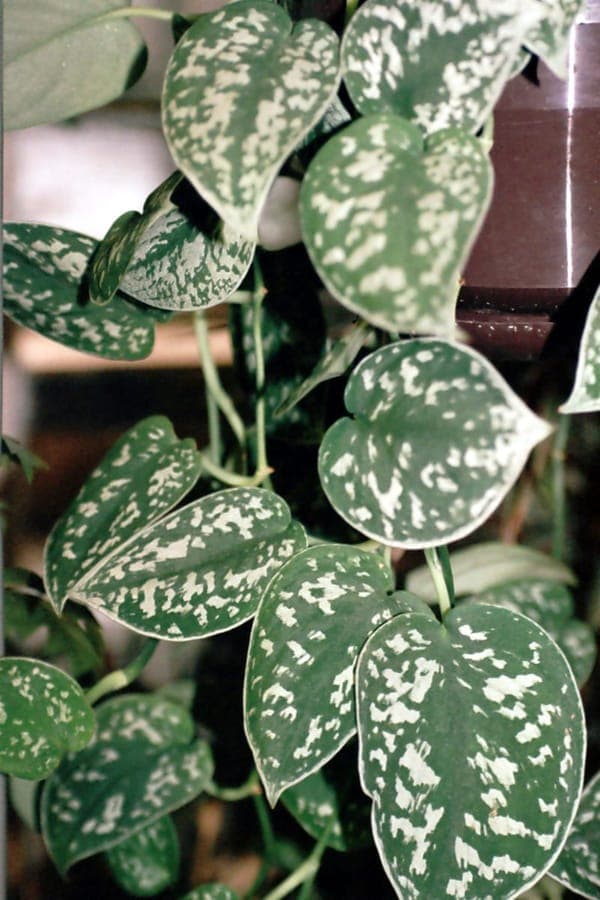
Kor!An (Корзун Андрей) / CC BY-SA 3.0, via Wikimedia Commons
Satin pothos (Scindapsus pictus): a practical care guide
Scindapsus pictus
Want to see Satin pothos (Scindapsus pictus): a practical care guide in your garden?
Full design in HD: €7.99
Look after your Satin pothos with the GardenWorld app
Identify plants with your camera and get a care calendar with reminders for this plant.


Overview
Scindapsus pictus is a climbing member of the arum family (Araceae), sold in the UK as satin pothos or silver pothos. Both names are a little misleading. The plant most people call pothos is Epipremnum aureum, which belongs to a different genus. The two are easy to confuse on a shop shelf, but Scindapsus pictus has thicker, matt leaves with a soft, satiny sheen and silver markings, whereas Epipremnum has glossy leaves streaked with yellow or white.
In the wild the species grows across tropical Asia, from Bangladesh and north-east India through peninsular Malaysia to Borneo, Java, Sumatra, the Philippines and Sulawesi. It scrambles up tree trunks in humid lowland forest, clinging on with short aerial roots. The epithet pictus means 'painted', a fitting description of the leaf pattern.
Indoors it makes an undemanding trailing or climbing plant that copes well with ordinary household conditions. It grows more slowly than Epipremnum, which means it keeps a tidy shape for longer. The most widely sold form is 'Argyraeus', which holds the RHS Award of Garden Merit and has small silver flecks and a fine silver margin. 'Exotica' has larger leaves with broad silver patches, 'Silvery Ann' and 'Silver Splash' are almost entirely silver, and 'Jade Satin' is plain green.
Appearance and growth
The leaves are lopsided hearts, firm and slightly leathery, usually 6 to 15 cm long on a houseplant. The underside is paler and unmarked. On a young trailing plant the leaves stay small. Give it something to climb and, over time, they become noticeably larger, because climbing is what the species is built to do. Mature plants in the forest produce far bigger, less patterned leaves than you will ever see in a sitting room.
Indoors the stems easily reach 1 to 3 m. Each node carries a leaf and a small root bud that develops as soon as it touches a damp surface. Flowers are almost never produced in the home; this is a foliage plant through and through.
There is one handy trait worth knowing. When the plant is thirsty, the leaf edges curl inwards. It is a clear signal to water, and it appears well before any lasting damage is done.
Position in the home
Choose a spot that stays between 18 and 24 °C all year. Below 15 °C growth stops and the leaves go limp, and cold draughts from a door that is often opened do it no favours. A bookcase, a hanging pot in front of a window or a shelf in a bright bathroom all work well. Keep it away from radiators, though: hot, dry air quickly browns the leaf tips.
If you want bigger leaves, give the plant something to climb. A moss pole, a coir pole or a slab of bark will do. Tie the stems on loosely and keep the surface slightly damp so the aerial roots can grip.
Light
Satin pothos likes bright, indirect light. An east or west-facing window is ideal, as is a spot one to two metres back from a south-facing window behind a sheer curtain. Strong midday sun fades the silver markings and can leave pale, scorched patches.
In a dark corner the plant will survive, but the stems grow long and bare with wide gaps between the leaves, and the variegation becomes weaker. Turn the pot a quarter every few weeks so it does not lean towards the light. In winter you can move it closer to the glass.
Watering
Water when the top 2 to 3 cm of compost feels dry. In summer that is roughly once a week in an average living room; in winter every two to three weeks. Water until it runs from the drainage hole, then tip away whatever is left in the saucer after fifteen minutes.
Overwatering is the most common mistake. Soggy roots rot, and you will see yellow, floppy leaves and notice a musty smell from the pot. Curled leaves, on the other hand, mean the plant has been left dry for too long. Use water at room temperature; rainwater or tap water that has stood overnight is fine.
Free preview
Want to see Satin pothos (Scindapsus pictus): a practical care guide in your garden? Make a free preview of your design.
Humidity
As a rainforest plant it enjoys humidity of 50 % or more, but it tolerates normal room air better than many tropical aroids. Dry winter air from central heating will give it brown tips. Stand the pot on a tray of wet gravel, group it with other houseplants or run a humidifier nearby. Misting has only a brief effect and is not really necessary.
Compost and repotting
Use an open, free-draining mix. Combine a peat-free houseplant compost with about one third coarse orchid bark and a handful of perlite. The roots need air, and in dense, wet compost they soon rot.
Repot every two years in spring, moving up only 2 to 3 cm in pot diameter. An oversized pot stays wet for too long. A drainage hole is essential. From April to September feed every three to four weeks with a liquid foliage-plant fertiliser at half strength, and stop feeding over autumn and winter.
Pruning and cuttings
Trim long, bare stems back without hesitation. Cut just above a leaf; the plant will shoot again from there, often with two new stems, which makes a hanging plant look fuller.
The trimmings make perfect cuttings. Take a length with at least two or three nodes and remove the lowest leaf. Stand it in a glass of water or push it straight into moist compost with added perlite. In a warm room, roots appear within two to four weeks. Plant several cuttings in one pot for a bushier result. Alternatively, lay a stem across the surface of a second pot, pin the nodes down and cut it free once it has rooted.
Care calendar
March and April: repot if the roots fill the pot. Start feeding again.
May to August: main growing season. Water when the surface is dry and feed every three to four weeks. The best time for cuttings.
September: final feed of the year. Check for spider mite and mealybug before the heating goes on.
October to February: water less, stop feeding and keep an eye on humidity. Move the plant closer to the window.
If you would like a reminder for repotting and feeding, the plant calendar on gardenworld.app keeps track of those moments for you.
Toxicity to pets
Every part of Scindapsus pictus contains needle-shaped crystals of calcium oxalate. When a cat or dog bites into a leaf, these crystals lodge in the lining of the mouth and throat. The result is burning pain, drooling, pawing at the mouth, vomiting and difficulty swallowing. Serious poisoning is rare because animals usually stop chewing at once, but if you see swelling or breathing problems, contact a vet straight away.
The same applies to children: the sap irritates the mouth and skin. Hang the plant out of reach, especially if you have a cat that likes to bat at dangling stems, and wear gloves for heavy pruning if your skin is sensitive.
Companion plants
Satin pothos sits well alongside other plants with the same light and watering needs. Green Epipremnum pinnatum and the climbing Monstera adansonii create a leafy corner with contrasting leaf shapes. Spider plant (Chlorophytum comosum) and Tradescantia zebrina are two more easy trailing plants whose colours set off the silver-grey foliage. On the floor beneath a hanging pot, a bird's nest fern (Asplenium nidus) thrives in the same humid, lightly shaded conditions.
If you have a patio or garden that you would like to tie in with your living space, you can have a garden design made on gardenworld.app so that indoors and outdoors work as one.
Final thoughts
Scindapsus pictus is a calm, resilient houseplant grown above all for its patterned leaves. Bright light without harsh sun, water only when the top layer is dry, an airy compost and a draught-free spot: that is really all it asks. Keep it away from pets, cut it back now and then and pot the cuttings back in. Over the years it will become a full cascade of silver-flecked leaves.
Frequently asked questions about Satin pothos
When and how do you prune Satin pothos?
Trim long, bare stems back without hesitation. Cut just above a leaf; the plant will shoot again from there, often with two new stems, which makes a hanging plant look fuller.
How much water does Satin pothos need?
Water when the top 2 to 3 cm of compost feels dry. In summer that is roughly once a week in an average living room; in winter every two to three weeks.

See it in your garden
See Satin pothos in your garden
One photo of your garden and a few questions. You see the result in about a minute.
Try it with a photoIdentify this plant in your own garden. Identify a plant
Similar plants
Epipremnum pinnatum: complete guide
Epipremnum pinnatum
Discover Epipremnum pinnatum, the variegated philodendron or tongavine, a stunning tropical climbing plant. Learn care tips, light requirements, watering, and propagation for indoor gardening success.
Monstera adansonii: complete guide
Monstera adansonii
Tarovine - an elegant climbing plant with unique perforated leaves. Tropical, easy-care, and hugely popular as an indoor plant.
Chlorophytum comosum: complete guide
Chlorophytum comosum
Discover everything about Chlorophytum comosum (spider plant). Learn care requirements, propagation, location and maintenance for thriving indoor plants.
